
Musharraf backs elections
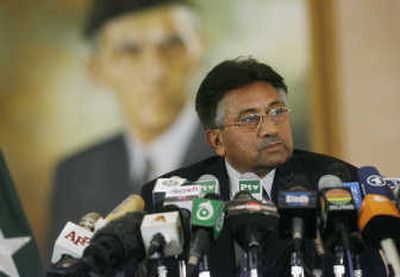
ISLAMABAD, Pakistan – Pakistan’s president, Gen. Pervez Musharraf, announced Sunday that he wanted parliamentary elections to be held by early January but did not set a date for ending emergency rule, making it likely that any elections will take place with the constitution suspended and most civil liberties banned.
Musharraf, wearing a grim expression and dark blue business suit, told foreign journalists he declared a state of emergency Nov. 3 “to save the democratic process” from a paralyzing conflict among the branches of government and to strengthen the ability of security forces to fight Islamic insurgents and terrorism.
“This was the most difficult decision I have ever taken,” Musharraf said. “I had to take a drastic measure to save the democratic process. … I stand by it because I think it was in the nation’s interest.”
With the growing terrorist threat and the country in “turmoil,” he said, emergency rule “is required to ensure peace and an atmosphere conducive to elections.”
But even as Musharraf defended the highly unpopular measure, under which thousands of civilians have been arrested and independent TV channels shut down, his government took a step closer to martial law by adding new military powers that permit the court-martialing of civilians for offenses ranging from treason to “giving statements conducive to public mischief.”
Reaction from opposition leaders, legal analysts and human rights groups to Musharraf’s latest moves was extremely critical. Many said that it would be impossible to hold credible elections under emergency rule and that the intensifying military crackdown was largely aimed at prolonging Musharraf’s grip on power.
“There is one thing very clear now, that one man is pitched up against the whole nation, just to keep himself in power at all cost,” said Ahsan Iqbal, a spokesman for an opposition group led by Nawaz Sharif, the former prime minister who was sent into exile after Musharraf took power in a 1999 coup. “To save the country from disaster, General Musharraf must resign and let democratic forces deal with the menace of terrorism and extremism.”
Benazir Bhutto, a former prime minister, was more muted in her response, reflecting her ambivalent position as both the president’s potential rival and partner in power. Bhutto called his election announcement “a first positive step” but added it would be difficult to hold elections under emergency rule.
Bhutto has been calling for public demonstrations against Musharraf since she returned from exile last month, and she plans to lead a massive protest caravan Tuesday that will travel 250 miles from the eastern city of Lahore to Islamabad, the capital. But before her return, she was negotiating a power-sharing agreement with the general, and she could still conceivably become prime minister with Musharraf as a civilian president.
Officials in Washington and London said they welcomed Musharraf’s announcement that parliamentary elections should be held by January, but they also urged him to end emergency rule. Secretary of State Condoleezza Rice, speaking on ABC’s “This Week,” praised Musharraf for seeking swift elections but expressed concern that he had not set a date for lifting the restrictions on civil rights.
“It’s not a perfect situation,” she said.
Musharraf, who was elected to a new five-year term as president by the outgoing Parliament and provincial legislatures last month, has promised to take off his military uniform and rule as a civilian once the Supreme Court upholds his right to hold office. On Sunday, he strongly reiterated that pledge, adding that he had “no personal ambitions” and that he was determined to hold free and fair elections for the new Parliament.
Musharraf said he hoped his election announcement and his explanations of the need for emergency rule would end the “aspersions, distortions, rumors and doubts about my intentions.” He said he had always followed the constitution and “put the derailed path of democracy back on the rails.”
However, human rights groups said they were especially concerned about the newly amended army law that would allow military courts to try civilians on a number of charges. Although ostensibly aimed at strengthening the state’s hand against terrorists, they said, the changes would have a chilling effect on peaceful dissent.
The changes were also made retroactive to 2003, which the groups asserted was aimed partly at legitimizing the disappearance and torture of missing prisoners, including separatist dissidents from Baluchistan province, whose cause had been taken up by civilian courts.
“Musharraf is on a collision course with Pakistani society,” the New York-based Human Rights Watch said in a statement. “There can be no transition to democracy or genuine elections when thousands of General Musharraf’s opponents are imprisoned,” the news media remain “muzzled” and the human rights situation is rapidly deteriorating.
Another aspect of the crackdown that Musharraf sought to justify Sunday was his purge of the Supreme Court and replacement of fired justices with others who were willing to sign an oath under a provisional constitution. The president said he took the step to settle a clash with the judiciary that had left the government in a “state of semi-paralysis,” confusion and turmoil.
But his comments also suggested the depth of his animus toward the deposed chief justice, Iftikhar Mohammed Chaudhry, whom he tried to remove from the bench in March on charges of misusing his office.