
Russian tanker wrecks in storm
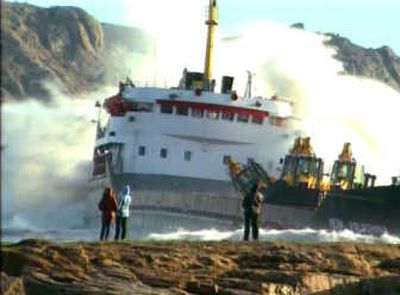
ROSTOV-ON-DON, Russia – Massive waves split a Russian oil tanker in two during a fierce storm Sunday, spilling at least 560,000 gallons of fuel into a strait leading to the Black Sea. It was the worst environmental disaster in the region in years, and one officials said could take years to clean up.
The 18-foot waves also sank two Russian freighters nearby, in the Strait of Kerch, a narrow strait linking the Black Sea and the smaller Sea of Azov to the northeast. Eight sailors from one freighter were missing.
The two ships together were carrying about 7,150 tons of sulfur, said Sergei Petrov, a spokesman for the regional branch of Russia’s Emergency Situations Ministry.
In total, as many as 10 ships sank or ran aground in the Strait of Kerch and in the nearby area of the Black Sea, and reports said three other sailors were dead or missing.
The Russian tanker’s 13 crew members were rescued, emergency authorities said.
The tanker, the Volganeft-139 – loaded with nearly 1.3 million gallons of fuel oil – was stranded several miles from shore. Stormy weather was preventing emergency workers from collecting the spilled oil, which was sinking to the sea bed, authorities said.
“There is serious concern that the spill will continue,” Oleg Mitvol, the head of the state environmental safety watchdog Rosprirodnadzor, said on Vesti 24 television. He said it would take several years to clean the spill.
Maxim Stepanenko, a regional prosecutor, told Vesti 24 that captains had been warned Saturday about the stormy conditions. He said the oil tanker – designed during Soviet times to transport oil on rivers – was not built to withstand a fierce storm.
Jim Farr, a chemist with the National Oceanic and Atmospheric Administration, said the sulfur wouldn’t create a “hazardous situation.” Farr said that while on land sulfur can be used as a fungicide, it would not act as one in a marine setting.