
Course required
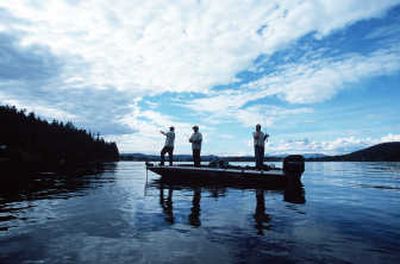
What is the most common cause of boat-related drowning among hunters and fishermen? The answer – along with the two essential pieces of boating equipment that would prevent these tragedies – is revealed later in this story.
However, boaters can learn those details plus a barge-load of other useful information in boating safety courses that will be required for some boat operators in Washington starting next year.
The grace period is ending for the 2005 law passed by the Washington Legislature that will require most powerboat operators to pass a boater safety education course and carry a Washington State Boater Education Card.
The law seeks to reduce the growing number of boating-related accidents and emphasize rules and etiquette on waterways that are becoming more crowded every year.
The law will be phased in over the next six years, starting Jan. 1, when boat operators ages 12-20 will be required to carry the official card while operating a motorboat of 15 horsepower or greater on Washington’s waterways.
Boaters can satisfy the requirements by taking a course in a classroom, online or by purchasing the state’s home-study course.
Certificates verifying completion of an approved course are required when applying to the State Parks and Recreation Department for the official boater card, which costs $10 and is valid for a lifetime.
The Washington card will be honored by other states, such as Oregon, that are phasing in boater safety requirements.
Residents from other states will be exempt from the state requirement while visiting Washington.
Classroom courses vary in length and cost, depending on the course provider.
But Jim Roeber of the Spokane Sail & Power Squadrons says the more expensive option – the squadrons classroom version of America’s Boating Course (ABC) – is a bargain. The course costs $40 or $20 for youths under 18 who take the course with their parents.
“I’ve heard over and over that people are flabbergasted at how much they learn,” said Roeber, who’s been helping teach the courses roughly every other month since long before Washington enacted a mandatory requirement.
“I normally give people a guarantee; just give me back the course materials and I’ll refund the fee if they don’t think they got their money’s worth.
“Most people tell me they got their money’s worth the first night.”
While online courses are cheaper and more convenient, classroom courses offer students the chance to interact with an instructor who is an experienced boater.
“You pick up more information, especially about this area, and you can compare notes with other boaters in the class,” he said. “And we have fun with it.”
The next of the Power Squadrons’ four-session courses will start next week, followed by courses offered in February during the National Boat Show.
“We expect the boat show courses to be packed,” Roeber said.
The ABC covers the spectrum, from boat designs to trailering and reading navigation signals.
Buoy systems and informational markers are covered, as well as the Global Positioning System.
“I’m a believer in GPS, but it has its limitations,” he said. “It might tell you how to get from A to B, but it doesn’t tell you about the rocks or shoals in between. Sometimes you have to consult a chart and punch in waypoints on your GPS to navigate around the hazards.”
The squadrons offer piloting and other courses that cover navigation in much more depth, he said.
Roeber says the classroom setting for the ABC offers elaboration on serious concerns such as carbon monoxide poisoning.
A 2005 tragedy involving a family on Dworshak Reservoir serves as one of many learning examples, he said, noting that an overloaded boat that put the transom too deep in the water led to the carbon monoxide poisoning and death of all the occupants.
“Depending on the wind, you could suffer carbon monoxide poisoning sitting in the cabin of your boat two slips away from another boat running its engine,” he said. “Boaters need to be aware of these dangers.”
Boating related drownings could almost be eliminated if boaters would simply wear lifejackets, he said.
About 700 boating-related deaths occur in the United States each year, with 450-500 of those deaths attributable to drowning, according to U.S. Coast Guard statistics. Of those drownings, 90 percent could have been prevented if the victims had been wearing life jackets, Coast Guard officials say.
Drunk driving is another major cause of accidents and injuries, statistics show.
“I wear a vest-type inflatable PFD (personal flotation device) through the entire course to demonstrate how comfortable and convenient they are,” he said. “At then end, we let somebody in the class put one on, pull the tag and inflate it to show how it should be adjusted and how it instantly becomes a life-saving device.”
The fanny-pack inflatables are discouraged in this region, he said. “When needed, you have to be able to pull it around and over our head,” he said. “That might be OK in warmer waters, but here where the waters are cold, people are likely to panic before they can get it secured.”
The course also touches specifically on boating safety for hunters and anglers.
“Overloading is a major cause of boating problems for sportsmen,” he said. “They don’t seem to appreciate the significance of freeboard when they lean over to net a fish. Once the boat starts filling with water, they’re sunk.”
Falling overboard during hunting season can be disastrous, he said. “The water is cold and hypothermia can kill you in minutes.”
Answer to the question posed at the beginning of this story: Taking a whiz off the side of a boat.
“The fly is open on more than 50 percent of the bodies recovered from hunting and fishing boating accidents,” Roeber said. “They fall in the water, usually very cold water, with all their gear on and that’s it.”
Solution: Wearing PFDs and equipping your boat with a pee bucket.