
Short wave connection
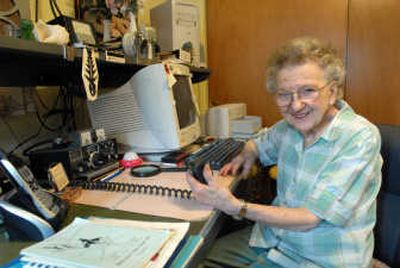
Long before e-mail and the Internet, 89-year-old Verda Siebenthaler, a licensed amateur radio operator for more than 46 years has communicated with hundreds of people all over the world – and she has the QSL cards to prove it.
A QSL card verifies that an individual has made a two-way short wave contact with another person. Siebenthaler, also known by her radio call sign K7UBC, proudly displays the cards hanging on the wall in her den, including one from Tom Christian, Pitcairn Island. Siebenthaler says that reaching Christian, a direct descendant of Fletcher Christian, took many tries before she was able to make contact with him and is happy to have his handwritten note addressed to her, saying, “Glad you finally made it, Tom.”
Another QSL card hanging on the wall is dated 1971 and has special meaning for Siebenthaler – it is from Princess Muna Hussein, the wife of Jordan’s late King Hussein. According to Siebenthaler, Princess Hussein wanted to become a member of the Young Ladies Radio League and since it was difficult at that time to send money from one country to another, Siebenthaler offered to sponsor the princess as an “adopted” member by paying her fees. She also said, “Members believed it was a good way to promote friendship with women in other countries.”
Besides her active role in YLRL, Siebenthaler is a member of MINOW, an acronym for women radio operators in Montana, Idaho, Nevada, Oregon and Washington. Siebenthaler says although the women couldn’t get together in person, they would meet for a weekly chat session every Friday over the radio. “It was really wonderful to talk with people all over the country, all over the world, and then finally get the opportunity to meet them at a convention in California or Colorado,” said Siebenthaler.
She is also a founding member of Kootenai Amateur Radio Society. KARS was organized in Coeur d’Alene in 1972.
“The purpose of the club,” Siebenthaler says, “was service to the community and training in the art of radio and to create better communications between radio operators and the people of Coeur d Alene.” According to Siebenthaler, one of the benefits of ham “was when things went kaput – no electricity or power. Amateurs were often the only ones who could get out, make contact.”
Today, 35 years later, the club remains strong and vibrant with 99 members. KARS second vice-president, Larry Telles gives much of the credit for the clubs success to Siebenthaler. He says her passion and enthusiasm for ham is contagious and she’s always willing to share her knowledge about radio with others. Talking with Siebenthaler at her home recently, she confirms Telles’ observation about her as she happily takes time to show her ATLAS 210x solid state two way radio then translates call letters – CQ, CQ is “calling anyone who is listening,” ORX means “wait a minute,” 33 is “goodbye” and 88 stands for “love and kisses.”
Siebenthaler has won many HAM awards, including Worked All States, Worked All Zones, Worked 100 Countries and worked All Continents. According to Telles “what’s so awesome about her awards is she got them years ago when there was much less high-tech equipment available.” He also points out Siebenthaler knows Morse code which was a requirement at the time she became licensed.
Among Siebenthaler’s keepsakes is a scrapbook full of cards and certificates including one from the state of Idaho, the Department of Disaster Relief and Civil Defense for “Faithfully and periodically checking into established civil defense communication net.”
Collecting dolls and playing the accordion are two other hobbies Siebenthaler has enjoyed over the years, but its clear her main interest and the one she continues to engage is ham. She said, “I’m a radio operator just because it’s fun!”