
REMEDIAL ACTION
With all the preparations and anticipation, the Apple Cup would be a disappointment if only a few Cougar and Husky players showed up for the big game.
Some wingshooting fans are suffering a similar empty feeling this season.
Spring rains did not fall favorably on upland bird hatches. Pheasant and partridge flocks are generally scarce, leaving a gap of incentive for investing time in finding a place to hunt this fall or introducing a kid to upland bird hunting.
The dearth of birds also is a setback for gun dog pups developing in their critical first season.
“There’s no substitute for getting the dogs out hunting a lot and getting them on birds,” said Dan Hoke, professional bird dog trainer from Dunfur Kennel near Cheney.
Even in a poor season for wild birds, relief for these and other bird-hunting issues is easy at more than a dozen game-bird hunting preserves scattered across Washington. Four preserves offering flight-conditioned, pen-raised pheasants and chukars are within a short drive of Spokane.
“We get a lot of parents bringing their kids, or business people bringing their employees and customers,” said Allen Widman of Squaw Canyon Shooters game preserve near Rosalia. “Sometimes its just friends getting together.
“We solve the problem of finding a place to hunt and finding birds,” he said, noting that some travelers who discover his services on the Internet would rather spend a day hunting pheasants with Widman and his German shorthaired pointer than sitting around hotels and bars in Spokane.
“I don’t have a hunting dog anymore, so I really enjoy coming down for a morning or afternoon of hunting with Allen’s dog,” said Bob Aho, a Spokane hunter and regular customer.
But the largest group of Squaw Canyon clients, Widman said, are hunters who want to get out for a productive day with their own bird dogs.
Emphasis is on the word “productive.”
In the past, I’ve enjoyed banner years for introducing hunting dogs to the sport. I’ll never forget the 1983 hunt in which my young Brittany broke through his barriers to staunchness and stature in a single day with 19 finds on pheasants holding tight in thick grass as we descended a single ridge down to the Snake River.
Two years ago, my English Setter, Dickens, made a transition from the “Terrible Twos” to seasoned gun dog in one afternoon after a covey of three dozen quail scattered onto a sagebrush flat layered with 10 inches of powder snow.
Birds in dependable supply allow a hunter to focus on the dog and pick his shots.
Shooting a bird over a young dog that has not performed perfectly only delays its maturity as a disciplined hunting partner.
That’s why I haven’t taken many birds this season over my new setter pup, Scout.
Months of summer training unraveled this fall in the first 10 seconds after Scout got a nose full of wild pheasant scent. I know from experience that patience will bring Scout back around to reach his ample potential. But it’s a slow journey when you’re walking miles to find a single bird that might flush out of range with no training opportunity.
To get control of the situation, I booked a day at Squaw Canyon and asked Hoke to come along and offer pointers that might help other hunters who are trying to advance their dogs.
Hoke mentioned two prerequisites:
“The dog must be trained and tuned in to a check cord and electronic collar before being introduced to free-flying birds.
“Bring plenty of water along on the hunt to keep the dog fresh through the entire experience.
When we arrived at Squaw Canyon last week, Widman already had scattered our requested number of birds in the natural and planted cover he’s groomed on the 480-acre preserve.
He can put them all in the flats for people who want a more leisurely hunt, but we preferred to have a mixture of chukars and pheasants scattered in terrain ranging from a corn field to basalt cliffs. He’ll let you know where the birds were planted, if you wish, but the birds are free to move about in the natural cover.
Widman’s wife, Emmy, often greets visitors with fresh cookies before they’re led over to shoot a few clay targets to warm up for the hunt.
“Now it’s time to focus on what you’re doing,” Hoke said as we walked to the rangeland above the farm.
Indeed, I had a mission. Many hunters enjoy the game preserve experience as they would a round of golf, with plenty of banter and camaraderie. But all attention must be on the dog if training is the goal.
I recruited Aho and Hoke to wield the shotguns while I released Scout and studied his nose and tail the way a poker player searches for clues in an opponent’s face.
Timing is the key, Hoke said, advising me to keep my finger on the transmitter button for the electronic collar. When the dog begins making game, I give it a signal — vibration or tone, depending on the type of electronic collar — to let it know I’m watching and I’m in control.
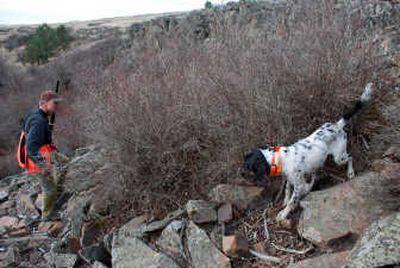
Despite a warning buzz, Scout failed to point and flushed the first bird. The correction had to be instantaneous, alerting Scout to his mistake. He stopped. I put him on leash, made him heel a ways and released him again.
The dog was weak on the next few birds. In his insecurity, he even flopped on his belly during a couple of close encounters with birds.
I picked him up, set him on his feet in pointing position, gave him praise and a few comforting strokes on the head and neck and released him to hunt some more.
On the fifth bird, Scout locked up in a picture-perfect point.
The bird was flushed and shot. (Like wild birds, these pheasants and chukars are delicious table fare.)
Since Scout is being trained steady to wing and shot, Hoke offered another tidbit of advice specifically for pointing dog owners.
“Everybody is eager for their pointers to go out for the retrieve,” he said as he walked out to pick up the pheasant. “But that just makes it harder to keep the dog from breaking.”
For this first season, I’ll let Scout go for the retrieve only in selected cases of perfection.
This time, Hoke rewarded his good work by bringing the bird back and tossing it to the still-steady dog at my side.
Scout picked it up immediately and we let him pack it around until he let it drop. I picked up the bird, and we continued with a hunting lesson that continued to build the dog’s confidence.
It was the most satisfying and productive dog session of the season, with the promise of many wild times to come.