
China showcases foreign exporters

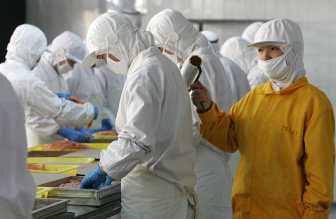
QINGDAO, China – First comes the “wind shower.” Wearing overalls and rubber boots, employees at Fusheng Food Co. stand in a narrow room as air jets in the walls blow away any dust on them. They wade through ankle-deep disinfectant and don caps, gloves and surgical masks.
Only then can they enter the chilly, white-tiled room where they pack Alaska salmon for American dinner tables and Russian cod for McDonald’s fish sandwiches in Japan. The Japanese-owned company says the fish already has been tested for more than 100 banned chemicals.
“I am very confident in saying our food is excellent and the safest in the world,” Zhong Yuhua, the general manager, told reporters invited on a government-organized tour of three food exporters in Shandong province, southeast of Beijing.
Fusheng is part of a Chinese food industry elite of export-oriented companies that, often with foreign help, have improved quality to meet standards in Japan, the United States and elsewhere.
As the government tries to repair the battered “Made in China” brand, it is holding them up as models to reassure foreign consumers and improve the rest of the industry.
“Foreign companies have done a good job. They can play a leading role. Other companies can learn their advanced management model to promote quality control,” said Huang Kunlun, executive deputy director of the Agriculture Ministry’s product testing center.
The reputation of China’s $31 billion-a-year food export industry has taken a beating after incidents over toxic chemicals in pet food and toothpaste, and banned drugs in seafood. Other exporters have been hammered by recalls or warnings about Chinese goods ranging from faulty tires and baby cribs to toys with lead paint.
U.S. authorities restricted imports of Chinese shrimp, eel and three types of fish in July after tests found unapproved drugs in some shipments. Chinese officials criticized the move as excessive. Last month, one Chinese supplier was cleared to resume shipments.
At Fusheng, visitors saw masked and gloved employees cut and pack salmon in a tidy workshop. Public areas were scrubbed clean. In bathrooms, signs over the sink reminded employees to soak their hands in disinfectant after washing.
Conditions in the rest of the industry vary widely. Chinese authorities argue that product liability cases have involved only a small fraction of China’s food processors.
Even before the recent safety cases, regulators were using leading exporters as industry role models, organizing delegations of managers to study their plants.
“A lot of visitors from companies across the country come to see how we ensure food safety,” said a spokesman for the Longda Food Group Inc., who would give only his surname, Jiang. “Last year we had 200 groups of visitors.”
Longda, which has joint ventures with Japanese partners, says 90 percent of its $203 million in exports last year went to Japan. That included vegetable snacks sold by Itochu Corp. and 5,000 tons of Vienna sausages.
Shandong province is the heart of China’s food export industry and has close ties with Japan and South Korea.
Its 2,600 food exporters sell frozen chicken patties, vegetables, fish and dumplings. One-third of their $3.5 billion in exports in the first five months of this year went to Japan, according to the government. Other markets include the United States and Britain.
People in the industry say Japan’s standards are the world’s most stringent, forcing Chinese companies to improve if they want to sell into its huge market.
Once a state-owned company, Fusheng was bought in 1994 by Japan’s Rinken Vitamin Co., which brought in consultants from the U.S. Department of Agriculture and food testing companies to meet Japanese import standards, Zhong said. Last year, the company reported $63 million in exports to the United States, Japan and Europe.
Today, Zhong said, enforcement measures include docking employees’ paychecks by up to 40 percent if inspectors find bones left in fish or other errors.
The third company, Kaijia Food Co., a Chinese-Japanese joint venture, exported $50 million worth of goods, including Japanese-style pickles to the United States and chicken patties to Britain.
After foreign reports of tainted products, all of Shandong’s food plants are being inspected to see that none use chemicals cited by the United States and other countries, according to Jiang Zongliang, deputy director general of the province’s export safety bureau.