
Unhealthy side effects
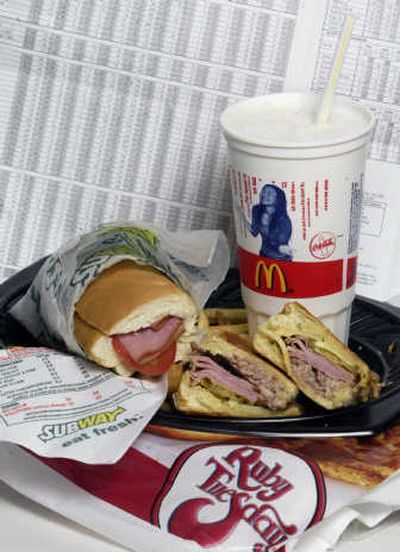
If you’re feeling virtuous about the sandwich you’ve ordered at a fast-food restaurant, you’ll probably grab some chips, cookies and a soda, too.
“There’s a health halo that surrounds a lot of the foods at restaurants like Subway that leads people to overeat on side dishes and grossly underestimate the number of calories they consume,” says Brian Wansink, director of Cornell University’s Food and Brand Lab in Ithaca, N.Y.
He created the “McSubway Project,” a series of studies that examine the habits of fast-food customers. Much of the research compares foods at McDonald’s and Subway, which advertises that it has more healthful options.
Wansink and his colleagues have reported some of their findings and are releasing more information in October’s “Journal of Consumer Research.”
“In one study, the researchers gave 46 graduate students a coupon for a McDonald’s Big Mac, which at the time had about 600 calories, or a Subway 12-inch Italian sub with meat, cheese and mayonnaise, which had about 900, he says. The students weren’t told the number of calories in their sandwiches. Participants also were given a menu and asked to indicate what extras they would like to order, if anything.
Those given the Subway coupon were more likely to order a large drink and less likely to order a diet soda. They also were more likely to eat chocolate-chip cookies.
Those with the Subway coupon ended up ordering a meal with an average 1,011 calories. Those with the McDonald’s coupon got meals with an average of 648 calories.
In another test, people ate more snacks later in the day if they had eaten a Subway sandwich than a Big Mac, even though both had been made to equal about 600 calories.
Though Subway has a health halo, “there’s also a health shadow that’s cast on McDonald’s. People know what they are eating may be indulgent, so they come much closer to estimating the right number of calories,” says Wansink, the author of “Mindless Eating: Why We Eat More Than We Think.”
Wansink further explored that halo effect in other research. He and colleagues interviewed more than 500 people after they had eaten lunches at either Subway or McDonald’s. The scientists also analyzed the calories in 320 meals that included a main dish, side order and beverage.
Those meals ranged from turkey sandwiches and Italian subs with chips and soda to cheeseburgers or Big Macs with fries and beverages.
People who consumed about 1,327 calories at a meal underestimated the calories by an average of 484 at McDonald’s and 681 at Subway.
“There’s a double curse to the health halo because you grossly underestimate the calories, and you overeat afterward because you think you deserve it,” Wansink says.
“Sometimes when you are guestimating the calories in what you think is a healthy dish, you’ll be more accurate if you double your best estimate.”