
Preserving the past

In the fall of 1934, 115 young men of Company 1965 arrived at the Plummer Point Civilian Conservation Corps Camp on Lake Coeur d’Alene to begin construction of park roads and the unique, rustic structures that have served Heyburn State Park for more than half a century.
Established in 1908, thanks to the foresight of Idaho Sen. Weldon B. Heyburn, the 800-acre park is Idaho’s oldest and was conceived before Idaho had a Department of Parks and Recreation. Next year will mark Heyburn’s 100th anniversary. Late in the summer this year, new workers, this time graduate students enrolled in the University of Oregon-sponsored 2007 Pacific Northwest Field School, came to replace logs, bricks and shingles worn by weather and use.
While the CCCs of 1934 were building for the future, 2007’s college contingent was working to preserve the past. The student workers have focused their efforts toward the restoration of the large picnic shelter in the Chatcolet picnic area.
The picnic shelter began its life as a rustic, roofless bathhouse that was walled off into two sections to provide privacy, according a nomination to the National Register of Historic Places. Later, in converting the building to a picnic shelter, a shingled roof was added along with a fireplace and enclosed, brick cooking stoves. For a picnic shelter, the fireplace is of exceptional quality and design. Vertical boards were removed to provide the window openings one sees today.
On the morning we arrived, the crew, consisting of the graduate students, instructors and several employees of Washington and Idaho parks, had finished removing the old shingles and several rotting roof-support logs, along with a gritty layer of history – imbedded ash from the 1980 eruption of Mount St. Helens. Heyburn Park Director Ron Hise said that the new roof logs had been cut from park property.
The director of the program, University of Oregon architecture professor Don Peting, said the purpose of the field school was to give students entering the university’s graduate program in historic preservation an opportunity for hands-on, practical experience in what is involved in preservation – experience that went beyond the theory of the classroom.
Stephanie Cremino of Hailey, Idaho, said she chose to enter the preservation program because of what she described as a “rare, hands-on experience.” She had spent the morning stripping old shingles, covered with volcanic ash, from the roof.
“While I was working in archeology I spent my time documenting buildings and places that would be torn down rather than in saving them,” she said.
Experts in the areas of stone-cutting, wood-working and masonry demonstrated their skills to the students and then turned the work over to them.
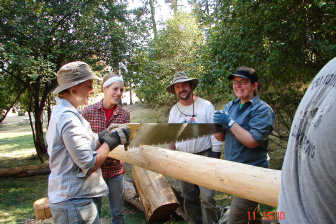
John Platz, of Boring, Ore., brought traditional tools to the project, stripping bark from the newly cut larch logs with a drawknife before letting a student take over. When the log was ready, the crew manually lifted it into place, just as had been done originally. Hand tools like those used by the original builders were used as much as possible, including a two-person crosscut saw to trim logs.
Peting said only the weakened parts of the building would be replaced to keep as much of the original as possible. New, hand-split cedar shakes will replace old shingles. In keeping with this plan, only the cracked and crumbling firebricks that line the fireplace and the three stoves would be replaced. Each of the original firebricks is stamped in large, molded letters, “MOSCOW”.
Dave West, of Washington Parks and Recreation, used a power saw to cut the new firebricks down to conform with the smaller size of the original “Moscow” bricks.
While West cut new bricks, students removed damaged, soot-covered bricks from the fireplace, cleaning off contact points where the new bricks would fit in and soaking the new bricks in water. Student workers explain that the new bricks must be wet so they dry along with the mortar in which they will be set. Students work under the direction of professional architect and master mason, Mike Hayden of Pocatello.
After removing the cast-iron stove tops, it is apparent that extensive work is in order to repair the brick and stone that make up the three stoves. Hayden said that the innards of the stoves may collapse, but they will go ahead and rebuild if that happens.
While participants work on the roof project, the fireplace and stoves, Fred Walters, from Cambridge, Idaho, cuts new stones that will replace weathered and damaged stones in the shelter’s lower, exterior walls. This is another “hands-on” project because Hayden cuts his stones as stone masons have done for centuries, using chisels and the stone mason’s mallet, a round, wooden hammer about the size of a salad plate with a handle in the center. He demonstrates while explaining.
First he places the point of the chisel at the spot to be cut; then he strikes the blunt end with his round mallet. “This way, when you hit the chisel, any part of the hammer, because it is round delivers a direct strike. You aren’t likely to miss,” he says.
The rock he is cutting for the shelter is like the original, a layered, ribbon-candy appearing sedimentary rock, found locally. Hayden, who uses antique tools, says that he cuts stone, “for fun.”
According to the register nomination, the use of logs, stone and rustic shingles in state parks is unusual and construction is reflective of influence from the National Park Service.
The nomination divides the CCC-built areas of the park into three sections: Chatcolet, Rocky Point and the lodge area.
Field school participants live in the lodge, the last structure to be built. It was completed in 1942. The lodge, like all other park buildings is rustic, built of logs, hand-split shingles and stone.
The field school which opened on Aug. 5, consisted of six separate five-day sessions that, along with the hands-on experience, included lectures, day trips to historic sites in Spokane, and visits to Cataldo, Idaho, and Hells Canyon, where the group evaluated a historic farm.
This is the 13th in a series of summer sessions, sponsored by the university in conjunction with the parks departments of Oregon, Washington and Idaho. One-third of the funding comes from tuition, one-third from the three participating states and the remainder, this year, came from a special appropriation for Heyburn park. Past summer schools have been set at the historic Peter French round barn in Harney County, Eastern Oregon, at Port Townsend, Wash., and the Railroad Ranch in Harriman State Park, Idaho.
By 4 o’clock on the last afternoon, a quiet had returned to the shelter at Chatcolet, but patches of new wood, rock and brick speak of the hard work that should carry the historic structure, built by men of the CCC, well into the park’s new century.