
U.S. envoys labor to calm Turks
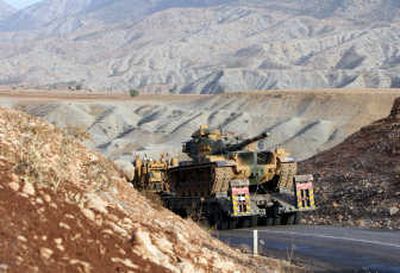
ISTANBUL, Turkey – U.S. officials began an intense lobbying effort Saturday to defuse Turkish threats to launch a cross-border military attack on Kurdish rebels in northern Iraq and to limit access to critical air and land routes that have become a lifeline for U.S. troops in Iraq.
“The Turkish government and public are seriously weighing all of their options,” Assistant Secretary of State Daniel Fried said after meetings with Turkish officials in Ankara, the capital. “We need to focus with Turkey on our long-term mutual interests.”
But even as the U.S. official appealed for restraint, Turkish Prime Minister Recep Tayyip Erdogan, speaking at a political rally in Istanbul on Saturday, urged the parliament to vote unanimously next week to “declare a mobilization” against Kurdish rebels and their “terrorist organization,” the Kurdistan Workers’ Party, known as the PKK.
Fears of a new frontier of instability in the troubled Middle East sent oil prices soaring Friday to a record high of $84 a barrel. U.S. military officials predicted disastrous consequences if Turkey carries out a threat to strike northern Iraq and warned of serious repercussions for the safety of American troops if Turkey reduces the supply lines it now permits.
The confluence of two seemingly unrelated events could not have come at a worse time. The bodies of 13 Turkish soldiers killed last weekend in the most deadly attack by Kurdish separatists in more than a decade were buried in towns across Turkey amid a flurry of emotional media coverage when the House Foreign Affairs Committee in Washington approved a resolution labeling as genocide the mass killings of Armenians during the final decades of the Ottoman Empire. Turkey does not deny the deaths but argues that they occurred as part of a war in which Turks were also killed.
“This is not only about a resolution,” said Egemen Bagis, a member of the Turkish parliament and a foreign policy adviser to Erdogan. “We’re fed up with the PKK – it is a clear and present danger for us. This insult over the genocide claims is the last straw.”
Domestic politics in both countries – the Armenian lobby that pushed for the genocide resolution in the U.S. Congress and growing pressure on the Turkish president to stop Kurdish rebel attacks – collided to create an international crisis.
“It’s a difficult time for the relationship,” U.S. Secretary of State Condoleezza Rice told reporters Saturday during her trip to Russia, noting that Fried and another senior State Department official had traveled to Turkey to reassure the Turks “that we really value this relationship.”
A recent poll conducted by the German Marshall Fund of the United States, a transatlantic public policy organization, found that Turkish attitudes toward the United States were becoming increasingly hostile. Using its 100-degree thermometer scale, the fund found that Turkish “warmth” toward the United States had plunged from 28 degrees in 2004 to 11 degrees in 2007.
“Each time we have a soldier killed, many people look at Washington and they believe that Americans are responsible for this because they prevent us from stopping the infiltration into Turkey,” said Onur Oymen, deputy chairman of the opposition Republican People’s Party.
Erdogan is feeling increased heat from his military, which is suspicious of his Islamic roots and acquiescence to Washington in taking no action against Kurdish rebels in Iraq. His public is angry over the genocide vote, frustrated with a European Union that is unwilling to admit Turkey to its club, and outraged that the United States has turned its back on what Turks consider their own fight against terrorism, a 23-year-long war with the Kurdish separatists.
“The Turkish newspapers are printing full front-page pictures of dead soldiers with Turkish flags,” said Bulent Aliriza, director of the Turkey project at the Center for Strategic and International Studies. “The accusation is that this guy is soft on the Kurdish issue and does only what the U.S. wants him to do.”
That perception prompted Erdogan to issue a warning to Washington last week: “If you’re against (the rebels), make your attitude clear and do whatever is necessary. If you cannot do it, then let us do it.”
A major operation by Turkey “would start a war with the Iraqi Kurds,” said Henri Barkey, a former State Department official who now heads the International Relations Department at Lehigh University. “Northern Iraq is the only place that the U.S. has managed to achieve a modicum of stability … .
“I’m sure the U.S. would say okay to a limited, one-time operation,” Barkey said. “But everyone knows a one-time operation is not going to solve the problem. The Turks want a carte blanche to do whatever they want to do. That’s the problem.”
Marc Grossman, a former U.S. ambassador to Turkey and undersecretary of state for political affairs during President Bush’s first term, said there were three reasons the United States has been reluctant to take action in northern Iraq against the PKK: U.S. troops are already fully engaged, and the north is generally stable. Plus, he said, “there’s a lot of sympathy in some parts of our government for the Kurds and some residual disappointment for the Turkish government decision on March 1, 2003,” to forbid the United States to launch an assault in Iraq through Turkey.
Human rights groups have long criticized Turkey for the brutal treatment of its Kurdish minority and its efforts to suppress the Kurdish culture and language within Turkish borders.
The PKK problem had become so frustrating to both Turkey and the United States that the retired U.S. and Turkish generals appointed in 2006 to help resolve some of the tensions have left their jobs: The Turk was relieved of his position just before he planned to resign, and the American offered his resignation letter weeks ago, though it was accepted by the Bush administration only this week, according to U.S. and Turkish officials.