
Man masks statues to protest China
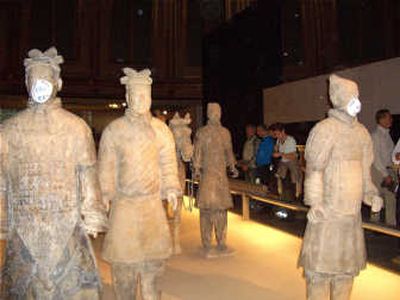
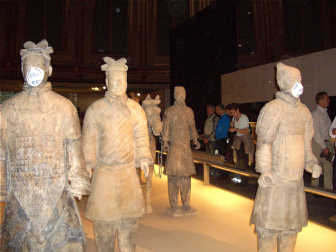
A man hopped over a security barrier in the British Museum on Monday and tied surgical masks to the faces of two Chinese terra cotta warriors in a protest of China’s pollution problems.
Security guards stopped the man and escorted him away after alarms sounded. The man was not arrested, and the statues were not damaged.
The exhibition includes 19 human figures selected from the more than 7,000 statues discovered in 1974 near the tomb of the ancient Chinese emperor Qin Shihuangdi.
The environmental protester stepped over a knee-high barrier to attach masks emblazoned with “CO2,” the chemical notation for carbon dioxide.
Greenpeace and other environmental activists have criticized China for its environmental policies. China recently surpassed the United States as the world’s largest greenhouse gas emitter, according to a June report by the Netherlands Environmental Assessment Agency.
Naqoura, Lebanon
Israel, Hezbollah exchange bodies
Israel returned the bodies of Hezbollah guerrillas on Monday in exchange for the body of an Israeli, the international Red Cross said. Israel’s government said the exchange was linked to efforts to win freedom of two soldiers captured by Hezbollah a year ago.
An Israeli military vehicle carrying the bodies of the dead Lebanese crossed into the no man’s zone along the border at sundown and returning shortly afterward, crossing paths with Lebanese ambulances headed the other way.
Although the exchange Monday was limited in scope, it could improve the chances of further exchanges involving the two Israeli soldiers whose capture triggered the conflict last year in which up to 1,200 people were killed in Lebanon, most of them civilians.
London
Witness testifies in Diana inquest
A man who claimed he saw a blinding flash of light in a Paris road tunnel just before the car crash that killed Princess Diana spent hours Monday answering questions about inconsistencies in statements he has made.
The inquest is investigating the deaths of the princess and her boyfriend, Dodi Fayed, on Aug. 31, 1997. Henri Paul, who was driving their Mercedes, also died in the crash.
Francois Levistre, whose testimony to the British inquest differed at key points from four other witnesses, testified that he saw two men on a motorcycle ahead of the princess’ car, a “major flash of light,” and then a crash.
Afterward, he said, the passenger on the motorcycle looked into the crumpled Mercedes and gave a gesture to indicate “job done.”
Fayed’s father, Mohamed al Fayed, has claimed that a blinding flash of light may have been used by British agents to cause the accident in a plot orchestrated by Prince Philip, the husband of Queen Elizabeth II.
Levistre said he was driving through the tunnel as the incident unfolded, and then stopped at the end and watched through his rearview mirror.
Questioned repeatedly about why he had told different stories to French police and an examining magistrate, Levistre said he hadn’t read the statements that he later signed.
“You know, people ask questions and you just answer,” said Levistre, who testified from Paris via videolink.