
‘Same time’ this year
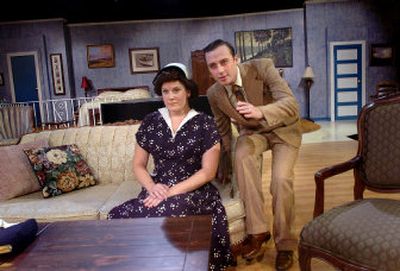

“Same Time, Next Year,” which opens this weekend at Interplayers, has long been considered the theatrical equivalent of a sure thing: a simple, one-set, two-actor romantic comedy guaranteed to make audiences laugh (and cry).
This is Bernard Slade’s heartwarming comedy about Doris and George, who have a rendezvous the same day every year at a country inn. We watch their relationship (and their lives) change with the times, from 1951 to 1975. The play’s spice, humor and air of ironic longing stems from the fact that Doris and George are married, but not to each other.
Since it premiered on Broadway in 1975 with Ellen Burstyn and Charles Grodin, this comedy has been a staple of regional theaters, community theaters and colleges. In the Inland Northwest alone, it has been staged three times in the last three years – and it would have been four, if Interplayers hadn’t replaced it at the last minute on its 2004-2005 season.
Now it’s back on the schedule, directed by Esta Rosevear, and featuring two accomplished actors as Doris and George.
Doris will be played by Beth Hallaren, an Actor’s Equity member and veteran of regional stages ranging from the Guthrie Theater in Minneapolis to the Berkshire Theater Festival in Massachusetts. She recently appeared as Launce in “Two Gentlemen of Verona” at the Fiasco Theater in New York.
George will be played by Cameron Lewis, a familiar name from Spokane stages. He played Cosmo Brown in the Spokane Civic Theatre’s “Singin’ in the Rain” a year ago and this summer was a member of the acting troupe at the Big Fork Summer Playhouse in Montana. He has some New York credentials as well: He worked two seasons with Hanging Cow Productions, which does musical parodies, interactive comedies and off-off-Broadway shows.
“Same Time, Next Year” has long been considered one of the theater’s best acting vehicles; Burstyn won a Tony for it in 1975. The show gained even greater name recognition with the 1978 film version starring Burstyn and Alan Alda. It was a box office hit, nominated for four Oscars.
Slade’s story hasn’t been universally beloved. New York Times movie critic Janet Maslin once excoriated the movie’s “patently phony pretext,” which she said avoids the obvious questions: If these two love each other so much, how do they live peacefully with their spouses? And how do they forget each other those other 364 days of the year?
Yet audiences rarely bother themselves with these questions when the laughs are rolling. That’s why audiences have been known to make a date with this show, year after year.