
South Florida basks in view
Yeah, the legend is true. South Florida’s football offices used to be in trailers.
But defensive coordinator Wally Burnham will tell you it wasn’t all that bad. After all, the trailer was a double-wide, and his office in Tampa even got some sunlight.
“There was a palm tree right in front of my window,” he recalled.
Not bad, but the view is better now.
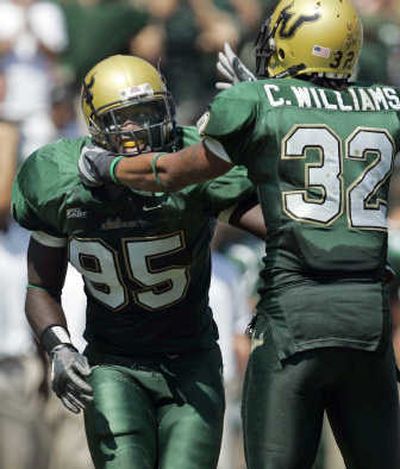
South Florida’s football program didn’t exist until 1997, and the school didn’t make the AP’s 2007 preseason Top 25. Look where the Bulls – not da Bulls – are now: ranked second in the nation and a solid No. 2 in the BCS standings.
“Honest to God, we do not talk about being ranked over here,” Burnham said. “I haven’t heard it mentioned this week by a coach or a player. We realize the situation we’re in. I know the players read the papers and see ESPN, but we don’t talk about it. We just say: We have to play the next game, wherever it is, whenever it is.”
The time is tonight, and the place is Piscataway, N.J. Big East foe Rutgers is the opponent for the game, and if South Florida prevails, its trophy should be a glass slipper.
The Scarlet Knights were last year’s Cinderella, gradually rising up the rankings to No. 8, as if not to offend the sport’s upper crust.
South Florida’s surge has been so sudden, so quick, it has led to public skepticism.
Alabama coach Nick Saban told the Birmingham News: “I think there are six guys starting on the South Florida defense who probably would have gone to Florida or Florida State, but Florida and FSU couldn’t take them.”
This from a guy who makes former Illinois Gov. George Ryan look ethically pure.
South Florida coach Jim Leavitt responded by saying that his 110-man roster has just two players who were non-academic qualifiers coming out of high school, and both are on track to graduate.
“A little of it’s jealousy, to be very honest with you,” Burnham said. “We tell our kids: Don’t listen to those people being critical or skeptical or whatever. You know what you are inside that dressing room.”
The room is filled with unconventional stories.
Receiver Amarri Jackson didn’t qualify out of high school and chose to attend Hillsborough Community College on a basketball scholarship. But football remained his first love, and on Saturdays he would watch USF play at Raymond James Stadium in his basketball warm-ups.
“We had games on Saturdays too,” Jackson said. “And we were right across the street from the stadium. I’d go back, shoot a couple of jumpers, take the opening tip and be ready to go.”
Linebacker Tyrone McKenzie began his college football career at Michigan State, where he played 11 games as a true freshman in 2004. But he said he left East Lansing after “a situation with my family” compelled him to return to his home near Tampa.
McKenzie then enrolled at Iowa State, sat out one season, and finished eighth in the nation last season with nearly 11 tackles per game.
But he decided to make his return to Tampa a permanent one for family reasons, and the NCAA granted him a hardship waiver so he didn’t have to sit out a year before joining USF.
“It’s been a trip and a blessing,” he said.
South Florida is mainly a commuter school, with most of its 45,000 students living off campus. But McKenzie said the excitement picked up after USF stunned Auburn 26-23 on Sept. 8. It didn’t hurt beating then-No. 5 West Virginia 21-13 on Sept. 28.
“Now it seems like the whole campus and the whole city of Tampa is going crazy,” he said. “You see people wearing football shirts. At the games there are lines around the stadium for people to get tickets. It’s awesome.”
South Florida football debuted in 1997 as a Division I-AA independent. After graduating to I-A status in 2001, USF joined Conference USA in 2003 and then the Big East in 2005.
Head coach Jim Leavitt has led the program from the first day. A Tampa-area native, Leavitt has guided USF to eight winning seasons out of 10. With his team 6-0 this year, he’s about to make it nine of 11.
“He’s the quintessential fit,” said USF athletic director Doug Wollard, a Southern Illinois alum who was born in Chicago and raised in Carbondale. “He knows the area, has lots of relationships and assembled one of the best staffs in the country. They’ve done a great job identifying talent.”
Burnham coached under Bobby Bowden at Florida State from 1985-93. After a stop at South Carolina, he joined Leavitt in 2000.
“Everything was in place (at Florida State), so all you had to do was go recruit,” he said. “Here you had to sell your program, sell the dream, so to speak.”
Burnham couldn’t find many buyers in those first few years. USF lost good local players to schools such as Southern Miss and Louisville. Florida, Florida State and Miami still dominate the area, but the state produces enough talent to go around.