
Forever Young
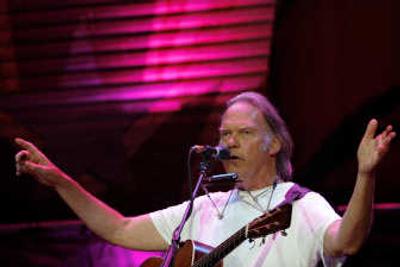
The centerpiece of Neil Young’s new album is a song titled “Ordinary People.” But there’s nothing routine about the tour that brings him to Spokane on Saturday.
Debate has raged online about the big ticket prices for the small-venue shows, Young’s choice of his wife – an inexperienced solo performer – as an opening act, and the quality of his new work.
Supporters say it’s worth top dollar to see a rock legend in such an intimate setting – particularly one who’s still cranking out a steady stream of material in his 60s, and who survived a brain aneurysm two years ago.
For his part, Young tells the British newspaper The Guardian: “It’s a long battle. I’m 61 years old and there are a lot of things that are starting to crop up. Different parts of my body don’t work the way they used to. And there’s pain and stuff.
“The older you get, the closer to the end of your life you get. It seems like there are a lot of things to do now.”
Spokane is the second stop on Young’s ambitious “Chrome Dreams Continental Tour,” which began Thursday in Boise. It’s the first tour under his own name (not counting last year’s outing with Crosby, Stills and Nash) since 2004.
Tickets topped out at $132 each for most of the INB Performing Arts Center floor – the highest price ever for a rock show in the building (formerly the Opera House), and, as Web wags like to point out, well out of the price range of “ordinary people.”
Still, the show sold out the 2,700-seat hall well in advance, as it has in similar venues across the country.
“It’s a tour that Neil wanted to do in 1980,” Young’s manager, Elliott Roberts, says in Rolling Stone magazine. “He always wanted to do a small-theater tour where he gets a chance to play acoustic and electric.”
Plans call for an opening set by Pegi Young, followed by acoustic and electric sets from her husband.
Pegi, a longtime amateur musician who started singing backup for Neil in the 1990s, released her self-titled debut in June to mixed reviews.
Opinions also have been split over Neil Young’s new CD, “Chrome Dreams II,” which officially arrives in stores Tuesday.
The title refers to a record called “Chrome Dreams” that Young had prepared in the mid-1970s, but decided not to release (though most of the material ended up on later albums).
The similarity, he says, is that “Chrome Dreams II” is a hodgepodge of diverse styles, like his classic 1970s work, compared to his more thematic releases of recent years (from the story-song cycle “Greendale” to the ardently anti-Bush “Living With War”).
Reviews in the music press have been generally favorable, with Britain’s Mojo magazine giving “Chrome Dreams II” a perfect five stars and declaring it “an album of great emotional depth and uninhibited artistry.”
Said Entertainment Weekly: “No one’s likely to place this among the top tier of Young’s 40-some solo albums. But it is his most enjoyable and well-rounded one in, like, an eternity.”
Fans who have heard advance airings are more divided. Even the president of the Scottish-based Neil Young Appreciation Society initially gave it only six stars out of 10 – with the notation, “Can do better” – though he’s since said the album has grown on him.
“Ordinary People,” a paean to the common man recorded in 1988 with a full horn section during Young’s blues period, was the first single released to radio – although, at 18 minutes, it’s received precious little airplay.
Two other tunes – the country-tinged “Beautiful Bluebird,” and “Boxcar” (performed a handful of times live, including at Young’s first Spokane concert in 1989) – are reworkings of numbers from his notoriously inconsistent 1980s output.
The seven new songs on “Chrome Dreams II” are spiritually tinged, with such titles as “Shining Light,” “Spirit Road” and “Ever After” (“Dirty Old Man” being the exception).
An early fan favorite is “No Hidden Path,” an extended electric guitar workout in the vein of such Young mainstays as “Down By the River” and “Cowgirl in the Sand.”
Perhaps the most distinctive is the closing track, “The Way,” a lilting melody with backing from a children’s chorus that has drawn comparisons with everyone from Brian Wilson to Sufjan Stevens.
But as always, with Neil Young, the unusual and unexpected are the norm.