
She’s on a mission of compassion
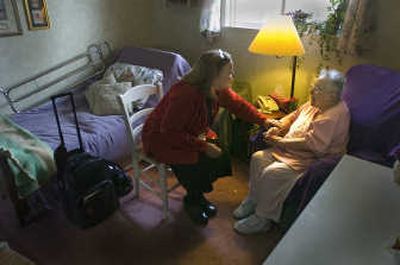
By caring for the dying, Ruth Palnick has learned how to live.
So as she sits with people who are close to death, she helps them celebrate life. She laughs and sings and prays, often with so much bliss that those around her can’t help but mirror her laughter, song and prayer.
“Day by day, and with each passing moment,” she sings in a rich soprano, her fingers trembling slightly as she plays music on a small, electronic keyboard. “Strength I find to meet my trials here. Trusting in my Father’s wise bestowment, I’ve no cause for worry or for fear …”
Vivien Attrill, 85, and dying of a pulmonary disease, closes her eyes and smiles.
For the last six months, she has looked forward to Palnick’s visits to her Spokane Valley home. Together, they read the poetry Attrill has written in the past week and sing melodies from an old hymnal. They talk about the years she spent living on an Iowa farm, about her children, grandchildren and great-grandchildren, about her health, and of course, about death. Then they pray, thanking God for the time they’ve shared.
“This is a joy to me,” Attrill says with tears in her eyes.
Through her experiences with Attrill and others, Palnick has allowed death to shape her life.
As a former nurse in Seattle, she worked with people who lost their battles to cancer. In Central America, where she lived for nearly a decade, she treated and comforted prostitutes and others dying of AIDS. Since she moved to Spokane three years ago, Palnick has devoted time to people facing the end of life, as well as to their grieving families. This month, she will be honored with Hospice of Spokane’s Volunteer Chaplain of the Year Award.
“My biggest calling is to listen to people’s stories and to connect with them,” she says. “They allow us into their lives during these vulnerable moments and share with us such incredible grace.”
Palnick, 54, describes herself as an “urban missionary.” In addition to working with the dying through Hospice of Spokane, the Oregon native also spends her time serving the poor, sick and disenfranchised in Spokane by praying and leading a knitting circle at the Women’s Hearth, a drop-in center for women; directing a 15-member choir made up of people with Parkinson’s; leading workshops and helping out at her church, Hillyard Baptist.
A full-time volunteer, Palnick’s work is funded by donations to Missions Door, a Christian organization that has sponsored missionaries worldwide since 1948. Committed to church-planting and evangelism, Missions Door has supported Palnick’s work for almost two decades.
“My work isn’t a sacrifice, it’s a gift,” she says, describing her life as a missionary. “I have a blessed existence – I’m doing what God has called me to do.”
Raised by a father who was a Baptist pastor and a mother who still travels to Ukraine to work with orphans, Palnick knew early on that she would follow her parents’ example. She wanted to be a missionary from the time she was 8 years old, after meeting a doctor who worked with lepers in India. The medical missionary not only inspired her to become a nurse someday, he also emphasized one of the lessons that she would eventually learn through her work with those who are suffering: Pain, he told her, is a gift.
After working as a nurse in Seattle and Olympia for 11 years, Palnick eventually earned a master’s degree in intercultural ministry from Western Baptist Seminary in Portland. She ended up working and studying Spanish in the Dominican Republic and Costa Rica before Missions Door sent her to Honduras for eight years.
There, she lived and worked in the capital’s red light district, in an AIDS clinic surrounded by about 60 brothels.
“I learned a lot about caring because we were caring for people whom nobody wanted,” she says, recalling her experience with prostitutes, the poor, and people who lived and worked on the streets. “The folks that we label as ‘the dregs of society’ are the ones who can actually teach us the most.”
One of the people whom she learned from was a man named Javier, a taxi driver in Tegucigalpa who also made extra money by having sex with the people who rode in his cab. While she taught him about Jesus and spirituality, Javier gave her practical “street Spanish” lessons so she could better understand the people she wanted to serve. They became good friends. She was at his bedside when he died of complications related to AIDS.
In 1998, Palnick was forced to return to the United States in a wheelchair – her own health debilitated by arthritis and diabetes. Four years later, she was diagnosed with Parkinson’s. She worked in Phoenix for several years before moving to Spokane.
When she arrived in 2004, Palnick had no idea what she was supposed to do here, but within three weeks, she quickly found her place at Women’s Hearth and also at Hospice of Spokane.
Now, Palnick is one of about 10 volunteer chaplains at Hospice of Spokane, a community-based, not-for-profit organization established in 1977. Every week, she visits about eight clients at their homes.
“My work is about helping people live well until they die,” she says. “It’s about listening, hearing their life stories, their disappointments, their pain and joys. … We want to walk with them through this journey.”
Reach reporter Virginia de Leon at (509) 459-5312 or virginiad@spokesman.com.