
Businesses cut waste by stressing lean
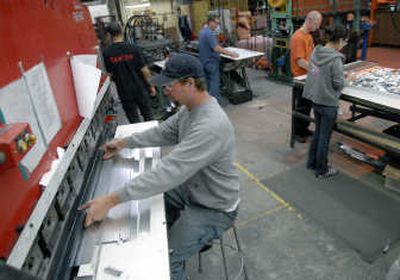
Workers at lighting-component maker Ecolite Manufacturing Co. recently moved a roughly 8-ton machine just because employees thought product flow would improve if it sat elsewhere.
“We reserve the right to cut a machine loose from the floor and move it tomorrow,” said CEO Ed Caferro. “Our people have gotten really good at moving equipment.”
The move took place because the 200-employee shop subscribes to “lean management,” a business philosophy centered on increasing efficiency by eliminating waste and creating a workplace culture of continuous improvement.
For Ecolite, the shift to lean has meant reorganizing from three departments into smaller work cells, switching from running batches to continuous production and being open to constant reorganization on the shop floor.
“My customer pays when I’m punching holes or bending metal or assembling a product,” he said. “The rest of it is waste.”
Ecolite went lean several years ago. But more local businesses, driven by increasing global competition and a desire to help their bottom lines, are integrating concepts of continuous improvement, lean practitioners and consultants say.
“Lean management is nothing more than a skill set of good business practices that look at a business front to back, or top to bottom,” said Darren Stuck, a consultant and executive in charge of lean for Berg Co.
Known for helping automaker Toyota become a global industry leader, lean principles aren’t limited to manufacturers, although it’s professed by companies ranging from Purcell Systems Inc. in Spokane Valley to Buck Knives in Post Falls. Banks and hospitals also are discovering the benefits.
“Any business that has a process has an opportunity for continuous improvement,” said Ezra Eckhardt, executive vice president for Sterling Savings Bank of Spokane.
The movement has even spurred the creation of the Inland Northwest Lean Management Consortium, a group of business representatives who meet monthly.
Nonprofit Washington Manufacturing Services, part of a network of organizations that aids manufacturers nationwide, had done hundreds of lean consultations in the 10 years since its formation, said Mike Schneider, project manager.
“Lean is not the flavor of the month,” Schneider said. “It’s a proven strategy that’s been developed primarily by Toyota over the last 50-plus years.”
Founded in 1937, Toyota Motor Corp. has transformed from holding barely 5 percent of the U.S. vehicle market in the mid-1980s to posting revenues of $202.8 billion last year and vying with General Motors Corp. for the title of world’s largest automaker.
More than moving
Rearranging equipment is just one way Ecolite aims to boost production. A system of color-coded cards showing whether a work cell is meeting output standards allows supervisors to do quick, visual productivity checks. Caferro said. Employees also move scale pieces on a “chess board” representing the shop floor to find more efficient equipment combinations.
For example, it now takes just three people instead of 8 to 10 to create parts for some suspended lighting fixtures, Caferro said. The products are boxed within 15 feet of where raw materials enter the machine, he said.
“I know that I can walk out onto the floor and see exactly what is happening, because it’s in a very small area right in front of you,” Caferro said.
Ecolite hired lean-management consultant Chris Wood, co-founder of TenX Ventures LLC of Spokane. Wood has also been retained by Purcell, Altek Inc. and MacKay Manufacturing.
Federal data show companies assisted by organizations such as Washington Manufacturing Services that go lean see an average 90 percent reduction in lead time — the time it takes a business to deliver a product after receiving an order — 50 percent increase in productivity and 75 percent reduction in space usage, Schneider said.
“Our experience has been that it strengthens businesses and they grow as a result of their lean transformations,” Schneider said. “Lean is about a transformation, not exclusively a management strategy. It has to be a cultural shift in an organization, rather than just a leadership issue.”
At Pearson Packaging Systems in Spokane, a machine that once required 225 to 250 hours to assemble now takes only about 80 hours, said president and CEO Michael Senske. Lead times for making the machine dropped by a third, and margins increased an average of 5 to 7 points, Senske said.
“It’s been very, very profoundly positive,” Senske said.
Pearson hired a consultant from North Carolina but has slowly weaned off, Senske said.
Ecolite’s neighbor, MacKay Manufacturing, had reported a 43 percent drop in inventory, one place lean experts look for waste, after going lean. That meant a rise in profit, and a 22 percent spike in sales over two years, owner Mike MacKay has said previously.
While lean processes may require fewer workers, many companies vow not to lay off employees because of improvements.
“Lean management does not seek a reduction in the work force, it seeks to be more efficient in the movement of the work force,” said Craig Dias, vice president and general manager of Haskins Steel Co. in Spokane.
Haskins did a pre-move rapid-improvement event to design the layout of a new 54,000-square-foot building completed in April, Dias said. The company has pursued lean management for about a year, he said.
“What drove it for us was we had customers that were embarking on their lean journey, and some whose business we were trying to obtain,” Dias said. “When you look at lean, it affects the entire supply chain, not just one part of it, so we wanted to better understand our role.”
Next month, the company will have a retreat with a consultant to coach its employees.
“It’s about bringing the intellectual talent throughout your whole organization to the table, rather than having a sort of top-down hierarchy, which a traditional business model would look like,” said Stuck, process analyst for Berg Consulting Group and lean consortium chairman.
Representatives of about 40 local education institutions and companies, including Goodrich, Triumph Composite Systems and furniture maker flexcel, participate in the consortium, Stuck said.
“It’s to keep the dollars here,” Stuck said. “It’s to keep, where possible, integrating the supply chain in the Inland Northwest.”
Because Ecolite doesn’t have hidden costs and people managing inventory, “I can reduce the markup and in the end give the customer a very competitive price, which brings the volume up,” Caferro said. “So it’s a snowball.”
There’s a sense of “if we don’t do something quick, we’re going to watch more and more manufacturing jobs move overseas,” Stuck said. “There’s really a sense of self-preservation at stake here”
Spokane-based Berg Co. uses lean principles in its four divisions, Stuck said.
“It’s helped our speed to market,” he said. “We’ve improved our turnaround time for product conception to product life, if you will. We’ve also improved our quality across the board; we’ve also used it as a means to find hidden capacity.”
Through a recent in-depth capacity study at its Berg Integrated Systems plant in Plummer, which recently won a contract to make fuel bladders for the U.S. Army, the company found extra capacity to pursue another large contract, Stuck said.The conversion to lean, however, may not be easy.
“There were people who didn’t like the conversion, and some of them just plain left,” Caferro said.
And by decreasing its inventory and making product on-demand, “you expose all of the shortcomings of your company,” Caferro said.
Broader acceptance
Once considered a philosophy for manufacturing, lean today also applies to schools, government offices and medical companies, Schneider said.
“Although our primary mission is manufacturing, we’re finding ourselves working with all of those other industries,” he said. “It’s greatly broadened in terms of its acceptance as a way of improving the performance of the organization.”
Sterling Savings Bank has applied lean thinking to behind-the-scenes tasks such as loan processing and generating monthly statements, said Eckhardt, who oversees continuous-improvement teams.
“We’ve taken sort of the pure form (of lean) and we’ve adapted it to the general categories of business process that we have,” he said.
In 2004, it took about three people three days to produce end-of-month statements, Eckhart said. The bank cut the process to one person using half the space over about one and a half days through changes such as putting machines closer together and eliminating excess movement, he said.
“You have to be able to have people take the time to look at what you’re doing and think critically about it,” he said.
Sterling has nine employees with continuous improvement training received at other firms, said Eckhardt, who learned about lean at Honeywell and Microsoft Corp.
Sacred Heart Medical Center began pursuing lean about four years ago, when it was averaging almost 80 hours a month of time that the emergency room was so full it turned ambulances away, said Sharon Hershman, director of operational excellence. It also was suffering from poor customer-satisfaction scores and anticipating increased volume from a new children’s hospital, she said.
The hospital hired EMPATH Consulting of Richmond, Calif., which used lean and other tools to examine its practices. The hospital made more than 3,500 small process changes, she said.
The time from when a person entered the emergency department until they were in a bed waiting for a physician, for example, decreased by 20 to 30 minutes, she said. The time in bed until seeing a physician decreased from more than 25 minutes to about eight.
“We didn’t have any defined processes, so everybody was kind of making it up on their own every day,” Hershman said. “First of all, we had to come up with a consistent way of doing things, and then we had to assign an owner.”
Sacred Heart incorporated changes into its other clinical areas over the last two years, she said. It’s now transitioning to managing improvement in-house through a small department.