
Breeders’ Cup shows its business side
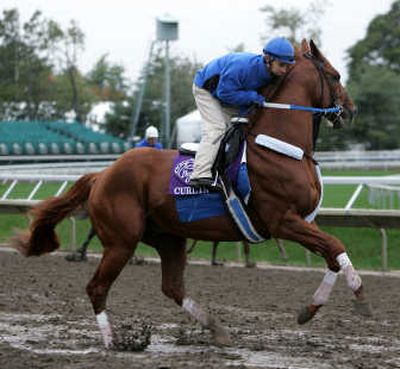
OCEANPORT, N.J. – Sheiks and princes and high-rollers from all over the globe will descend on a charming little Jersey Shore racetrack this weekend, and some of them will be bringing along their horses.
But horse racing’s biggest day – the 24th Breeders’ Cup World Championships – isn’t about wearing the fanciest hat, and there won’t be any infield beer fests. Kid Rock won’t be there, or K-Fed, or the rest of the B-listers who flock to Louisville on the first Saturday in May.
“This is the Super Bowl,” said Bob Kulina, vice president and general manager of Monmouth Park. “This is the biggest racing event in the world.”
And it’s serious business.
Unlike the Kentucky Derby, the Super Bowl or the World Series, where half the crowd is there to be seen and be part of the scene, the Breeders’ Cup will draw 45,000 hard-core horse-racing fans. A mix of billionaires and $2 bettors, and hordes of handicappers – the gamblers who are the sport’s lifeblood and who see the Breeders’ Cup races as an ultimate test of their skill.
A record $23 million in purses will be on the line at the Breeders’ Cup, and many more dollars will change hands based on the results. Last year, more than $134 million was legally bet on the Breeders’ Cup, more than on the Kentucky Derby.
Each division, from sprinters to fillies and mares to turf horses, has its own race – with three new Breeders’ Cup races today, and eight more on Saturday. In addition to the overall horse of the year award being on the line, the Breeders’ Cup often determines the champion horse of each division.
The Breeders’ Cup itself goes down as the most successful thoroughbred initiative of the last half of the 20th century, said Don Clippinger, editorial director of the Thoroughbred Times.
“It used to be the championship events were in New York or California,” Clippinger said, “and then we always had sort of a lack of a consensus, (especially) if we had a West Coast horse who didn’t go East, or an East Coast horse who didn’t go West. Here you have one event that pretty much settles it all.”
The format worked from the start.
“They had the good sense to have one race that would be pretty much a definitive race for (each) division,” Clippinger said. “It has an enormous energy to it. You keep going from one to the next, every 25 minutes.”
The North American horse of the year should be crowned on Saturday in the big race of the day – in maybe the deepest Breeders’ Cup Classic. The Kentucky Derby winner, Street Sense, probably won’t even be the favorite.
The local horse who made the biggest waves in 2007, Malvern-bred and Delaware Park-trained Hard Spun, the Kentucky Derby runner-up, will be in the Classic and has a case for horse of the year – if he pulls off an upset.
For all the Triple Crown excitement provided to this region by Smarty Jones and Afleet Alex and Barbaro, none of them was still running by the Breeders’ Cup, and none of them ended up being the horse of the year. The last three years, the winner of the Classic took that honor.
Hard Spun would need the best race of his life in the last race of his life before he is retired to a Kentucky stud farm owned by the ruler of Dubai. Hard Spun is owned by Rick Porter of Wilmington, who won last year’s Breeders’ Cup Distaff with his filly Round Pond.
Hard Spun probably will be the fifth betting choice behind Preakness winner Curlin, Street Sense, top 4-year-old Lawyer Ron, and Any Given Saturday, a 3-year-old who won this year’s Haskell Invitational over the same Monmouth Park course.
Asked what it would mean to win the Classic, Hard Spun’s trainer, Larry Jones, said, “The next day you (might) read my obituary. I may go down for the count.”
As big as this event is for the jockeys and trainers, Monmouth Park has the most riding on it this time. Kulina, the track general manager, acknowledges that racing in New Jersey is fighting for its survival as surrounding states get help from slot-machine revenue.
“We went after it very aggressively and we didn’t ease up,” Kulina said of getting the Breeders’ Cup, which sparked the state to fund $32 million in renovations to the racetrack.
First run in 1984, the Breeders’ Cup rotates among the big tracks, such as Churchill Downs, Santa Anita Park and Belmont Park, but also occasionally drops in on smaller tracks.
“First, they said, ‘This is going to be a New York event,’ ” Kulina said of the Breeders’ Cup organizers. “We said, ‘No, this is a New Jersey event.’ “
Attendance will be kept to 45,000, about what Monmouth handles for the Haskell. Limited tickets are still available, Kulina said. Each race will be shown live on the Web site and ESPN.
Referring to today’s races, Breeders’ Cup president Greg Avioli said of ESPN: “They had to actually move some NASCAR (programming), which shows we’re doing better than we used to.”
As always, the lion’s share of Breeders’ Cup betting will be done away from Monmouth Park. Last year, $17 million was bet at Churchill Downs, while the simulcast handle was $117 million. Much of the money goes toward Pick 3 and Pick 4 bets, when you need to have the winner of consecutive races. The biggest payout often goes out to Saturday’s Pick 6 bet, calling for six straight winning selections.
“You’ve got big fields – they’re impossible to handicap,” said Bob Levy, the former owner of Atlantic City Race Course, who has run three horses in the Breeders’ Cup. “Every year I go into a Pick 6 and we’ve never come close. And I mean the guys who are in it are pretty sophisticated handicappers, and we take a lot of horses, and we still haven’t come close. Long shots win a lot of the races. Everybody’s good or they wouldn’t be here.”
Clippinger pointed out that one of the main goals of the Breeders’ Cup turned out to be a failure.
“It was intended in its time to get more people in the seats,” he said, referring to races around the country leading up to the Breeders’ Cup. The advent of simulcasting a decade later “basically bailed out the industry,” Clippinger said, and slots revenue has been crucial in recent years. But nobody is claiming that the Breeders’ Cup has brought more fans to racetracks other than on Breeders’ Cup day itself.
“They don’t count attendance anymore at racetracks,” he said.
At Monmouth, where great horses and slower ones have run for parts of three centuries, they’re hoping that racing’s biggest day turns out to be the start of a new chapter, not the end of something grand.
“Hopefully, this game can survive and we can look forward instead of backwards,” Kulina said.
But the focus next weekend will be on the 141 horses already entered for the 11 championship races, ready to take center stage.
“Everybody’s good or they wouldn’t be there,” Levy said.