
Huckleberries Online: CdA’s new chief likes helping people
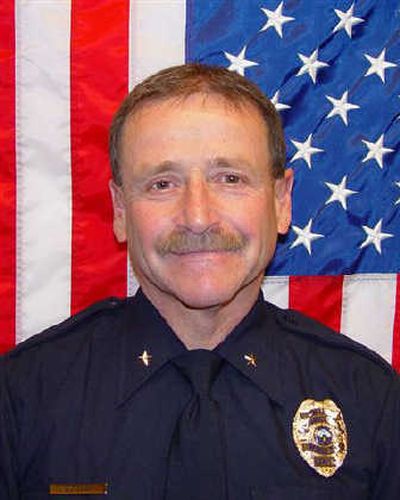
Wayne Longo, a former captain of the Idaho State Police, is the new Coeur d’Alene police chief. You can read his entire interview at Huckleberries Online this morning: spokesmanreview.com/blogs/hbo.
DFO: Where’s the name Longo come from?
Wayne Longo: My dad is second-generation Italian.
DFO: What would you be if you weren’t a police officer?
WL: I was an altar boy for 10 years. I was raised Catholic. I went to a two-week course in the summer for orientation to possibly become a priest. To this day, I wonder why I didn’t do it. I probably discovered girls.
DFO: How did you get from your native New York to Idaho?
WL: When I was a senior in college in Buffalo, N.Y., I was looking for a police job anywhere. The Idaho State Police offered a job. I’d never been further west than Buffalo.
DFO: Yanks or Mets?
WL: Yankees, absolutely.
DFO: How many hours do you work a day?
WL: I’m hitting 60 hours per week at the city.
DFO: I know that you started to run in 1984 as a stress relief.
WL: It’s a lifestyle now. I’ve run every Coeur d’Alene Marathon since 1984. I’ve done Boston a couple of times. Portland, too. I start training in January. If I’m not training, I’m doing five miles per day. I was chosen as Idaho representative at World Games for Special Olympics. We ran a torch throughout the state of Alaska.
Also, I held the record for a while at the National FBI Academy for the mile and a half.
DFO: What’s something few people know about you?
WL: I’m an adjunct faculty (member) for Lewis-Clark State College (since 2000) and North Idaho College (since 1989).
DFO: What would you tell a young person who is interested in law enforcement?
WL: Don’t expect anything more than a middle-class lifestyle. But if you’re looking for a rewarding profession that helps people, it’s the best profession for you.
DFO: How have you avoided becoming cynical?
WL: There are times I do become cynical. But it’s important as a manager that you don’t let your people see that. It leads to morale problems. That’s why I run (and get involved in the community). Every (officer) has to have something outside of policing.
DFO: Have you ever had to fire your gun?
WL: I’ve come close. But no.
DFO: Have you ever had a life-on-the-line close call?
WL: Yes. Two come to mind. I was on a tactical team that went into Ruby Ridge to pull out (U.S. Marshal) Bill Degan’s body. I was with the first responders. It took us about five hours to go a mile and a quarter. We were afraid of snipers behind every tree. The other was a meth house in Coeur d’Alene in 1999. The house exploded on us while we were inside. We pulled two people out. I and another guy went back into the house to find a third person. That guy passed out and almost died in my arms. I had to pull my partner out.
DFO: What were you doing when you heard about (ISP Officer) Linda Huff’s murder in 1998 at ISP regional headquarters?
WL: I hadn’t gone to bed yet when dispatch called and said: “We need you at the station right away.” I knew something was bad. I got there so quickly that the sheriff’s office was still challenging (Scott) Yager in the street. I knew Linda pretty well. I went into my professional mode.
DFO: What’s the worst part of your job?
WL: The death. Just before I left ISP, I went out to a scene of a fatal crash by Rose Lake involving three young girls. I got there just as a girl was being pronounced dead. The girls were 4, 5 and 9. Three sisters were dead. You don’t block that stuff out, no matter what the public thinks.
DFO: What’s your favorite cop show?
WL: I always liked “NYPD Blue,” being from New York because it was extremely realistic in regard to language and culture.
I feel I’m (Detective) Medavoy. He’s hard-working and honest. But he’s not the star.