
Looming landmarks
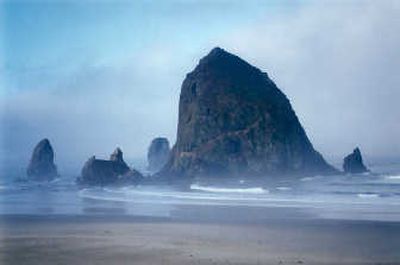
They are called haystacks, huge rocks or monoliths on the Oregon and Washington coasts rising out of the ocean that help define the West Coast scene. They are the landmark that some coastal towns are recognized by. They come in different sizes, some have arches or windows but they all have a similar shape, like a haystack.
Possibly the most famous is the haystack located in Oregon at Cannon Beach. But there is another huge one off the coast of Pacific City that is 327 feet high compared with the Cannon Beach’s stack of 255 feet. These two are only the start of a list of other haystacks that the same geologic history created: Twin Rocks near Rockaway, Proposal Rock at Neskowin, Three Arches Rocks at Neskowin and Tillamook Rock. Tillamook still supports, after its top was blasted off, the Tillamook Lighthouse.
These stacks even have a tie-in with Idaho. Geologists say that 100 million years ago, Oregon’s seashore started out in what is now western Idaho. Through a series of tectonic collisions and volcanic upheavals, the land – made of basalt and harder than the surrounding sandstone – gradually worked its way west. Wind, weather and waves shaped what we see today.
Most of the haystacks are off limits to the public. As desolate and barren as they look, they are home or nesting areas for an amazing number and kinds of birds that live on the haystacks. The birds choose these locations because they are close to food sources and offer safety from ground predators and humans.
Constant wind, air currents and the stack’s height help the seabirds land and take off. This is important for birds like puffins, whose short wings and heavy bodies are better suited for diving under the water than flying. One of the birds, the Common Murre, doesn’t build a nest on the rocks. Its pear-shaped egg spins around a narrow end, helping to prevent it from rolling off a cliff.
Sea bird chicks have two choices when they are ready to leave the nest on a cliff or haystack – jump or fly. Jumpers like the Common Murre cannot fly when they leave. Tiny, 3-week-old Murre chicks leap from the tops of rock and cliffs gliding down to the water on their stubby little wings. Some fall onto rocks below and die. Those who survive are taken care of by their father for another six to eight weeks.
The stacks are restricted but a pair of binoculars will open up a land and birds that most of us have never seen. Most of the birds sitting on the rocks feed at sea. So it’s unlikely to see them on land. Tuffed Puffins have a very strong-looking beak and bright clownlike colors and markings. They are definitely worth looking for. Information about the haystacks and the sea birds are found at several wayside signs along coastal Route 101.
The Washington and Oregon coasts are some of the most rugged and beautiful in the country. Even bad weather can make the stacks more dramatic with fog and mist swirling around the waves and beaches. However, sometimes the fog is so thick the sea stacks can’t be seen. Be prepared for rain and hope for good weather.
The best room rates can be found in the winter. Look for coupons for lodging in the gas stations, restaurants, visitor centers, etc. The coupons can save $10 to 20 per night. But read the small print. Some are not valid on weekends or have other restrictions. Even during the winter months lodging can fill up on weekends. For those who camp or have a RV, Oregon state parks along the coast are exceptional. There are sites that place the camper practically on the beach.
Most of the time there is changing weather along the coast. Blowing mist and the waves crashing around the sea stacks make a good time to sit down and simply watch a haystack. If you sit and watch for a period of time, the color, texture and even the shape of the rock seems to change. Plan to watch a sunset behind a haystack some evening with the roaring waves breaking before you. Coastal haystacks provide a scenic reason to make a trip west to the ocean.