
A HOLY CALLING
In the fall of 1890, on the eve of Yom Kippur, a young Jewish woman made history in Spokane.
Standing before a large audience inside the old Concordia Hall, Rachel “Ray” Frank – a Sabbath school teacher and newspaper correspondent from Oakland, Calif. – became the first Jewish woman in the United States to formally preach from a pulpit.
Her words during the two-hour service not only earned her the nickname of “Girl Rabbi of the Golden West,” it also expanded the role of women in Judaism.
Frank had no interest in becoming a rabbi, according to the Jewish Women’s Archive, but her High Holy Days speech as well as her role as a lay leader at her synagogue compelled other American Jews to consider the possibility of women’s ordination. “By occupying the pulpit temporarily, Frank opened the door, however slightly, for Jewish women’s long journey towards public religious leadership,” according to the Jewish Virtual Library.
Nowadays, most Jewish congregations – except those in the Orthodox tradition – welcome female rabbis. Since 1972, when Sally J. Priesand became the first woman to be ordained a rabbi in the Reform movement, nearly 1,000 women have become rabbis, according to the Associated Press. In some Jewish seminaries, female rabbinical students make up the majority.
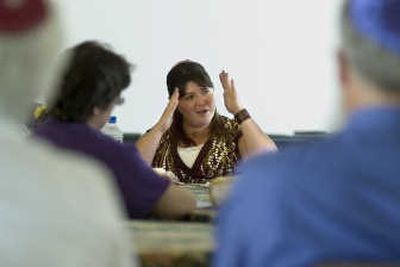
During this week’s observance of the High Holy Days, another young Jewish woman has come to town to preach. Jessy Gross, who is preparing to become a rabbi through Hebrew Union College in Los Angeles, is the student rabbi for Congregation Beth Haverim, a Reform congregation of about 40 families in Spokane. Beginning this month, the 27-year-old will spend one weekend a month in Spokane, where she will lead services, provide educational programs for kids and facilitate Jewish debate and discussion among members of the congregation.
This is the first time Gross has officiated services during the High Holy Days, which is the most significant time of the year for Jews all over the world. During the Rosh Hashanah services on Wednesday and Thursday, she not only helped organize the music, activities and discussions, she also delivered sermons on forgiveness and the importance of relationships with each other and also with God. Gross also will spend next weekend with the congregation to observe Yom Kippur, a time of fasting, reflection and prayers and the most solemn day of the Jewish year.
“These holidays are a period in which Jews take stock of their lives and assess the decisions they’ve made in the past and their resolutions for the future,” she said.
Before the congregation’s involvement with the student rabbi program, Beth Haverim used to invite rabbis from other cities to officiate during its High Holy Days services. Gross is the second female rabbinical student to come to Spokane and work with Beth Haverim. When she’s not there, services at the small congregation are led by lay members.
“They’re a phenomenal group of people,” said Gross, describing her experience with Beth Haverim. “The Jewish community here is very small but they’re willing to make a real investment to foster Jewish life and create a community in Spokane.”
Born and raised in the Washington D.C. area, Gross had felt a calling to work with Jewish communities from the time she was a teen. At the University of Maryland, where she majored in history with a focus on American and Jewish history, it became clear that she was meant to be a rabbi.
Since she was in the fifth grade, one of the people she watched and learned from was Amy Schwartzman, the rabbi of Temple Rodef Shalom in Falls Church, Va., where Gross’ family have been members for years. “She was my role model,” Gross said.
So she enrolled at Hebrew Union College and spent the first of the five-year program last year living and studying in Jerusalem. Now attending classes in Los Angeles, Gross said most of her fellow rabbinical students are women.
That’s a far cry from the situation in 1890, when men’s voices dominated American synagogues. Frank, who was 29 at the time and the superintendent of Oakland’s Sabbath School, definitely raised eyebrows when she came to Spokane, then known as Spokane Falls.
“It is Yom Kippur or the day of atonement. Prayer and fasting take the place of business cares among the Hebrews,” according to the Chronicle article about Frank and her presentation. “Miss Ray Frank, who addressed an audience at Concordia, has the honor of being the first of her sex to occupy the pulpit on atonement day.”
Jewish communities across the country called her a “latter-day Deborah” for her speech, which admonished the local Jewish community for their inability to work together. She urged them to unite and form a permanent congregation.
“This is a progressive age and some of the customs of two or three thousand years ago will not do for today, and at the same time, many customs which were good then are just as good now and can be just as appropriately used,” Frank said, as quoted from The Spokane Falls Review. “It would be well for you to throw aside all little disagreements and unite in the one cause – that of upholding the creed of our religion.”
Frank was apparently invited to give the sermon by “a prominent member of the community,” according to the Jewish Women’s Archive.
Although it didn’t garner the headlines the way Frank’s presence in Spokane did more than 100 years ago, Gross’ role in the High Holy Days services is perhaps just as poignant to members of Beth Haverim. And her goals are more or less the same as Frank’s – to foster dialogue among all Jews while making Jewish tradition and teachings relevant to modern-day life.
“These women are big thinkers and very open-minded,” said Beth Haverim member Debra Schultz, describing the two female student rabbis who have come to Spokane. “Jessy is here to help people express their Judaism. She brings a wonderful blend of the emotional, academic, ritual, political and cultural aspects of our faith.”
Virginia de Leon can be reached at virginiad@spokesman.com or (509) 459-5312.