
One person’s yard art is another person’s trash
ST. LOUIS — Battles over landscape decor can land property owners in court and cost thousands.
Dwight DeGolia’s landscaping project started innocently enough when the 62-year-old retiree cleared some trees a few years back from the sliver of sloping land outside his Chesterfield, Mo., home.
Then DeGolia installed two putting greens that were more than 30 feet long. He built a little creek and a gazebo.
And since nothing spells tropical golf getaway quite like a beach, he brought in about 50 tons of beach sand. The scene really came together once he got the portable golf hitting cage and a bar with pergola roof. “We had that place really shining,” DeGolia said.
But his neighbors said he crossed the line with the four artificial palm trees — exclamation points standing 8 to 12 feet high that screamed “tacky” to the subdivision trustees.
“We gave it a nickname,” said Dennis Taylor, a former trustee. “Wally World.”
Thus began another costly legal battle over landscape decorum.
To a few people with eccentric palettes, a lawn is a canvas, and the results can vex city officials and homeowners associations for years.
“It’s a hard balancing act,” said Carlos Trejos, planning and zoning administrator for the city of Olivette, Mo. “We are not there to determine taste.”
The questions that arise in such cases are perplexing. Whose property rights should triumph — the homeowner who wants to be surrounded by dozens of cherubic statues, or the neighbor who has to look at them every time he walks to his car? A judge often decides.
Would you tolerate landscape overload from your neighbors?
Jennifer Cowley, an Ohio State University assistant professor, who has researched yard art, said two things seem to drive the conflicts. “There are always people who want to do something different,” she said. “People use their yards to say something about themselves.”
Two months ago, a group of Ballwin, Mo., residents begged their Board of Aldermen to do something about a retired art teacher, Lewis Greenberg.
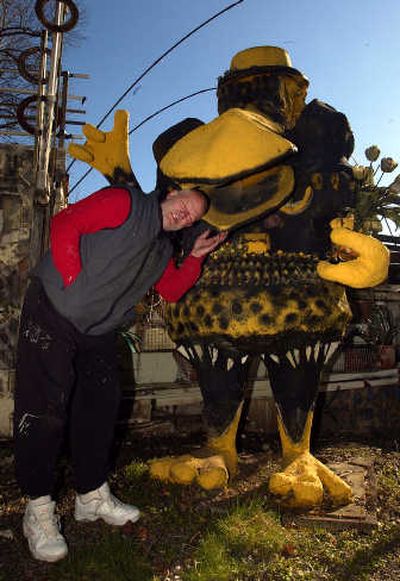
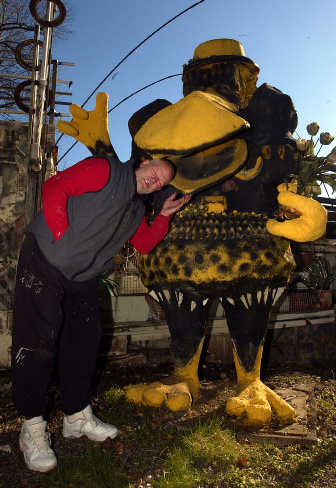
Greenberg constructed clusters of colorful, twisted metal and wooden spikes on his front lawn, and hung silver bowls from the trees. Greenberg says the project is intended to commemorate the Holocaust.
The city cited Greenberg under a littering ordinance, said David Howard, Greenberg’s attorney. “It’s going to be extremely expensive, the route they’ve chosen.”
Howard argued that under the law, Greenberg’s art is no different from a resident who puts up Christmas lights, a birdbath or a rosebush trellis, adding that the city wants Greenberg’s art removed merely because it offends people.
“Once you go down that slippery slope, where do you stop?” Howard asked.
If landscaping is a form of self-expression, it’s difficult to tell what message the shimmering rock garden in front of the home on Ashby Road in the St. Louis, Mo., area is trying to convey.
Giant slabs of granite line the sidewalk. Faux flowers make their way up a metal trellis, surrounded by pieces of quartz.
“Rocks symbolize the new Jerusalem,” said Carol Isbell, who lives in the house with her husband, Carl Johnson. “The stones will be perfected in the new Jerusalem. … It kind of helps me concentrate so I don’t go out and mess up my life. … It’s a constant reminder that we have to do the will of God.”
Well, at least they don’t have to cut the grass.
Still, some of Isbell’s neighbors don’t share her post-apocalyptic views or appreciate how she puts them on display.
“It’s Sanford and Son,” said Linda Badgley, who lives across the street. “I’m sure it does a lot for our property values.”
Years ago, in addition to the rocks, Carl and Carol decorated their yard with a collection of hubcaps. But that was too much for the county, which persuaded a judge to order the couple to remove the hubcaps.
Not all self-expressive yards end in neighborhood disputes.
You can’t miss Ronald Kuper’s house just across the street from Blackburn Park in Webster Groves, Mo. — just look for the two pairs of stone lions that guard a couple of sidewalks leading up to the home at the corner of East Jackson Road and Hazel Avenue.
In a couple of driveways, he’s got seven collectible automobiles including four 1960s and 1970s Silver Shadow Rolls-Royces.
A waist-high iron fence and several stone columns encircle the backyard where a dozen seminude female statues stand along with a couple of ornate birdbaths lined with artificial flowers.
“Some people collect women,” said Kuper, 66. “Some people collect beer cans. I collect female statues and Rolls-Royces. They don’t talk back.”
Ellen Harken who lives three houses down isn’t bothered by Kuper’s taste for all things Roman.
“I just look at it and laugh,” she said. “He followed his dream.”
Sure, Julie Jacobs noticed the house when she moved into neighborhood a couple of years ago, but it didn’t deter her from buying the place across the street.
“I guess I said to myself, that has to be an interesting person,” she said. “People ask where we live and we say we live next to the statue house.”
In Olivette, Rebecca Pickens strolled through her backyard and pointed out the human-size bird’s nest filled with large ceramic eggs.
“This is my empty nest,” she said, pointing to one corner of her yard. A wooden post stands next to the nest; it’s etched with the year 2014, the year her 11-year-old son will fly off to college.
When Pickens moved into her home a couple of years ago, she said her yard looked like all the others in the neighborhood. “It just wasn’t my style,” she said. “It just wasn’t me.”
Trejos, the city’s zoning administrator, said a neighbor was worried about rodent infestation and complained about Pickens’ yard recently. When inspectors visited the place, they found branches and foliage scattered about. Later, Trejos said, Pickens e-mailed him pictures of the lawn and nests after it had been cleaned up.
Dwight DeGolia’s battle for his tropical golf getaway ended with a compromise last December.
DeGolia was allowed to keep the gazebo, the putting greens and a couple of bridges. But the palm trees had to go, along with the golf cage.
The fight ended up costing DeGolia about $12,000 in legal fees. The Greenleaf Valley subdivision paid about $20,000, Taylor said.
When he looks back on it, DeGolia said he could have communicated better with the trustees — and vice versa.
Today, the house sits empty.
DeGolia still owns the Chesterfield home, but he and his wife moved to Oklahoma earlier this year, partly because of his troubles in the subdivision.
“We didn’t feel very welcome where we were at,” he said.
He took the palm trees with him.