
Something for everyone
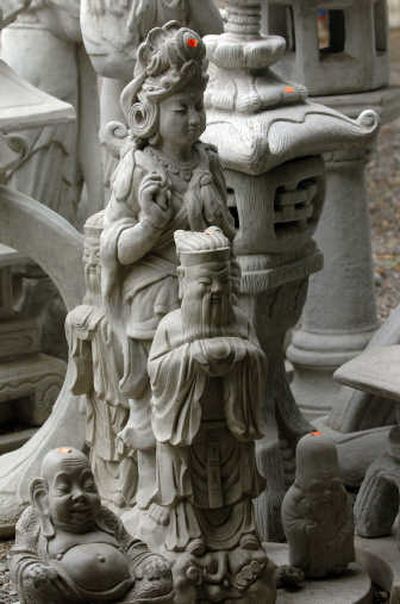
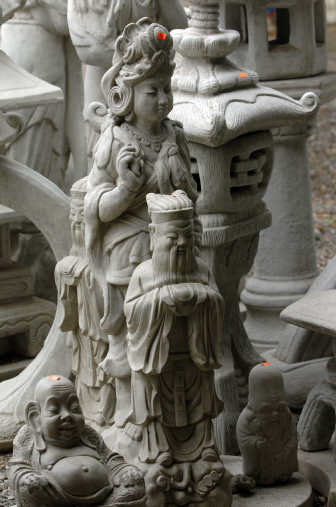
How would you like to have a 3,000-pound rhino for your front yard? Or maybe, on either side of your driveway, a life-sized lion to protect the premises?
Anyone driving on Hayden Avenue between U.S. Highway 95 and Ramsey Road cannot help but notice the concrete sculptures lined up on the south side of the avenue where Scott and Sandy Rudy, owners of Backyard Creations, make and sell cast-cement garden sculptures of all shapes and sizes.
“People drive by and they think all we have are the big pieces but once they stop and come in they find everything from an elephant weighing a couple of tons to a sparrow weighing a few ounces,” Scott says.
He says that prices cover a wide range, too, from a dollar to about $5,000.
Scott has been in business for 10 years and at his current location for eight. Before that he had worked in the building trades which included carpentry and cement work. His interest in concrete sculptures began on a visit to his dad who lived in Salt Lake City.
“My dad had a concrete turtle that fascinated me. After I came home, I continued to think about that turtle. Finally I went back to Salt Lake City and asked the man who had made my dad’s turtle if I could work with him and learn how to cast concrete yard ornaments.”
Learning turned into a full-time occupation which the couple obviously enjoys even though it can be hard work. “Sometimes,” Sandy says, “it takes two of us to remove the latex mold from the cured sculpture. Last week we struggled to strip the latex from that huge bowl.”
She points to a basin, roughly 4 feet in diameter that sits beside three smaller bowls. The three are sections of a fountain waiting to be assembled. “This mold was a one-piece mold without a center seam and had to be peeled off in one piece.” This made removing it difficult because it had to be pulled and stretched over the bowl’s outside rim.
Because of their artistic detail, most of the sculptures are poured into molds with two halves and an inner and outer shell. Using one of his turtles, Scott demonstrates the process.
There are two parts to the mold – the firm, fiberglass, exterior mold and the inner, flexible latex mold which acts as a skin that can be peeled away without damaging the finished form within.
Once he has removed the exterior mold he next peels away the latex mold, beginning at the center seam and pulling downward and away from center. He repeats the process on the opposite half. He explains that there is a special lubricant that he sprays on the inside of the latex before pouring the concrete that makes removing the latex easier. It’s almost as slick as peeling a banana.
He turns a mold over, showing a hole. “We pour the concrete into this hole to fill the inside.” He also says that during the pouring process the mold sits on a platform that vibrates to make sure the mold fills uniformly.
The results are amazing, a perfectly formed turtle, about the size of a wash tub, with a realistically detailed shell and wrinkled skin. It’s easy to see why Scott was fascinated with his dad’s turtle.
First-time visitors are likely to be overwhelmed and likely to notice only the larger forms – a bear, deer, moose an elephant, the full-sized cowboy, but there is so much more and more comes in all sizes – something for everyone.
“We have religious statues.” Scott points to a grouping of biblical figures. There are various wall plaques, dragons, geese, classical gods and goddesses, boats with fishermen aboard, a family of quail, birds no larger than a chicken’s egg – even a motorcycle with rider. We walk on stepping stones and pass three, life-sized dog figures, two German shepherds and a cocker spaniel.
In the shade, under a tree, fountains splash and Snow White and the Seven Dwarfs wait. For Prince Charming perhaps? Sandy has painted these familiar figures and also paints other sculptures, like the green sea serpent. She will paint any sculpture on order to suit the customer.
Some of these works, done on order are special and have touching stories. Scott recalls a family whose daughter had died in an automobile accident. They brought her ashes and they themselves placed the ashes in the French angel mold that would enshrine her memory.
“People commemorate family pets, too, and place their ashes in statues. One woman placed her cocker spaniel’s ashes in a cocker spaniel mold and Sandy used a photograph to paint the concrete animal to resemble the pet.
“Sometimes people will order a garden bench inscribed with the name of a loved one. We have done head stones for people and pets.” Scott brings out two, flat, head-stones ordered for a pair of deceased pet cats.
Sandy says the gargoyles and grotesques along with benches and stepping stones are the most popular sculptures.
She explains the difference between “gargoyles” and “grotesques,” the goblin-like figures we associate with decorating old buildings and cathedrals.
“A true gargoyle is intended as a spout to drain water from a building while a grotesque is a decorative figure,” she says.
At present, Scott is working on a special-order grotesque, a goblin, probably 4 feet tall. He says, “The man I am making this for plans to set it beside his front door. He wants it to have red, electric eyes that will flash off and on when a visitor comes to the door. I have to inset the wiring and the eyes when I cast it. The flashing eyes will be activated by a motion sensor.”
Scott says that one of his biggest jobs was for Walt Worthy and the Davenport Hotel. Worthy ordered four planters for the hotel to sit in the area where there once was a swimming pool.
That was only the beginning. Anyone who has looked closely at the ornamentation on the exterior of the Davenport is familiar with the rams’ heads that are a re-occurring motif.
Worthy saw a planter that Scott already had made with rams’ heads in the base and he ordered 62 of these planters for the hotel.
“I wore out the mold I had and had to make another mold to finish the job,” Scott says.
In addition to the planters, Worthy also purchased a hippopotamus for his home.
Scott does make molds on order but molds are expensive to make or buy, costing $8,000 to $9,000 each. Making and designing molds is usually a winter project.
He explains that he sometimes borrows molds from others who have businesses like his. He can give you just about anything you want, except for a gorilla, some may remember, that stood near the road with one arm upraised.
“The gorilla was 7 feet tall and we had it for two years until Sean Montee bought it and placed it in front of his logging business office. We had a club in the gorilla’s hand and he replaced it with a chain saw. I can’t get that mold any more because the people who leased it to me went out of business.”
Despite having unattended sculptures near the road, Scott and Sandy say they have not lost any to theft probably because they are so heavy and the couple live on the premises. However, a neighbor did have a problem.
Scott points across the street to a row of boulders in front of a house. “The couple who lives there bought a mermaid from us and set her on one of those boulders – like the little mermaid in the fairy tale. Someone did steal her one night and since then the wife who bought her passed away. As soon as we have time we are going to make another one and give it to the family.”