
Great horned owl impressive hunter
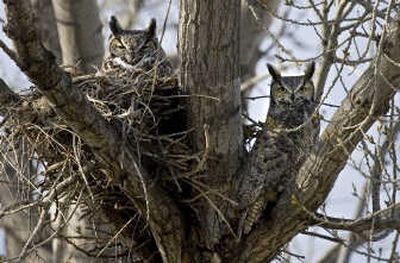
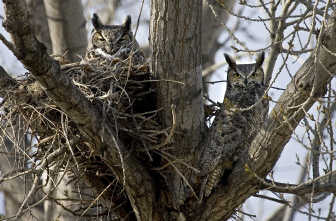
There is no fiercer bird in the Inland Northwest than the great horned owl. No other bird takes prey the relative size or the challenge of that taken by this owl.
The great horned owl is not a scavenger as are the largest birds of prey, the eagles. It does not tolerate fellow hunters the way hawks and eagles do. In such interactions, the hunter becomes the hunted. As a killer, there are no other birds as proficient or as determined.
Great horned owls often take prey larger than and almost as fierce as themselves. They are the only predator to skunks, seemingly immune to their potent spray. They will tackle raccoons and porcupines, the latter to their own detriment.
A great horned owl has roughly the dimensions of a red-tailed hawk, but has a thicker body and a much larger head. It weighs a third more. It is not as large or heavy as a snowy owl, but it is close, and it is not as large as a great gray owl, but it weighs more.
In the world of predatory birds, however, the great horned owl is the wolf, while hawks and other owls are coyotes and foxes. Where great horned owls live, which is practically everywhere – from Alaska to Argentina – they are kings of the night, but their presence in nature is felt in daylight as well due to their overall dominance.
Great horned owls are not generally creatures of the day, but they can be, especially when they are feeding young. They also are not generally creatures of the deep night. They are crepuscular, creatures of dusk and dawn, and however many hours after and before that it takes to get the night’s job done.
In some areas, the great horned owl is referred to as the “cat owl” due to the catlike appearance of its face when its feathery ear tufts, or “great horns,” are erect. In semisuburban areas, such as the Rathdrum Prairie, the name could apply equally well to its dietary habits.
Overall, great horned owls can be described as aggressive, powerful, dominant and opportunistic generalists. They adapt well to habitat disruption and do not frequent old-growth forests. They kill many different species and are often considered a serious nuisance in recovery programs for threatened and endangered species. They appear secretive and calculating. In short, the great horned owl would make an excellent mascot species for the U. S. Department of the Interior under the current administration.
Great horned owls are tough in all their ways. They do not bother to make a nest. They generally use or steal nests of hawks or ravens or any other species that makes a suitable platform, never applying more alterations than the addition of a few feathers to the bottom. Sometimes they’ll nest in the exposed top of a broken tree, on a ledge or even on the ground.
No other bird breeds and lays eggs as early as they do. Great horned owls begin courtship in November and will have laid eggs by mid-March, if not sooner. In the past weeks, our local female great horned owls have been determinedly sitting on their nests, incubating eggs, often covered up to their ear tufts in snow.
Even nestling great horned owls are tough. Two to four eggs are laid, but unlike songbirds, owl eggs are incubated starting with the first egg. Thus the first egg will hatch a day or two before the next, and that egg a day or two before the next and so on. In years of plenty, two or three owlets may survive to fledge. When times are hard, the older, larger, better fed and stronger owlet will eat its younger, smaller and weaker siblings.
Great horned owls are tough enough to last the winter through. They don’t migrate, and they guard virtually the same territory they had for nesting purposes – about a square mile with average prey availability.
With large, lemon-yellow eyes unique in the bird world, owls can see even small prey from a distance in either daylight or dark of night. An owl’s eyes are distinctively positioned on a relatively flat face rather than on the sides of its head. Its eyes are more tubular than round – telescopic – and their light sensitive cells, the rods, are long and more numerous.
Thus designed, owl eyes cannot move in their sockets, so the owl must rotate its head, as much as 180 degrees, to see to its side, or behind. As it is with all bird eyes, owl eyes have a ring of bony plates that support the relatively huge avian eyeball in its socket. Only dinosaurs have shared this feature of the eye.
In addition, with ears that offer “binocular hearing,” owls can locate prey they cannot see, even pouncing on victims under a heavy cover of snow. They attain this unique hearing ability by having overly large ear openings that are slightly offset, one side against the other. Great horned owl ear openings have no relationship to their ear tufts. Birds do not have external ears at all.
As I mentioned before, there isn’t much alive that a great horned owl does not consider potential prey. Mostly it is a perch-and-pounce hunter, getting by on mice and voles, even large insects if there is a need. But it won’t hesitate to take a hawk, adult or nestling, right off a nest, or another owl on the wing, passing through its territory, or a bird as large as a Canada goose, or snakes, lizards and frogs where available, or mammals larger than itself.
Smaller prey is swallowed whole. Larger prey is shredded with the owl’s knifelike beak. All prey is killed by the tremendous crushing force of great horned owls’ toes and needle-sharp talons. The skull of a raccoon can be pierced by a talon, but most deaths come from a crushed spine at the base of the skull.
Being at the top of the food chain, great horned owls are also fearless in advertising their presence. Males defend a nesting territory, often beginning in November, with typical rhythmic hooting that brings both a tingle of fear and a certain amount of awe whenever heard by the unsuspecting.
Male great horned owls have a deep, rumbling hoot, while females answer with a higher-pitched call. But mostly it is the male’s territorial call one will hear, especially in January and February. The owls become quiet while the female, considerably larger than the male, is on the nest. Things get noisy as the owlets grow, but juveniles are driven from the territory in early fall, and it is quiet again until November.
For many reasons, not least among them the great horned owl’s calls, owls are thought to portend evil and death. The latter is certainly true for its potential prey, but owls are amazingly tolerant of humans, often nesting near rural houses.
Unfortunately, it is not so true the other way around. As with its mammalian counterpart, the wolf, great horned owls are too often killed by hunters and land owners. In both cases, many people cannot tolerate having to share in the killing of wild creatures. Predators are not seen for the balance they bring, but for the competition they represent.
One characteristic I have not attributed to owls is wisdom. The idea of owls being wise is imparted unashamedly by people contemplating an owl’s relatively humanlike face. The face makes them good at seeing, but not particularly intelligent. But neither are they conniving or devious in what they do. Aggressive and powerful, in the animal world at least, does not equate with malevolent or wicked.
Great horned owls are capable killers, but they are neither of the above. They are, in the words of a description I read in a natural history guide, “competent, able and efficient exploiters of their habitat and environment.” They could also be good role models for our species.