
Reflecting on the Holocaust

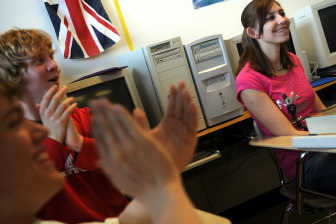
On a blustery April afternoon at Gonzaga Prep, teacher Christian Birrer’s sixth-period sophomore honors English class pulled their desks into a semicircle. They had more on their minds than upcoming tests or after-school sports.
Instead, the students spoke of inherent evil, genocide and groupthink. The class had recently read “Lord of the Flies,” by William Golding. The classic tale of British schoolboys struggling to create a semblance of civilization while stranded on a deserted island had prompted lively discussions. When Birrer saw a contest in the newspaper, sponsored by the Spokane Community Observance of the Holocaust Planning Committee, he thought it would be a great way further that discussion.
“Our creative writing contest challenged the students to imagine how they would respond to the tremendous amount of pressure extant in Nazi Germany to corrupt their moral compasses,” said Hershel Zellman, chairman of the organization.
Birrer showed his students a short video from the U.S. Holocaust Memorial Museum, and then asked them to submit essays to the competition. He said the video showing Nazi soldiers picnicking and celebrating birthdays was startling. “The reason it’s so horrific is that they don’t look like monsters – they’re people just like you and me.”
Gonzaga sophomore Amanda Boik submitted the winning essay. Her narrative wove a storyline tracing the devolution of a group of German citizens from making racist jokes about their Jewish neighbors to actually working in concentration camps. “I wanted something people could relate to,” she said, “something people could feel like it could have been them.”
Zellman said Boik’s essay “thoughtfully analyzed the processes that transform ordinary people into mindless mass killers.”
Another of Birrer’s students wrote from compelling contemporary experience. Evelyne Mulindangwe’s family fled her native country in 1994. She grew up hearing stories about the genocide in Rwanda. “My mother was targeted because she is Tutsi,” she said. “My father was targeted because he married her.”
Mulindangwe said several of her mother’s sisters have recently arrived in America. “Some are traumatized,” she said quietly. “It’s kind of hard, hearing about it.”
Her classmates had no difficulty imagining the type of peer pressure German citizens faced. The teens talked about how high school is often a hotbed of pressure to conform. Sixteen-year-old Ben Rowland said, “People get wrapped up in being part of the group. Sometimes you do things you wouldn’t do by yourself.”
Fellow student Peter Ganz pointed out, “It’s easier to single out people when you’re in a group of friends.”
Zack Heffernan agreed. “Everyone wants to be part of something.”
In fact, the students had a perfect example of the chaos caused by groupthink. “Last week the seniors started a food fight,” said Ben Ward. The class erupted in laughter. Everyone seemed to have an anecdote about food being flung and tables being tipped over. Ward’s point was that if freshmen had started it, the food fight would have been largely ignored. “But the seniors started it,” said Peter Ganz. “We look up to them.”
The students drew a parallel between their high school high jinks and the government-sanctioned persecution in Nazi Germany. Laughter subsided as the students pondered ongoing genocides in other countries. The majority of Birrer’s sixth-period class agreed that normal human beings are capable of perpetrating great evil. “Most people are afraid to go against the crowd,” said Meg Cressey.
So what does it take to prevent further atrocities like the Holocaust? “Conversations like this,” Ben Rowland said. Other students believe that education and electing effective leaders will prevent genocide from taking place on American soil.
Ben Ward said, “Be aware of your own moral convictions. Keep your conscience clear.” But as the class remembered how quickly good kids trashed their school cafeteria – as they pondered how easy it is to make fun of those who don’t fit in the room grew quiet.
Finally, James Huesner said those who opposed the slaughter of the innocent in Nazi Germany cared more about others than themselves. They were willing to lay their lives on the line to stand against evil. “It really comes down to courage,” he said.