
Penn’s political stand
Actor hopes his portrayal of Harvey Milk can help gay-rights movement

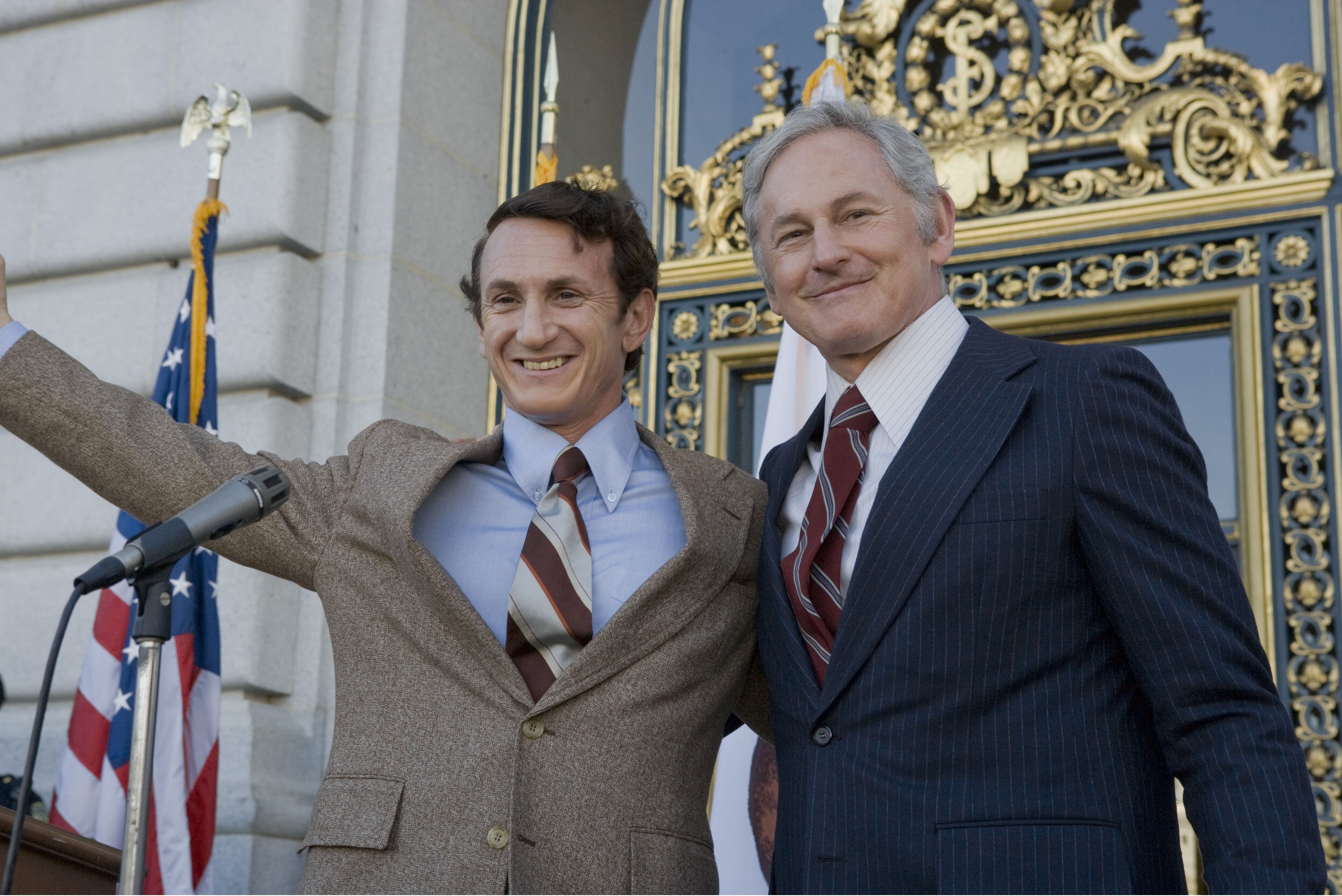
It has been 30 years since San Francisco Board of Supervisors member Harvey Milk, the first openly gay man to hold such a high office, was shot to death by a former supervisor, Dan White.
Now Sean Penn wants to make sure we don’t forget Milk’s work as an activist and his sacrifices to help open doors for gays.
“What struck me is that even if Harvey Milk had not been a politician, he would have been a political figure,” Penn says during an interview to promote his new film “Milk,” which opens today in Spokane.
“He had been one of these people who came up against the obvious obstacles in life and greeted them with such courage and warmth. He was politically kind. He was a kind spirit, and that was going to be strong whatever he did.”
The film, directed by Gus Van Sant, continued to gain awards momentum this week, winning best picture honors from the influential New York Film Critics Circle.
The group also chose Penn as best actor, and Josh Brolin as best supporting actor for his performance as White.
The movie charts how Milk moved from New York to San Francisco in the late 1960s. After several unsuccessful attempts to win political office, he was elected as a supervisor in 1977.
White became convinced Milk and San Francisco Mayor George Moscone had undermined him politically. On Nov. 27, 1978, he killed both men.
At his trial, his lawyer argued that White was not competent at the time because he had eaten too much junk food – which became known as the “Twinkie defense.”
White was convicted of manslaughter and served five years of a seven-year sentence. He committed suicide in 1985.
Penn believes Milk would have been an even bigger political figure had he lived.
“One of the great tragedies of his death was (that) later that year was the beginning of the (AIDS) plague,” he says. “There is no question in my mind Ronald Reagan would have talked about AIDS if Harvey Milk made him.”
Penn, who has had a tough-guy image both on and off screen, pauses as his voice begins to break: “A lot of lives would have been saved.”
Though Milk was a vocal activist for gay rights, Penn says his life and work has a much broader reach.
“It speaks to any activism,” he says. “When people stand up, things change. The spirit of that feeling is in the film, not only in terms of gay rights, but in general it becomes an inspiring tool for participation.”
The “Milk” role is the latest zigzag in Penn’s career.
The 48-year-old Santa Monica, Calif., native caught the eye of moviegoers with his cool-dude performance as Jeff Spicoli in 1982’s “Fast Times at Ridgemont High.”
Since then, his credits have covered a broad spectrum, from the intensity of “Carlito’s Way” and “Colors” to the human dramas of “Dead Man Walking” and “All the King’s Men.”
Penn has even showed his comedic side on the TV shows “Friends” and “Two and a Half Men.”
None of his career choices has been planned. The Oscar-winner (for 2003’s “Mystic River”) just looks at each project as it comes along.
The first two keys to whether he will agree to a project are the director and the script.
Penn says he can count on one hand the number of directors “who only make an organic and beautiful picture like Gus does every time.” He also liked the “Milk” script by Dustin Lance Black.
The clincher came when Penn began to do his research. He developed an increasing affection for Milk the more he got to know about him.
Penn prefers not to think about any responsibility that might come with the role because it is a real person.
“You almost try to keep that at bay in terms of your thinking. It is almost an invitation to pressure,” he says.
Penn lets others judge how well he has played the part. One such person is Cleve Jones, a close friend of Milk’s, who is played by Emile Hirsch in the film.
Along with being the founder of The NAMES Project AIDS Memorial Quilt, Jones travels the country as a motivational speaker and a political activist. He says that next to his mother and father, Milk was the biggest influence in his life.
That’s why it hurts him so much that after only one generation, Milk’s name does not resonate more loudly in discussions of human rights.
“When I am on the lecture circuit, I will ask every college and high school student if they know the name of Harvey Milk,” Jones says. “Usually they do not. I tell them his story is very timely.
“Young people are overwhelmed and isolated and disconnected. We have produced a generation uncertain of how to change the world and address enormous issues. Harvey’s story shows them an ordinary person can succeed in changing the world.”
Jones had worked for years trying to get Milk’s story told in film. He finally started to believe it was going to happen when Black agreed to write the script, and served as the historical consultant during the filming.
The big concern for Jones was whether the right actor would be found to play Milk.
“Sean is an amazing human being,” he says. “All of us who knew Harvey saw how Sean succeeded in capturing the tone and the mannerism and the spirit of Harvey.”
Not everyone has welcomed the film. Penn was at an event in San Francisco where protesters carried signs that said “Matthew Shepard Burn In Hell” – a reference to the gay college student who was murdered near Laramie, Wyo., in 1998.
Penn, who doesn’t conceal his anger about the event, says it just made him even more convinced it was the right time for “Milk” to be released.
He wants the film to continue Milk’s philosophy of what a tremendous impact it has on straight people to know even one gay person.
“I think there is a version of that that comes from this film,” he says. “You are watching a lot of very good-hearted human beings. How they decide to (have sex) is irrelevant.”