
Celebration of survival
Immigrants who fled persecution to host holiday gathering
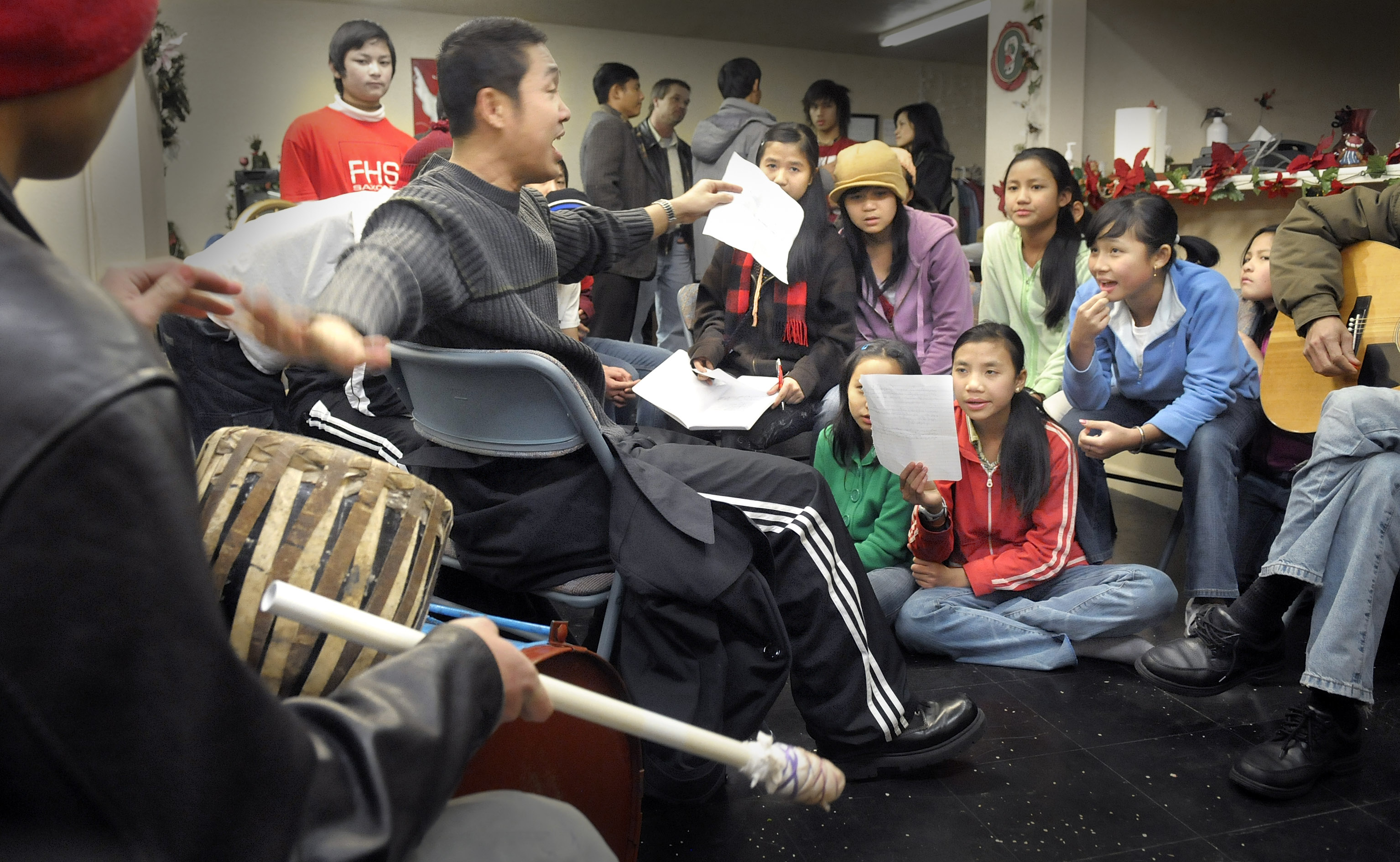
The men, women and children gather in a circle to sing – their voices accompanied by the strum of a guitar, the thumping of drums, the clicking of woodblocks and the clang of cymbals.
As they huddle together at Jacob’s Well Community Resource Center in Spokane’s East Central neighborhood, their music and the closeness of their circle quickly bring warmth on a cold December night.
“Let us be happy,” they sing in their native KaRen, the language spoken in the villages of southeastern Burma. “Let us celebrate. Let us be grateful. Let us have a good life.”
Although they’re poor by most standards in the United States, these immigrant families who fled persecution in their native land and later persevered in Thailand’s refugee camps consider themselves blessed.
They are together, they say. They are safe. They have survived.
And as they give thanks for the opportunity to begin a new life in America, the roughly 100 members of the ethnic KaRen community want to share their culture, their food and their celebration with the rest of Spokane.
For the past few weeks, KaRen families in East Central have been rehearsing dances, songs and speeches that they will present during the KaRen Christmas and New Year Celebration on Dec. 27 at the East Central Community Center.
They’re inviting everyone they know – neighbors, friends, schoolteachers and others in the area – to get better acquainted and to partake in their festivities.
Next Saturday’s event will be the first KaRen celebration in the region, says Saw Gay Gay, one of the KaRen leaders.
“We like Spokane – it is beautiful here,” he says. “We would like to invite the community to be part of our celebration.”
Spokane is home to more than 200 people who have escaped Burma, an Asian country now called Myanmar by its military rulers.
Since 1962, the country has been governed by repressive authoritarian regimes, according to the U.S. State Department’s Bureau of Democracy, Human Rights and Labor. Several human rights groups also have accused Burma’s military government of ethnic cleansing and suppression of religious freedom.
Many of the refugees who have resettled in Spokane are KaRen, but others are from the Chin and Burman ethnic groups. The majority are Christian, while some are Muslim or Buddhist, according to the Rev. Eric Blauer, pastor of the nondenominational Christian community known as Jacob’s Well.
Blauer and his wife, Lee Ella, sponsored the first KaRen families to move to Spokane in the fall of 2006. Blauer’s brother, Matt, works for nongovernmental organizations in Southeast Asia and creates documentaries that detail the struggle of the KaRen and other refugees.
As a result, most of the KaRen people who resettle in Spokane are associated with Jacob’s Well.
Blauer’s church – which was established just two years ago and now has more than 100 members – provides space for KaRen families to gather each week for their own Christian services, as well as a center where they can get clothing, help with paperwork and other aid.
These families were able to relocate to Spokane thanks to World Relief, a Christian organization that works globally to relieve human suffering, hunger and poverty.
Like thousands of others from Burma’s ethnic tribes, the refugees in Spokane fled their homeland and spent many years living in squalid conditions in Thailand’s camps, says Moon Light.
A farmer in Burma, he was forced to escape to the jungle after the army threatened to destroy his village. Moon Light and his family then spent nine years in the crowded refugee camps.
“It was very horrible,” says Moon Light, his words interpreted by 16-year-old Jenny Wah. “It was a hard life. People died. We had no food. We had no medicine.”
Because of all they’ve been through, Moon Light, his wife, Yoeyoo, and their three children – 14-year-old Haley, 12-year-old July and Larde, who’s 8 – say they always will be grateful for everything they have.
After moving to Spokane in 2006, they’ve been joined by Moon Light’s parents, who are 68 and 67, as well as siblings and other relatives.
The transition to their new life in Spokane hasn’t been easy, but like everything else they’ve experienced, they accept the challenges in stride.
Temperatures in Spokane are unbearably cold compared to the warm climate of Southeast Asia, Moonlight acknowledges, but they all have warm coats and a roof above their heads. The food is foreign, but at least they have enough to eat.
And with help from Jacob’s Well and others, they’ve made friends, he says.
Besides the harsh winter, the biggest obstacle for many of the families is finding a job, says Saw Gay Gay. Because of the economy and the fact that they’re still learning English and acclimatizing to the culture, many KaRen have a tough time getting hired for full-time employment in Spokane.
Moon Light and a few others must drive to the Tri-Cities every week to work at a meat-packing plant. They stay there during the week and drive back to spend time with their families in Spokane on weekends.
“It’s really frustrating,” says Blauer. “They want to work but finding entry-level jobs has been hard.”
Some of the men have applied for fishing jobs in Alaska, he says. A few families have moved to Nebraska, where they have found consistent work in the meat-packing industry.
Despite the employment scarcity, most of the KaRen want to stay in Spokane, Moon Light says.
People here have been friendly and helpful, he says. The public schools have welcomed their children. They also have established a close-knit ethnic community in East Central and other neighborhoods, with help from Jacob’s Well, World Relief and others.
At the Jacob’s Well Community Resource Center, which opened in September 2008, the KaRen families gather several times each week for fellowship. They have their own lay pastors, and their services are conducted in KaRen.
“They were always on the run and hunted down like animals – they’ve really suffered,” says Jim Carney, a member of Jacob’s Well and the resource center’s director.
“But despite all that, they seem so happy and grateful. They never take anything for granted.”
Through their friendship with the KaRen, Carney and his wife, Linda, say they’ve learned how to live simply and frugally. They’ve also rediscovered the meaning of community.
“We’ve learned how to be family,” says Linda Carney. “That’s something that has been lost in American culture. … They bend over backwards to help others out.”
In the same way that the KaRen families are learning English, the Carneys and a few others from the church are now taking up the KaRen language.
“Tablu Padoh,” says Linda Carney, reciting a phrase that means, “Thank you very big.”
This week, the KaRen families plan to spend many hours in their kitchens, cooking rice and noodles as well as dishes made of chicken, pork, beef flavored with curry, chilies and other spices that they wish to share with guests.
They’ve spent the last month preparing for a six-hour event that will include games, dancing, music and colorful traditional KaRen clothing woven by hand from dyed threads.
In their homeland, the KaRen celebrate the New Year by building a stage at the center of the village and watching people perform, explains Saw Gay Gay. In some areas, people organized competitions among various villages and the festivities lasted as long as a week.
While the Spokane celebration will last just for a day, it will offer guests a window into the world of the KaRen refugees, a resilient group of families that value tradition, hard work and the hope of education and a better life for their children.
“They really wanted to open it up to the community and let everyone know they’re happy to be in Spokane,” Blauer says. “They want to be part of this community, too.”