
Tiny flying dinosaur found
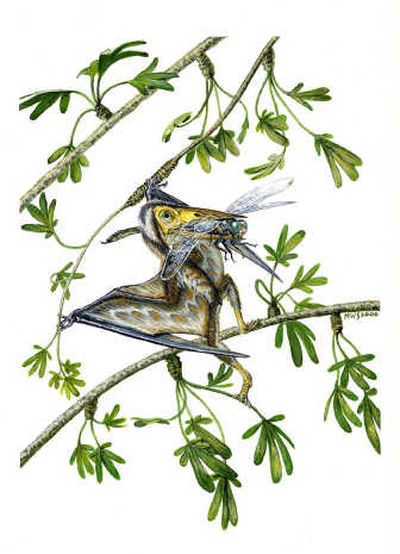
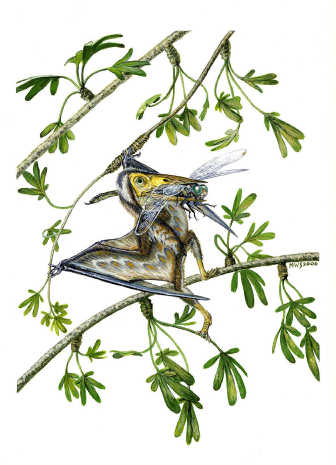
WASHINGTON – As pterodactyls go it was small, toothless and had unexpectedly curved toes – yet scientists are welcoming a recent find as another piece in the puzzle of ancient life.
“We have this really amazing creature, sparrow sized, which lived essentially in the trees, showing us a very new, very interesting side of the evolutionary history of those animals,” said Alexander W. A. Kellner of the National Museum of the Federal University of Rio de Janeiro, Brazil.
The find, by researchers led by Xiaolin Wang of the Chinese Academy of Science, is reported in this week’s online edition of Proceedings of the National Academy of Sciences.
Pterodactyls are best known from giant examples of the ancient flying reptiles, and most specimens have been uncovered in coastal areas.
Dubbed Nemicolopterus crypticus – hidden flying forest dweller – the new fossil was uncovered in the western part of China’s Liaoning province, a forested region when the animal lived there about 120 million years ago.
“We just had one side of the story of pterosaur evolution,” Kellner said.
“It’s a new species. It’s showing us a new chapter of the evolutionary history of those animals,” Kellner said at a news conference in Rio on Monday.
The curved toes, he said, indicate that the pterosaurs lived most of the time in trees.
“Because they were flying animals, their fossils are extremely rare. So, discoveries such as this are fundamental to understand the evolution of these winged vertebrates,” he said.
It was the smallest of its group of flying pterosaurs, he said, and when first uncovered the researchers thought it was a baby.
The skull was not fully fused, meaning it was not an adult, but the bones were developed, so it was not a hatchling either.
“How much could it grow? We have no idea,” he said. “But even if it would double its size it would still be the smallest of its particular group.”
The researchers said the legs and feet of Nemicolopterus had attachments for muscles indicating that it could grasp limbs, but unlike most pterodactyls it lacked teeth. They speculated it might have eaten insects.