
Postmaster retires
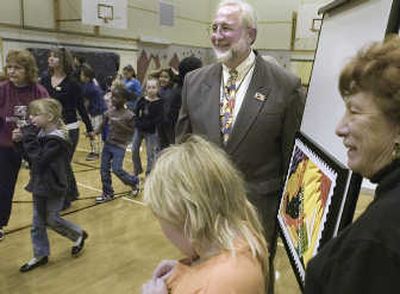

When Edward Schierberl took a temporary job as a letter carrier in 1966, the price of a first-class postage stamp was 5 cents. That temporary job evolved into a lifelong career with the U.S. Postal Service. Schierberl, Spokane’s 26th postmaster, will retire this week. The price of stamps isn’t the only thing he’s seen change.
“When I started, the pony express rider was still our emblem,” he said with a smile, from his downtown office. “Then we went to the eagle, and now we have this streamlined, contemporary emblem.”
One of the most radical changes he witnessed occurred in 1971. That’s when the Post Office Department was transformed into the United States Postal Service, an independent establishment of the executive branch of the government. “In 1971 the Postal Service started to run more like a business,” Schierberl said.
As automated systems were introduced, the once foundering organization became more efficient and customer-service oriented. According to Schierberl, in the past postal employees would painstakingly sort each piece of mail by ZIP code. New advances in technology, like software that deciphers handwriting, continue to make mail delivery quicker. “Ninety percent of letters come to the carriers already sorted,” he said.
Throughout the course of his career, the soft-spoken gentleman with the silver beard has held many different positions – from letter carrier to postal inspector. Along the way he’s heard rumors and rumblings regarding the relevance of the institution that employs him. “The demise of the Postal Service has been talked about since the invention of the fax,” he said with a chuckle.
In reality he believes the competition they face from businesses like UPS and Fed Ex has only made them better. “Nobody competes with us in the last mile, going to every house and business, six days a week.”
Schierberl said the Postal Service is still a labor-intensive organization. As postmaster he oversees approximately 600 employees. But as technology advances, so does the business of mail delivery.
Ironically, instead of shunning e-mail, the Postal Service itself is going paperless. “We send an average of eight million e-mails a day, internally,” Schierberl said. They also direct customers to their Web site, www.usps.com. “We refer to our Web site as the post office that never closes,” he said. “You can print up mailing labels, check prices – everything from home.”
In addition, after 9/11 the organization developed new technology to help cope with the threat biochemical attacks. “We’ve been on the cutting edge in identifying harmful substances like anthrax,” he said.
As much as things have altered over the years, Schierberl believes some things will never change. “It’s still very touching to receive a personal card in the mail.”
Those catalogues and postcards from businesses will continue to appear in mailboxes, too. Schierberl said, “Direct mail is still a very economical way to advertise.”
The retiring postmaster is pleased at the changes he’s seen in Spokane’s Postal Service. “We’re one of the leaders in the country as far as service,” he said. “Our customer satisfaction rate has never been higher. People in Spokane are happy with their postal service.”
Schierberl and his wife plan to stay in Spokane after his retirement. He’s looking forward to traveling and spending time with his children and grandchildren. “I even took up fly-fishing after we moved here,” he said.
As he reflected on a career that spanned over three decades, he said he’s most proud of the team he leaves behind. “Employees and management have responded well to the changes I instituted,” he said. “Our net income went up 69 percent in 2007, in the Spokane Post Office. It’s been an amazing turn around. What a fantastic way to end my career.”