
Opposition leader proposes talks
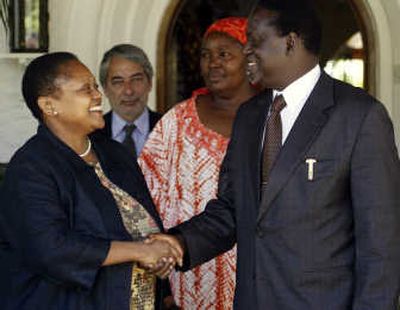
NAIROBI, Kenya – Kenya’s embattled president and his main political rival agreed Monday to meet for the first time since a flawed election last month that a senior U.S. official said had “cheated” the Kenyan people.
President Mwai Kibaki’s invitation to opposition leader Raila Odinga came after talks over the weekend with Jendayi Frazer, the top U.S. diplomat for Africa. Kibaki claimed a re-election victory last week despite serious charges of vote-rigging, triggering violent clashes that have killed nearly 500 people, according to a government estimate.
Kibaki’s invitation followed days of pressure by Frazer and other Western diplomats on both sides to end the fighting, which has forced more than 200,000 Kenyans to flee their homes.
“The people of Kenya have been cheated … by their political leadership and institutions,” Frazer, the assistant secretary of state for African affairs, said near the end of an urgent four-day visit to Kenya. “We’re saying the only way to restore the Kenyan people’s … confidence in the system is that political leaders have to stop the violence.”
Frazer indicated that future Bush administration support for Kenya – which received more than $300 million in U.S. aid in 2006 – would depend on how the government resolves the crisis.
“It can’t be business as usual without addressing that problem,” Frazer said.
Kibaki issued his invitation for Friday. An aide to Odinga said that he was willing to meet Kibaki, and earlier in the day Odinga had called off protests to pave the way for negotiations. But diplomats remained doubtful of a speedy resolution because of the deep enmity between the men.
“They don’t trust each other very much,” Frazer said.
Odinga’s support was key to Kibaki’s landslide election victory in 2002, and in exchange, Kibaki agreed to share power with Odinga and to serve for only one term. Kibaki’s critics say he’s instead handed more power to members of his ethnic group, the Kikuyu, whom other groups see as having dominated politics and business in Kenya since independence in 1963.
Since the disputed vote, Odinga supporters from various tribes have targeted Kikuyus, driving them from towns and villages throughout the country with stones, machetes, and bows and arrows.
Frazer said that the events – especially the ethnic dimension of the violence – had shaken U.S. faith in a country that’s a key partner in the war on terrorism in East Africa, and which serves as a conduit for humanitarian assistance to southern Sudan and war-torn Somalia.