
Making a splash
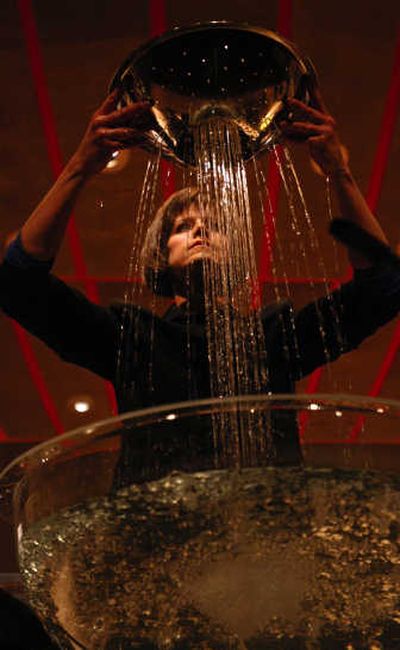
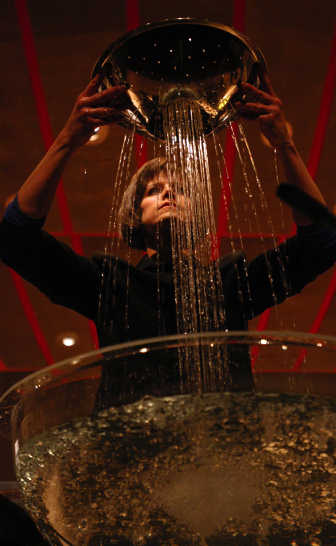
Do you have a problem getting to like new music? You’re not alone. So does percussionist Maria Flurry. Flurry will perform Tan Dun’s Concerto for Water Instruments and Orchestra in two concerts this weekend with the Spokane Symphony.
Music director Eckart Preu will conduct a program that also includes Charles Griffes’ sensuous tone poem “The White Peacock” and Brahms’ Symphony No. 4.
“When I hear a new piece of music, I need to have some way to get into it – some entry point,” Flurry said from her home studio in Prescott, Ariz.
“I think there are a lot of things to use as entry points to the ‘Water’ concerto. In the first place, there are all these unusual instruments most people will be seeing and hearing for the first time.
“I’m looking at the set up of the instruments as we speak,” she continued, pausing to count. “There are 21 instruments, or one more if you count the water goblets as a pair or two separate instruments.”
The list includes some typical percussion, such as gongs and vibraphone; ethnic instruments like the African Agogo bells; newly invented instruments such as the Waterphone (an invention of Richard – you probably guessed it –Waters); and off-the-rack items including sieves, glass and wooden bowls, and plastic tubing.
And lots of water. The instrument list in the printed score has a line that reads, “One towel for drying hands.”
Alongside Flurry in her role as principal soloist, symphony percussionists Paul Raymond and Rick Westrick will both play sizable arrays of instruments from the right and left sides of the stage.
“So there’ll be a lot to look at,” Flurry says, “and a lot of unusual things to listen to, as well.
“Tan uses water to produces intriguing new sounds. I ‘play’ the water with my hands and fingers, and play instruments that sound like water.
“There are people who are just fascinated by the physics of how those sounds are produced,” she adds. “The vibraphone, for instance, has coins taped on the bars to produce bell-like sounds.”
Tan Dun is probably best known to most audiences for the score he composed for the film “Crouching Tiger, Hidden Dragon.”
His Concerto for Water Percussion and Orchestra was one of six commissions by the New York Philharmonic for its “Message for the Millennium” series for the 1999-2000 season.
Regarding the concerto, he told an interviewer: “What I want to present is music that is for listening in a visual way and watching in an auditory way.”
Flurry, born in West Virginia, lived in Virginia, North Carolina, the Dominican Republic and Arizona before her college days at Baltimore’s Peabody Conservatory and the University of Michigan.
She taught Spanish in public schools while playing in several orchestras in southeastern Michigan.
Flurry first performed the “Water” Concerto in 2005 when she was timpanist for the Flint (Mich.) Symphony, making her one of only a handful of percussionists who have played the work.
“We had scheduled the concerto to be performed with a guest soloist, but he had to cancel,” she said. “So our conductor decided to use an orchestra member instead.
“I luckily had four months to learn it. Much of that time was consumed assembling all the instruments it required, and I got a lot of help from Christopher Lamb, who premiered the piece with the New York Philharmonic, and Steven Schick in California, who had also played it before.”
Flurry says she has never met Tan, “but I have read many of the things he’s written about his own music.
“What comes through is the passion that he achieves in the combination of the 20th-century elements in Tan’s music. There’s the aleatory element of improvisation, there is minimalistic repetition, there are a few touches of jazz, there are mechanistic sounds, melodies that are drawn from Chinese folk music or describe shapes …
“But they all creates an emotional, dramatic environment you can easily imagine some story for,” she says. “It returns music to an emotional experience, which I hope is the direction music of this millennium will take.”
Flurry will give a pre-concert talk an hour before each performance, providing audience members with hands-on experience with some of the instruments used.