
A divine blend
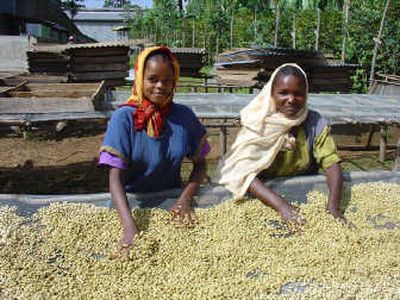
In a remote village in Ethiopia, a young woman once crippled by polio now sings a song about the kindness of a Liberty Lake man.
She doesn’t mention him by name, but as she sifts coffee at a plant in the country’s Yirgacheffe region, the woman known to villagers as Tsehaynesh often bursts into song as she gives thanks to God and praises the work of a former Kaiser executive named Mike Stemm.
Stemm, 62, never imagined he would devote so much of his life to Ethiopia, let alone make friends with people living 8,000 miles away.
When he first visited this East African country seven years ago, Stemm had planned on staying for just two weeks as a volunteer during a church mission trip.
But something tugged at his heart as he traveled along Ethiopia’s dirt roads, as he drank coffee in the homes of people who had almost nothing but were still willing to share with him what little they had.
When he returned to Eastern Washington after that visit, Stemm’s life suddenly veered off a steady, predictable path.
Six months later, he quit his job.
After working for more than 30 years at Kaiser and establishing a reputation as a sharp businessman with a knack for strategic planning, Stemm gave up a lucrative career in order to fully dedicate himself to a new calling: to give hope – not just to Ethiopians looking to find sustainable solutions to famine and poverty; but also to ordinary people like himself searching for ways to live out their faith.
“There has to be more to life than making aluminum,” Stemm told himself as he met with many hard-working Ethiopians who had no access to basic health care or education yet still welcomed him with great joy.
“It soon became clear to me that you don’t have to be the president of a company or an ambassador or a political figure to make a difference in people’s lives,” he said recently, recalling that first visit to Ethiopia. “You just have to be willing to give a little bit of yourself. … I knew I had to make a lifestyle change and redefine my perception of retirement.
“I wanted to do something to benefit others and not just myself.”
Answering the call
Stemm’s devotion to the people of Ethiopia is the tale of a man who took a leap of faith.
But it’s also the story of coffee – premium whole-bean Arabica grown in a region rich with volcanic loam and considered the coffee mecca of the world.
Stemm had no clue of this when he returned from Ethiopia in February 2001. All he knew at the time was that he was supposed to return. What he would do, exactly, remained unclear for many months.
So he prayed. Along with Craig Meredith of Post Falls, a close friend and fellow member at His Place Church in North Idaho, Stemm spent many hours in his living room asking God for guidance.
Meredith, a consultant with a background in agricultural engineering, also traveled to Ethiopia with Stemm and other church members in 2001. The two had befriended a man named Werku Golle, a leader in Ethiopia’s Kale Heywot evangelical church. Golle had spent several months in North Idaho so that his wife and son could receive surgery the year before. It was Golle who had asked Stemm and Meredith to travel to Ethiopia in the first place.
Meredith shared Stemm’s conviction that they were called to serve in Ethiopia, but like his friend, he also didn’t know what role they would play.
Six months later, the two formed New Covenant Foundation, a non-profit that they hoped would provide sustainable ways to bring health care, education and other humanitarian aid to the people of Ethiopia.
In February 2004, they returned to the country and brought a team of doctors, nurses and health care professionals from the Inland Northwest. In addition to performing surgeries and offering their services, the group wanted to see what they could do in the long-term to help improve living conditions for Ethiopians.
Golle and others in the town of Dilla, located about 220 miles south of the capital of Addis Ababa, wanted the Americans to help them build a hospital. But the medical team discovered a facility would have been useless in a community where most people didn’t even know how to access clean water for drinking.
“The whole purpose of New Covenant was not to be an ongoing source of aid, but to be a model for self-sufficiency and independence,” said Stemm.
So he and Meredith eventually partnered with LifeWind International, a Christian organization that has promoted community health evangelism throughout the world for the last 30 years.
Soon after, the idea for coffee came along.
Putting people first
As the scope of New Covenant grew to encompass the economic, educational and spiritual needs of the people in Dilla and other Ethiopian communities, Stemm and Meredith became aware of the fact that they couldn’t rely on donations alone.
So in 2004, when world coffee prices were at a 30-year low and processing plants in Ethiopia were going out of business, they started a partnership with a group of six Ethiopian businessmen to buy a coffee facility located in the same area of New Covenant’s ministry: the Yirgacheffe region, known worldwide for its coffee.
That facility formed the basis for Dominion Trading, a for-profit created by Stemm to fund New Covenant’s initiatives and also to ensure that farmers in the region are paid a living wage.
The business returns 60 percent of its net profits from coffee sales to Ethiopia through profit-sharing with coffee growers and also through New Covenant. So in addition to paying farmers a higher price for their coffee, Dominion Trading and New Covenant have focused on community health care, literacy, finance, founding churches, and other initiatives.
Their mission is supported by individuals and investors nationwide, as well as dozens of evangelical Christian churches that buy and serve Dominion Trading’s coffee. Their coffee from Ethiopia is also served exclusively by two local shops: Moon Dollars in Post Falls and the Service Station in north Spokane.
“I was struck by what God was doing in an entire continent using regular people,” the Rev. Jim Putman of Real Life Ministries said during a recent sermon describing the work of Stemm and others in Ethiopia.
For Stemm, the experience in Ethiopia has been eye-opening, especially as a seasoned executive in America who has since adopted a new business policy.
“My mode of operation has always been: You see a problem, you gather a team, you look at possible solutions, go after it, then move on,” Stemm said. “The process is different in Africa. What you do first is develop relationships with people, which takes time. … American businessmen are impatient when it comes to developing relationships because we are always looking at the bottom line.”
In Ethiopia, Stemm discovered a new business formula: First, invest in people and relationships, he advised. Then, out of those relationships, lasting solutions to problems will emerge. Once you provide the solutions, he said, lives are forever changed.
Just a few years since New Covenant helped their Ethiopian partners invest in the coffee processing plant, the company now sells about 200,000 pounds of green coffee to roasters in Europe and the United States. Last year, Dominion Trading’s coffee came in second place in the annual East African coffee competition and fourth place in all of Africa.
In turn, the New Covenant Foundation has used the money to train several hundred community and church leaders in health care education. Many villages and rural communities that have sent people to Addis Ababa for the training are now seeing children’s mortality rates drop, according to Stemm. They’re also beginning to protect their water sources as well as invest in education.
Rescued from the mud
In addition to starting a certified organic cooperative for roughly 1,500 growers who now receive a living wage, the coffee plant in Yirgacheffe also employs at least 185 people. Those workers include Tsehaynesh, a young woman who was orphaned as a little girl.
When Stemm first saw her in November 2006, Tsehaynesh was covered in mud. Stricken with polio as a child, she couldn’t use her legs and so she scuttled along the ground like an animal.
Wanting to work, Tsehaynesh spent most of the day crawling beneath the tables, picking coffee beans that had fallen on the floor.
Touched by her struggle, Stemm called Dr. Duane Anderson, a North Idaho orthopedic surgeon who had moved to Ethiopia two years ago to work as the director of Soddo Christian Hospital.
Now, with her lilting voice, Tsehaynesh is able to move around with a walker. She also sings a tribute in her tribal language, a song about Stemm and others involved with New Covenant: “I want to thank God and thank you for helping me.”
Thousands of people recently heard that story during one of Putman’s sermons at Real Life Ministries. Stemm, however, shies away from the spotlight, according to those close to him. He’d rather talk about Ethiopia.
“Mike is probably the greatest guy I have ever worked with,” said Meredith, 45. “I have been encouraged by his faith and willingness to do this – he started out as a businessman who relied on his own skill and now, he relies on God … He’s a great leader and a true friend.”
Stemm, who has two grown children and 10 grandchildren, has traveled to Ethiopia 10 times in the last four years. During each visit, he spends about two to four weeks nurturing the friendships he established in Yirgacheffe, developing relationships with people in government and business in Addis Ababa, and working side-by-side with Tsehaynesh and others at the coffee processing plant.
Until July of last year, when Dominion Trading’s three-member management committee voted to give him a modest salary as general manager and the company’s only full-time employee, Stemm’s last paycheck was the one from Kaiser in 2002.
His leap of faith and the risks he took seven years ago has certainly changed his plans for retirement. Still, he has no regrets, he said.
“This hasn’t been a cakewalk and I still feel overwhelmed,” Stemm said. “But I reached that point in my life when God said, ‘Step out in faith and trust me.’
“It’s the best thing I ever did.”