
Democratic hopefuls invoke MLK
COLUMBIA, S.C. – Racial politics, complaints and the Rev. Martin Luther King Jr.’s legacy dominated discourse in the Democratic presidential contest Sunday as Nevada caucus winner Hillary Rodham Clinton and Barack Obama sought to shore up their bases for the South Carolina primary on Saturday.
Speaking Sunday night to 3,500 supporters during a rally at the Metropolitan Convention Center in Columbia, Obama toughened his criticisms of both the New York senator and her husband, former President Clinton, accusing both of distorting his recent statement about President Reagan’s ability to “tap into the discontent of the American people.”
“When I see Senator Clinton or President Clinton distort my words, say somehow that I was saying Republicans were the only ones who had good ideas since 1980, that is not a way to move the debate forward,” Obama said.
Clinton spokesman Phil Singer responded that “we understand Senator Obama is frustrated by his loss in Nevada, but facts are facts.” Singer added that “President Clinton is a huge asset to our campaign and will continue talking to the American people.”
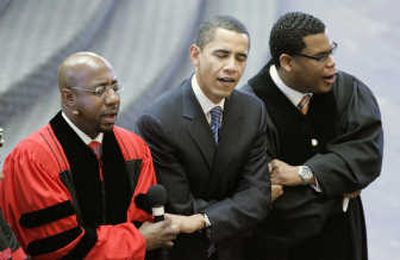
Clinton and Obama spent Sunday in historic churches with black congregations, talking about race in America in advance of today’s King holiday and a primary debate tonight in Myrtle Beach sponsored by the Congressional Black Caucus.
With the black vote in South Carolina and elsewhere coalescing around Obama, Clinton went to the Abyssinian Baptist Church in Harlem in New York City on Sunday to firm up community support that has showed signs of hemorrhage despite backing from a long list of black political leaders. The New York senator won an endorsement from the Harlem church’s influential pastor, the Rev. Calvin O. Butts.
Describing how she went as a teenager to hear King speak, Clinton recalled that King’s “transforming” speech “made it very clear that the civil rights movement was about economic justice” – a campaign theme she has pressed hard as the nation grapples with a looming recession.
Despite overseeing a warm welcome, Butts admitted his decision had been opposed by some parishioners. One man heckled Clinton outside the church. “Don’t come to Harlem and steal the black vote,” he sniped. Butts tried to reassure his flock, saying his move was not “a race-based decision.”
In Atlanta, Obama sought to consolidate his support from southern black voters with an appearance in King’s own pulpit at the Ebeneezer Baptist Church. In lofty cadences, the Illinois senator spoke glowingly of King’s legacy but also reminded his audience of his recent dust-up with Clinton and several of her surrogates over what he considers racially tinged criticisms.