
A doula serves as mother to moms
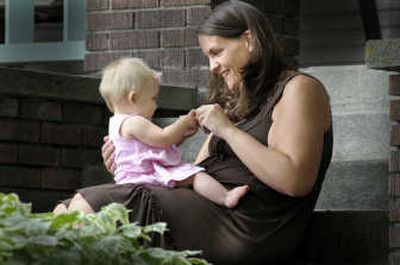
As a doula, Andrea Kennedy’s job is to mother the mother. While women labor through the pain of childbirth, doulas like Kennedy remain at their side to provide emotional and physical support. She holds the mother’s hand, applies counter pressure to her aching back, rubs her feet and helps her stay calm as she endures the burning contractions of her uterus. Most of all, Kennedy tries to empower the mother and help her feel safe.
“I tell her that I believe in her and in the process of birth,” said Kennedy, who is also a certified pregnancy massage therapist in Spokane. “I help her find her voice.”
Doulas, also known as birth companions or assistants, are professionals who have been trained to nurture and care for mothers during and after childbirth. Unlike midwives and doctors, doulas don’t perform clinical tasks; however, they do provide information to help educate the woman so she can make informed decisions. Although their primary role is to help mothers, doulas also provide support to fathers, partners and other family members as they prepare for and carry out their plans for birth.
In recent years, a growing number of mothers have made doulas part of their birth team. Some of these moms give birth at home, but most go to the hospital. And while doulas often are associated with natural childbirth, their services are available to all – women who want an epidural, those who have planned Cesarean sections as well as those seeking as few medical interventions as possible.
“A lot of moms think that a doula means that they have to have a natural birth, but that’s absolutely not the case,” said Julie Denlinger, a doula in Spokane for the past three years. “A doula’s job is to have their birth plan played out as closely as possible. If a client wants an epidural, then it’s my job to get her one. I tell my clients, ‘I had my babies my way, now my job is to help you have your babies your way.’ “
According to “Mothering the Mother: How a Doula Can Help You Have a Shorter, Easier and Healthier Birth,” some of the benefits of having a trained doula include: shorter labor times by as much as 25 percent; a 60 percent decrease in epidural requests; a 40 percent reduction in forceps delivery and a decrease in the Cesarean-section rates by one-third.
Nationwide, the Cesarean delivery rate rose to more than 30 percent of all births in 2005, according to the Centers for Disease Control’s 2007 National Vital Statistics Report. That percentage set a new U.S. record and reflected a 4 percent increase from the 2004 figure. According to the CDC, the C-section rate fell sharply between 1989 and 1996 but has since risen by 46 percent. The 2007 report also noted that the rate of labor induction rose 5 percent in 2005 to 22.3 percent – a level that has more than doubled since 1990.
In addition to fewer medical interventions and lowering the rate of C-sections, having a doula at birth also helps increase the mother’s level of satisfaction with her birth experience. These moms also are more likely to breastfeed and less likely to suffer from postpartum depression, according to “Mothering the Mother.”
Birth is a sacred experience, said Kennedy.
That moment when a baby enters the world – when she takes her first breath and fills the room with her cries – is like watching a black-and-white photograph come alive with color, she said.
“It is such a holy, sacred and amazing experience,” said Kennedy. “I always feel so blessed when the mother has allowed me to experience this. Each birth changes my life. (Being a doula) is spiritual work that feeds my soul.”
Doulas don’t have to be certified, but many get their certification anyway through organizations such as DONA International, the Association of Labor Assistants and Childbirth Educators, and the Childbirth and Postpartum Professional Association.
Kennedy, the mother of a 1-year-old daughter, became a doula 10 years ago after reading Ina May Gaskin’s “Spiritual Midwifery.” She went to the Seattle Midwifery School and studied under Penny Simkin, who is considered the mother of the doula movement.
“It made me believe in the normalcy of birth, in the idea that women have an inherent birthing aptitude,” said Kennedy. “It made me believe in myself as a woman and as a caregiver.”
According to DONA International’s Web site, the Inland Northwest is home to about 15 to 20 doulas who have received DONA certification. Some doulas also are affiliated with the Inland Northwest Doula Network, which has about 20 members.
Most doulas in the Spokane and Coeur d’Alene area charge about $300 to $500 for the entire package. Generally, they meet with the mother and her partner two times before the birth. During this time, they help the woman or the couple write a birth plan. They also talk regularly on the phone and are on call during the final weeks of the pregnancy.
During the birth, a doula can spend more than 24 hours with the expectant mom depending on the length of her labor. She’s also there to offer support to the partners, who sometimes get nervous or exhausted as well.
“I tell them that my job is not to be the woman’s primary support,” said Kennedy. “I’m the secondary support to the family unit. I also remind dads that this is not only the birth of a child, but the birth of a whole new family.”
Doulas routinely return the day after a birth and then again several days later when the mother’s milk comes in. They also offer phone consultation and support up to six weeks post partum.
Some doulas, including Denlinger, even take the time to take notes during labor in order to write birth stories for their clients. “Birth is an experience that a woman never forgets,” said Denlinger, a mother of four and the president of the Inland Northwest Doula Network.
“Being a doula is the most amazing privilege,” she said.
With the growing awareness surrounding birth as well as the attention that’s been given to documentaries such as “The Business of Being Born,” more people in the region are learning about the benefits of doulas, Denlinger said.
Some hospitals also are welcoming their help.
“Nurses say it’s very comforting to the mom when someone is there to coach and support her,” said Lori Schneider, director of women’s and children’s services at Kootenai Medical Center. “… If a mom’s goal is to try and have a natural birth without medication, the more help she has as far as physical and emotional support, the more likely she is to achieve that.”
Many women, particularly single moms, women whose husbands are deployed to Iraq or Afghanistan and unmarried teens, could benefit from having a doula attend their birth, Denlinger said.
“Everyone needs a doula,” said Kennedy. “They’re important for women, for families and for the entire community.”