
Classics along Cannon Hill Park
Shines’ Craftsman bungalow among historic homes on tour
When Thomas and Molly Shine bought their Craftsman bungalow on West Shoshone Place in 1981, both were attracted to the water features: Tom to the Cannon Hill Park pond across the street, where he ice skated as a boy; Molly to the swimming pool that occupies a good portion of the home’s double lot.
“Molly had a goal of having a pool for the girls,” her husband says of the couple’s four grown daughters, one of whom still resides in Spokane with two of their 10 grandchildren.
For Tom Shine, a longtime Spokane architect, the park brought back memories of his school days at nearby St. Augustine’s, now Cataldo Catholic School.
“The park was a legacy for me,” he says. “We played in the park for recess, and in the winter we had fresh ice when the fire department would watch the weather and flood it when (the weather) would get cold.”
Built in 1917, the Shines’ home is one of four park-side residences featured during a historical tour of Cannon Hill Park on Saturday. The tour will highlight the work of the Olmsted Brothers Landscape Architects, a celebrated firm that designed New York City’s Central Park, in addition to a number of venerable green spaces in Spokane.
Linda Yeomans, a historic preservation consultant who researched the history of homes on the tour, says Cannon Hill Park is one of Spokane’s best examples of Olmsted design and engineering. The site for the park – an abandoned clay and sand quarry that served as a brickyard in the 1880s – once held a small, natural lake and a border of native pines. Near the turn of the 20th century, the Arthur D. Jones Development Co. started work on a residential neighborhood around the park. Jones platted the area, installed sewer pipe, paved sidewalks and streets, planted curb-line shade trees and provided fresh drinking water. Yeomans says lots cost from $500 to $2,500 and homes were built from 1908 to 1948 in a variety of styles and sizes.
In 1918, Dr. Charles Ward and his wife, Ella May, purchased the bungalow in which the Shines now live. According to Yeomans’ research, Ward and his partner, Dr. Arthur Betts, specialized in “X-Ray diagnosis/treatment and radium therapy.” The Wards moved to Seattle in 1932, after which the house had several owners, including a grocer, wholesale electrical supplier, food broker, pharmacist and investor.
An excellent example of Craftsman-style architecture, the Shines’ bungalow follows a horizontal orientation accented with a deep, one-story front porch. Additional horizontal emphasis is evident in the porch extension that covers the driveway, forming a porte cochere. Original Craftsman features include wide, overhanging roof eaves, wood shingle siding, thick tapered porch posts, multipaned windows and handcrafted porch lights.
Yeomans says the home’s interior was likely remodeled in the 1930s or ’40s to reflect the neo-colonial style popular at that time.
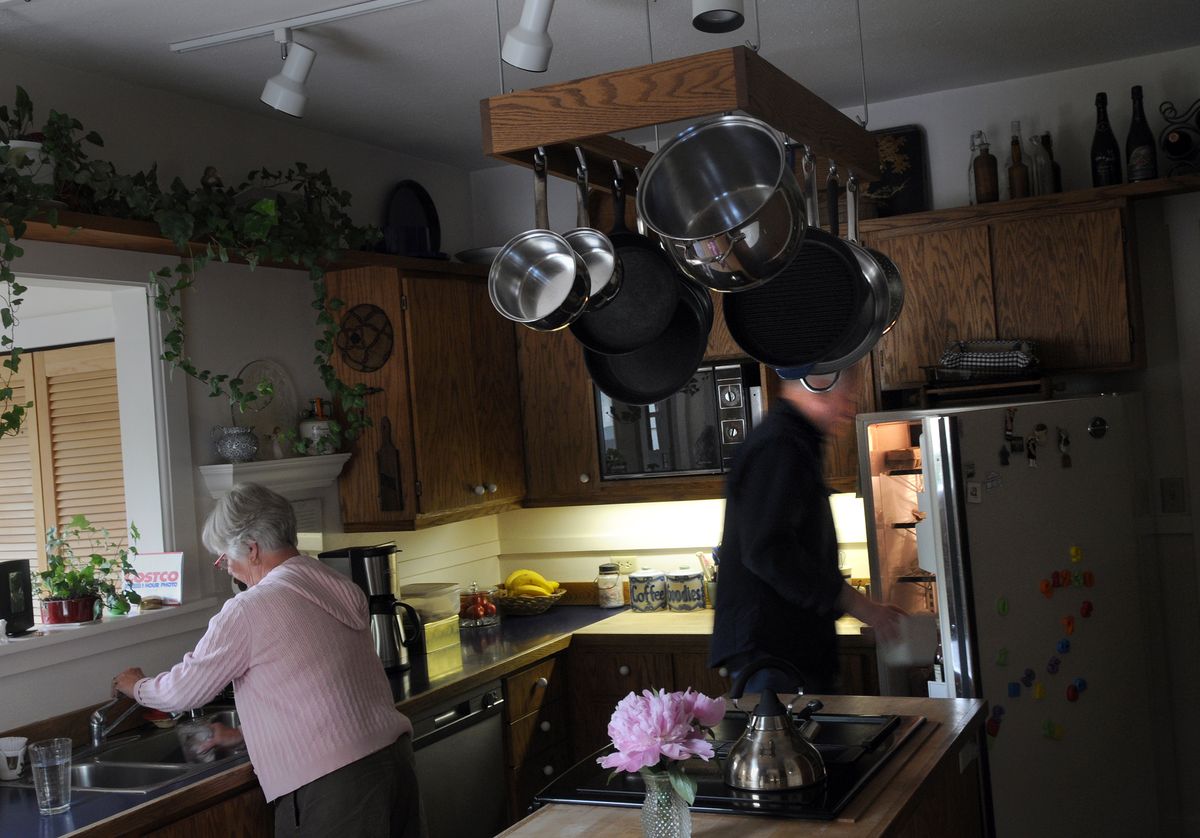
Since purchasing the home nearly 30 years ago, the Shines have done some remodeling of their own, including new kitchen cabinets and counters and the addition of a central island.
“We stripped out the wallpaper and widened a doorway,” says Molly Shine, a retired surgical nurse at Sacred Heart Hospital.
The couple also restored the home’s breakfast room, with its original Craftsman-era chandelier and window hardware. Tom Shine removed old carpet and refinished the original wood floors.
“This is where we spend most of our time,” he says of the sunny breakfast room.
The Shines’ spacious main-floor bath includes a number of original features, including a mosaic tile floor in pale peach and periwinkle blue, yellow and blue subway tiles with an inlaid flower motif on the walls, the original porcelain tub, and the original vanity mirror, now flanked with two contemporary mirrors, an addition Tom Shine attributes to raising four girls.
“We added power (in the upstairs bath) for their curling irons and hair dryers,” he adds.
Throughout the home, original Craftsman doorknobs are set unusually high, a feature that, when coupled with the 9-foot ceilings, makes the rooms feel especially large.
One room that was likely a study or receiving area near the home’s entrance may have been used as a bedroom at one time: a built-in vanity with sconces suggesting the neo-colonial style sits opposite the wide, double-door entry off the living room.
When the Shines bought the home, the exterior was painted white with bright-green trim. The Shines have since painted it a softer cream with trim in shades of forest-green and cranberry.
Ironically, the style of brickwork done on the exterior of the Shines’ home is known as a “shiner,” which means brick laid horizontally on end with the largest, broad face exposed.
“There used to be real craftsmanship in the way people did things,” he says.