
Peeking out the Steel curtain
Romance novelist peddles her 75th book

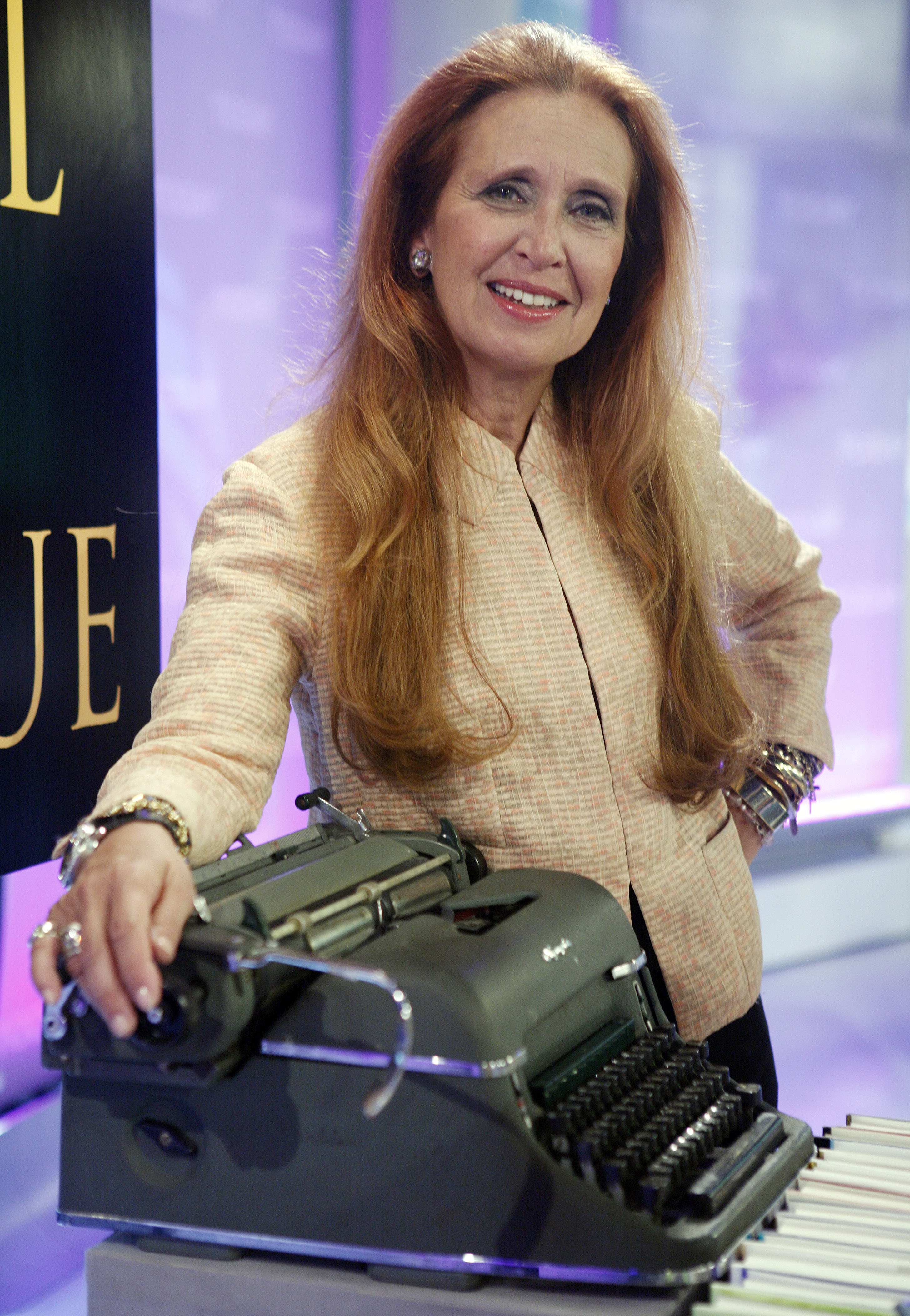
NEW YORK – It’s only 9:33 a.m., but already Danielle Steel is having a lousy morning.
She’s in a Rockefeller Plaza dressing room, having her hair tugged and her makeup tweaked. She’s endured questioning from Matt Lauer on the “Today” show and soon faces a second round with Kathie Lee Gifford and Hoda Kotb.
Crowding around are fashionably dressed publicists, agents with noisy cell phones, burly camera operators and various preening hangers-on. The plaza outside vibrates with throngs of screaming fans.
Steel hates it.
From her pained expression, it’s clear she’d rather be anywhere but here, her zone of privacy now no bigger than Al Roker himself.
“This is so not me,” she says. “I hate having the spotlight on me. I hate being the focus of attention.
“I like being the invisible observer. So this is very painful.”
Steel, who turns 61 in August, doesn’t need fame: Her name is virtually synonymous with the romance novel. She doesn’t need cash: Some 570 million of her books are in print.
What she wants is a Garbo moment: to be left alone, to write more.
So why would she agree to an interview sandwiched between TV appearances?
“Occasionally, I have to stick my nose out the door,” she says, warily. “Otherwise, people are going to think I’m 100 years old and dead.”
Any visit to a bookstore would disprove that, with an ever-lengthening list of such Steel titles as “The Wedding,” “Sisters” and “Second Chance” crowding multiple shelves. She knocks out about three books a year.
What brings her to New York and the media glare is her 75th book, “Rogue,” the tale of a sober-minded psychologist and her playboy ex-husband “whose kisses were as intoxicating as everything else about him.” When one of the two considers remarriage, their lives take a turn.
The novel, which Publishers Weekly called “a familiar formula with fresh results,” debuted at No. 4 on The New York Times list of best-sellers, No. 8 on USA Today’s list and No. 6 on The Wall Street Journal’s.
Sitting atop such lists is a familiar Steel perch. Between 1996 and 2003, Publishers Weekly reports, 16 of her novels were best-sellers. The Guinness World Records once cited her for having at least one book on the Times list for 390 consecutive weeks.
All that, strangely, doesn’t calm her. Steel may have been writing novels since she was 19, but there’s an insecurity that remains untouched, no matter the plaudits.
“I still never finish a book without being terrified I can’t write another one. I never start one without being terrified I can’t finish it,” she says. “It’s sort of a torturous process.”
While it’s hard to generalize, Steel’s books are usually populated by smart, attractive heroines juggling work, love and family.
About one in five is historical, set in, say, pre-World War II Europe or the Russian Revolution. Some tackle larger issues, such as homelessness in “Safe Harbour,” domestic violence in “Journey,” infertility in “Mixed Blessings” and even cloning in “The Klone and I.”
“I think the one recurring theme that I didn’t used to be aware of is that I try to give people hope,” Steel says. “I think that’s so important. Love is wonderful, but hope is more important. Without hope you can’t live.”
Reviewers haven’t always appreciated the effort, often recoiling from her shallower characters, brand-name dropping and the sugary aftertaste her books leave behind.
How does Steel handle critics?
“It’s very simple: I haven’t read them in years,” she says.
“My feelings get very hurt when people say mean things about me. The trouble I find is that they don’t just criticize the book – they then get nasty personally. And so I stopped reading them.”
No matter – Steel is critic-proof, a one-woman publishing phenomenon. She’s a leader of a genre that generated $1.37 billion in book sales in 2006, outselling every market category except religion/inspirational, according to the Romance Writers of America.
Her mini-empire also includes 15 children’s books, multiple adaptations for TV or DVDs, a volume of poetry and even a perfume from Elizabeth Arden. She was decorated by the French government in 2002 for her lifetime contribution to world culture.
Steel pounds out all her novels in a tiny office in her San Francisco home, where she lives half the year. (The other half is spent in Paris, where she refuses to work.)
All the books are written on a 1946 Olympia manual typewriter and first drafts are usually done in a punishing 20-hour shift while “dressed in my nighty with my hair sticking up straight.”
“Sometimes I don’t leave my house for two or three weeks,” she says.
In person, Steel is far more approachable than the woman whose regal photograph appears on her book jackets. Her chestnut hair flows freely and her jewelry sparkles in an understated way. She’s a mix of elegant and down-to-earth, a fun rich aunt who might whisk you away for expensive adventures.
Nita Taublib, senior vice president and deputy publisher at Bantam Dell, confesses she didn’t know what to expect before she started working with Steel nine years ago.
“From the second I met her, I just felt the warmth from her,” says Taublib. “She really is charming and normal and probably the opposite of everything people would expect her to be. She’s just a real human being.”
The one thing Steel isn’t warm about is questions about her own love life. She has been married and divorced five times, but visibly stiffens at queries about that.
Born in New York, she lived through her parents’ divorce and was working in public relations when she was urged by the then-editor of Ladies’ Home Journal to write a book, which became “Going Home.”
“I tried it. I thought it was a fun idea. And it sold very quickly,” Steel says.
“And then I wrote five more that nobody ever bought. They’re in my basement in a box,” she adds with a laugh.
The mother of seven children and stepmother to two more, Steel lifted her cocoon of privacy in 1999 to write “His Bright Light,” the chronicle of her son Nick Traina’s battle with manic depression and suicide in 1997 at age 19.
The loss of her son and collapse of her fourth marriage soon led to a cause she champions: ending homelessness. She says that when the bottom fell out of her world, she went to church.
“I was praying, ‘Who can I help that’s more miserable than I am?’ And I got this thing in my head, ‘Help the homeless.’
“I was like, ‘You didn’t understand. Let’s try that again. A different message, please?’ And it kept coming. So I thought, ‘OK, OK!’ ”
She traveled the streets of San Francisco and was haunted by what she saw. Steel set up an outreach team called Yo! Angel! and goes out about once a month, incognito, handing out sleeping bags, food and toiletries.
Even so, she won’t leave her typewriter for too long.
“I’m driven from inside. A story will come to mind and it has to come out, like a frog with a bubble,” she says.
“I want to work forever. And try to get better forever.”