
Lessons from a bluegrass field
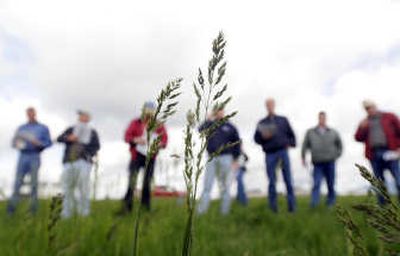

WORLEY – Kentucky bluegrass farmer Chris Ramsey’s fields are proof, at least to University of Idaho researchers, that burning grass crops leads to more seeds and a much bigger payday.
About 20 people, including farmers, seed companies and researchers, stood Tuesday among Ramsey’s 16 Kentucky bluegrass test plots off Sun Meadows Road– just north of the Coeur d’Alene Casino – and listened to test results that came as no surprise to anyone who has worked the fields or in the grass seed market.
Without the annual fire – and smoke that makes clean-air advocates angry – production decreases by about a third, test results show. The lack of burning also increases the amount of weeds, specifically tufts of ventenataand cheatgrass.
“This just isn’t a healthy field,” Ramsey said, pointing to the thin strands of feathery grass. Thick tufts of low-growing, weedy grasses have taken over, choking the more delicate bluegrass.
That’s why it’s good news for bluegrass farmers that field burning in Idaho is expected to resume this summer, likely by August. And for the first time, farmers and clean-air advocates endorse the new regulations that make public health a priority by limiting the amount of smoke on a given day, more monitoring and regulation by the state Department of Environmental Quality, rather than the state Agriculture Department.
The expansive test plots in Ramsey’s fields are part of a seven-year study by the University of Idaho, what scientist Donn Thill believes is the longest-running study of its kind to look at grass burning alternatives.
The plots were managed in various ways – from full burning to no burning – to show how to get the most seed production over the long term. The results show that farmers can make almost as much profit if they bale the grass and remove it before burning the field. But Ramsey said success depends on whether there’s a market for the straw bales, often fed to cows, to make up for the decrease in seed production.
The discovery gives farmers hope that they can still afford to grow bluegrass.
“The study has brought this to our attention,” Ramsey said. “We can change some of the practices of farmers.”
Yet Thill said there’s no question burning the fields, to spur new crop growth without reseeding, is still the best practice to produce the highest yield and most profit.
“It costs you about one-third of your yield long term to not burn bluegrass,” he said.
The results are on par with what grass farmers in Washington and Oregon have discovered, Thill said.
After touring Ramsey’s farm, the group drove across the state line to Washington to inspect test sites near Rockford where researchers are experimenting with herbicides to rid fields of cheatgrass.
Bluegrass field burning has been outlawed in Washington since the late 1990s. In Oregon, field burning has been curtailed and is strictly regulated by the state Department of Agriculture.
Last year was the first year that there was no bluegrass field burning in Idaho, except on tribal lands such as Ramsey’s. In January 2007, a federal court overturned the state’s regulatory system as a violation of the federal Clean Air Act. Sovereign Indian reservations weren’t affected by the federal court decision.
The same clean air advocate group that filed the lawsuit – Safe Air For Everyone, an organization started by Sandpoint-area physicians concerned about the effect of field smoke on their respiratory patients – believes the UI study is skewed in favor of burning. The lawsuit blamed at least two deaths in the past six years on smoke from field burning.
“They always continue to still try to use fire as a primary tool for grass management,” said Patti Gora, executive director of SAFE. “That’s how the experiment is designed. I’m a little disappointed to see there haven’t been better results in the state of Idaho in terms of looking at alternatives.”
Gora also doesn’t believe the “bale and burn” method is much better than straight burning. Despite the fact that the majority of residue is removed so less black smoke is produced when the fields are burned, Gora alleges that the remaining smoke is actually more toxic because the fire doesn’t burn as hot.
Even though the farmers and clean air advocates will likely continue to clash on the need for burning, this is perhaps the first year they will agree on how Idaho should regulate field burning outside reservations.
The U.S. Environmental Protection Agency, which proposes approving the new state regulation plan, just closed the public comment period. The plan is expected to get approval by July.
Under the proposed rule changes, the DEQ must give advance approval for any field burning. Before it does so, it must consider the existing air quality in the area, the expected emissions from the proposed burn, the proximity of the proposed burn to other burns and the proximity to sensitive populations, such as hospitals and schools or areas like public roadways or airports. The DEQ must notify the public in advance about the date of the burn, location, acreage and crop type.
Under the previous system, which the federal court overturned, burn locations were kept secret.