
Musical marvel
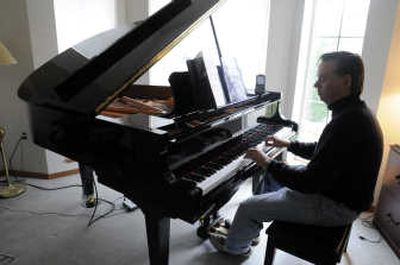

Most people wouldn’t spend $44,000 on a new car or truck. But Spokane’s Ron McIntire had no trouble spending that money on a new Yamaha Disklavier Mark IV piano.
The 42-year-old Spokane resident, who runs the online real estate site Spokanebyowner.com, bought the instrument about 10 weeks ago and says he hasn’t had a moment’s regret.
Not just another grand piano, the Mark IV has been called the world’s first truly Web-enabled full-size piano.
The Web feature makes the Disklavier a player piano with a nearly unlimited list of songs. For $20 a month McIntire and his family enjoy hours of music streamed to his piano from the Yamaha online music service — a piano aficionado’s version of iTunes.
A first look shows that the Disklavier is, in fact, a full concert grand piano made with high-quality woods, metals and alloys. But inside lurks the humming heart of a 21st-century control center.
On the left underside of the key row sits a thin black box, the 80-gigabyte hard drive that can hold thousands of songs in the piano’s playback library.
It comes with a remote to manage the music menu or select playback mode.
McIntire, who studied piano at Seattle Pacific University, enjoys using the piano’s quiet mode at times; with that setting he can play any piece normally but he’ll only hear the strings at reduced volume.
“That’s one way I can play and not wake up our dog or my son, who might be sleeping upstairs,” said McIntire.
“I’m a happy customer. I’ve been wanting a Mark IV for some time.”
Martin “Sonny” Wittkopp, owner of Spokane’s Music City, said the Mark IV Disklavier (pronounced disk-laveer) is nothing less than the Rolls-Royce of player pianos.
When Yamaha introduced the first version of the Disklavier in the 1980s, Music City became the area’s exclusive dealer for the product. At first, Wittkopp said he feared the area’s conservative shopping habits would discourage sales.
In the past several years Music City has enjoyed a spurt in the number of Disklaviers sold in Eastern Washington and North Idaho. Wittkopp said those sales are a barometer of an improving economy and changing demographics.
“That change is seen dramatically in the North Idaho area,” Wittkopp said, adding there’s been a surge in interest among lake homeowners for the high-priced Mark IV.
Music City has one of the Disklaviers in its Monroe Street showroom. But Wittkopp said the best sales method is to take the instrument out to a house or a business lobby and set it up. “Once you set it up outside the store, it sells itself,” he said.
Among the businesses buying a Mark IV are the Coeur d’Alene Resort, the Black Rock Lodge and the Lillian Wilkins home design firm.
At that end of the spectrum, the Disklavier becomes the ultimate music jukebox. Owners typically program the piano to play several hours of music, selecting from the online Yamaha store or using the machine’s hard drive.
Other owners see the instrument as a practical teaching tool. One Pullman family bought a Disklavier so their daughter can record her pieces on the Yamaha, then listen to it play back the work note for note.
Because Yamaha’s internal technology includes a laser-modulated panel that tracks the exact strike of hammers and foot-pedal pushes, any recorded work will sound exactly the same on playback, said Darrin Wittkopp, Music City’s general manager, and Martin’s son.
The piano controls let you speed up or slow down the playback. It’s also capable of adding virtual “voices” to a work you’re playing and recording. As you sing along into a microphone cabled to the piano, it analyzes the keys you’re playing and provides the vocal accompaniment.
McIntire said he likes to learn a piece by first playing the left-hand part and having the Disklavier record that part. Then he’ll play along with the left hand, adding and working with the right hand.
Some students and teachers also connect a video recorder to the Disklavier and record a student performance. The Disklavier replays the piece accurately and exactly.
The Web software that comes with the latest versions of the Mark IV allows for performers to play music on a Disklavier in some other state, and have that same piece of music performed, almost ghostlike, in real-time on the Disklavier one’s listening to.
Because the instrument is also a digital piano, any other musical parts in a piece being played through the Disklavier — drums, brass, woodwinds, guitar, for instance — all come out sounding distinct and clear.
One thing the Disklavier doesn’t do yet is create piano accompaniment to something sung into a microphone. But according to Darrin Wittkopp, don’t be surprised to see that feature come along in a year or two.
Piano prices
Mark IV Disklavier: $44,000 (suggested retail price)
Grand piano: $21,000 (good quality, new)
Upright piano: $6,000 (good quality, new)
Digital piano: $1,600-$20,000 (new)