
St. Helens elk waste away
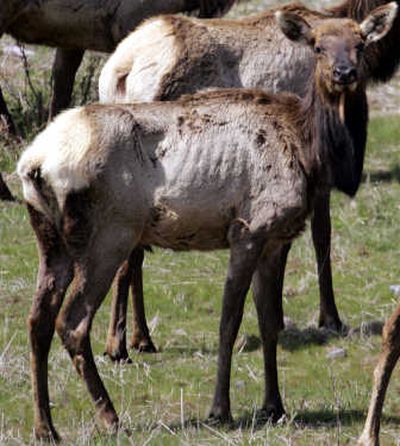

Harsh winter conditions took a heavy toll on elk in the Mount St. Helens Wildlife Area in recent months, even though wildlife managers trucked in tons of hay to feed them.
In a preliminary survey, Washington Department of Fish and Wildlife biologists and two-dozen volunteers counted about 150 elk that had succumbed after months of driving rain, cold temperatures and heavy snowfall that extended into April.
Those conditions were a major factor in this year’s elk-mortality survey, which documented the highest number of “winter-kill” elk on record in the state wildlife area, said Brian Calkins, department wildlife area manager. The previous record was noted in 1999, when survey teams counted 79 elk that died of malnutrition and related causes.
“Winter weather always takes a toll on elk and other wildlife, but conditions were especially tough in the south Cascades this year,” Calkins said. “Even now, there’s twice as much measurable snow in the watershed as in an average year.”
The survey area, which includes a portion of the volcanic mudflow in the 2,773-acre wildlife area, serves as an index of elk losses for the Mount St. Helens elk herd, Calkins said. Dead elk reported elsewhere in the herd’s five-county range that are not reflected in the survey results, he said.
In January, concerned about heavy snowfall and predictions of a hard winter, wildlife managers began feeding St. Helens-area elk for the second straight year. By mid-April, they had distributed approximately 131 tons of hay to up to 800 elk that congregated daily in the area.
“Artificial feeding may have helped some elk through the winter, but it’s not without its drawbacks,” said Sandra Jonker, regional wildlife manager in Vancouver. “The main problem is that it tends to further concentrate these animals, which can spread disease and disrupt natural behavior.”
In an effort to bring the elk population in line with range conditions that are declining as the Mount St. Helens area recovers from the 1980 eruption, elk-hunting opportunities have been expanded throughout the region starting last year.
The plan calls for habitat restoration and reducing the size of the Mount St. Helens elk herd – the largest of the state’s 10 elk herds – from about 12,500 animals to 10,000 over a five-year period, Jonker said.