
Stage presence
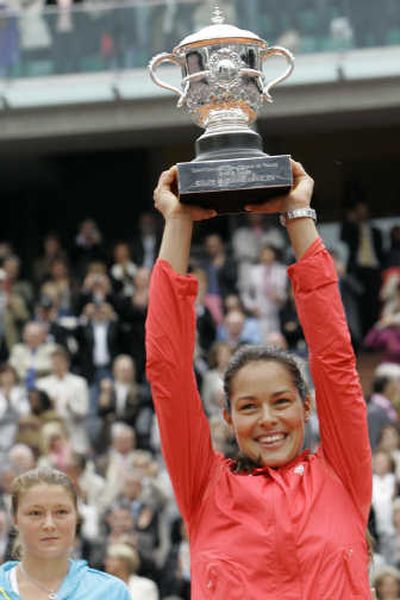
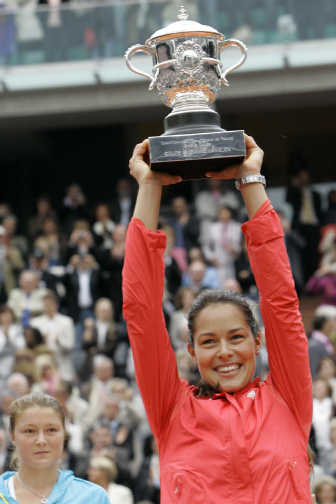
PARIS – At last, Ana Ivanovic overcame her stage fright.
In two previous major finals, Ivanovic was so overwhelmed by the setting, so shaken by the stakes, that her focus fell apart and her shots went awry.
Not on this day.
Already assured of rising to No. 1 in the rankings for the first time, Ivanovic collected Grand Slam title No. 1 by beating Dinara Safina 6-4, 6-3 in the French Open final Saturday.
Rather than erasing the memories of those lopsided losses in championship matches against Justine Henin at Roland Garros a year ago and against Maria Sharapova at the Australian Open in January, Ivanovic used the bitterness to help her.
“Many, many people ask me, ‘Oh, you want to forget last year’s final?’ But I don’t, because it was a great learning experience,” said Ivanovic, a 20-year-old from Serbia.
She won only three games against Henin, then eight against Sharapova, and said of the latter defeat: “I had a few sleepless nights after that.”
But in the months since, Ivanovic realized this: Part of her difficulty in those matches rested with either looking ahead – “Hey, maybe I can actually win this thing,” she was thinking against Henin – or looking behind – failing to put a few key points out of her mind against Sharapova.
Ivanovic lost two consecutive matches on clay before coming to Paris, and she knew she had to change something. She credits her strength and conditioning coach, Scott Byrnes, with helping find what she called a “tool” to make sure she stays focused on the court.
It couldn’t be simpler: Take the time to pause and breathe.
“My personality is I tend too much to think about what will be, and try to think too much in advance, which is definitely not too good,” Ivanovic said. “So I found that breathing helps me to go back in a moment and just enjoy that very moment.”
That’s what carried her through the tightest of times against the 13th-seeded Safina, the younger sister of two-time major champion Marat Safin.
Ivanovic was a point from taking a 5-1 lead in the first set when Safina showed some spark, using a running forehand winner and a swinging volley winner to get to break point. Ivanovic then dumped a forehand into the net, and 10 minutes later, when Safina smacked a backhand winner down the line, suddenly the score was 4-all.
“It was tough, because a lot of emotions build up inside,” said Ivanovic, who was seeded No. 2 behind Sharapova at the French Open but will pass her in Monday’s rankings. “All of a sudden, you’re equal again. So to keep my composure at that point – it was huge for me.”
In the next game, Ivanovic broke back with a backhand winner of her own, then pumped her fist and let out one of her many yelps of “Hajde!” (sounds like “HIGH-deh!”) – Serbian for “Come on!”
Safina was trying to become the first woman to win a major title after having saved a match point against two opponents. Against both Sharapova in the fourth round, and No. 7 Elena Dementieva in the quarterfinals, Safina trailed by a set and 5-2 in the second set, then was a point from losing at 5-3, before coming all the way back to complete the upsets.
Those were part of a 12-match winning streak Safina carried into Saturday, including six victories over top-10 opponents.
“This time? I tried,” Safina said, “but I didn’t have any more of that fire.”
In the men’s final today, top-ranked Roger Federer will meet No. 2 Rafael Nadal in their third consecutive title match at Roland Garros.
Nadal seeks a fourth French Open championship, and Federer is hoping to complete a career Grand Slam.