
Hewitt speaks out
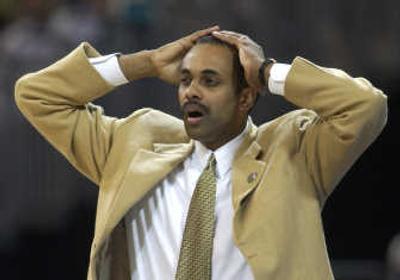

WASHINGTON – Georgia Tech basketball coach Paul Hewitt turned a tedious discussion of numbers into something lively.
Amid questions and answers about grade-point averages, graduation rates, surveys and APRs on Tuesday morning during a routine Knight Commission meeting, Hewitt turned on his microphone and chided the reform-minded panel for making “incomplete conclusions” and taking “a fly-over view of the supposed carnage that is college basketball.”
“While I like to see everyone who reaches college earn a degree,” Hewitt said, “we need to find more effective ways to achieve our goals.”
Hewitt spoke during a discussion meant to highlight the progress of the NCAA’s new rating system that penalizes teams for failing to meet academic standards. The latest APR – or Academic Progress Report – led to 218 teams from 123 schools receiving some sort of penalty when it was released last month. APR scores have been on the rise since the standard was introduced four years ago, heartening news for the independent Knight Commission, which has pushed for academic reform in athletics for nearly 20 years. Hewitt doesn’t mind the APR per se, but he sees it as only part of the solution.
“I do have a problem with putting numbers out there, saying ‘Meet these numbers or else,’ ” Hewitt said. “You’re turning education into a race.”
A race, he contended, that might be tempting coaches to deter athletes from taking more difficult courses that could lead to lower grades and loss of eligibility. He said that topic was discussed among Atlantic Coast Conference coaches after the APR was first implemented.
“If a kid wants to major in engineering, I’m not going to tell him not to major in engineering – but I’m going to counsel him before he takes that first class,” Hewitt said.
Hewitt, a member of the NCAA Men’s Basketball Academic Enhancement Working Group, offered a range of ideas. He said he’d like to see basketball become a one-semester sport and that coaches overall would like to see a shorter schedule.
Hewitt took shots at the NBA players’ union, saying the near free reign that agents have on campus has turned the sport into the “wild, wild west.” He noted that the NFL players’ union is more proactive about disciplining agents who misbehave. Hewitt would like to see coaches granted more access to players during the summer months to counter the influence of the agents.
Hewitt then pulled out his set of statistics, based on federal graduation rates and supplied by the NCAA. His chart noted that white male basketball and football players – despite scholarships and access to tutors and other perks received as athletes – have a graduation rate lower than that of the white male general student body. Conversely, black football and basketball players and women’s basketball players graduate at a pace ahead of the general student body for their respective groups.
Hewitt said those numbers – particularly regarding blacks – were a result of successful mentoring programs for athletes, programs that should be encouraged at more schools.
“I’m getting tired of coaches getting beat up,” Hewitt said, “when I think we are doing a very responsible job.”
Hewitt’s also not a fan of the “one-and-done” rule that forces NBA aspirants to attend at least one year of college before becoming draft eligible. Hewitt likes the baseball model: High school students can declare for the draft, but they must stay in school for three years if they go the college route.
That prompted a spirited exchange with Knight Commission member and ESPN analyst Len Elmore, who would like to see no basketball player become draft eligible until three years of college. Elmore later said LeBron James’ lack of college experience explains why the Cleveland star has “no midrange game.”