
Preparing for the market roller coaster
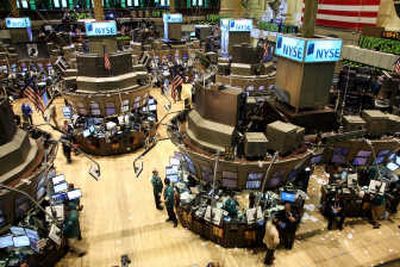
What can anyone make of this crazy stock market?
Volatility has dropped a bit from earlier this year, but prices continue to bounce around plenty as investors adjust to a steady flow of mostly unsettling economic news. Some recent observations on stocks and related topics:
•If history offers clues, investors shouldn’t expect much from the market near term.
Summer and early fall are traditionally a weak stretch. Since 1945, stocks in the Standard & Poor’s 500 index gained 7.1 percent on average from November through April but only 1.6 percent from May through October, noted Sam Stovall, chief investment strategist at Standard & Poor’s Corp.
About one-fifth of the time, stocks actually lost ground.
It gets worse when you factor in a weak January, as we had this year. “When the S&P 500 fell in January, which happened 22 times since 1945, it posted an average decline of 2.1 percent in the subsequent May through October period, versus the average 1.6 percent advance for all May-October (periods) over the past 62 years,” said Stovall, who thinks a recession might still be coming.
•Plenty of investors have fled stocks for money-market mutual funds, only to be greeted by low yields.
Money funds have avoided the price declines that have hampered short-term bond funds lately, says the Money Fund Intelligence newsletter from Crane Data. They’ve also gained ground at the expense of banks and offer a safe haven for rattled equity investors.
In fact, money funds are as popular as ever, with assets recently topping $3.5 trillion for the first time, according to the Investment Company Institute. That’s almost double their $1.9 trillion level of 2004.
•What goes up comes back down, then goes back up again.
In investing circles, that describes the concept of “reversion to the mean,” the idea that stock-market returns will tend to cluster around a long-term, upwardly sloping trendline. It’s also the basis of a new book by John K. Harris, a retired accounting professor and self-described “numbers guy.”
Harris wrote “The Wall Street Traffic Light” in response to a friend’s question about when to sell stocks. He calls reversion to the mean a “powerful magnet” that tends to lift market returns after slumps and cool results after big rallies.
He claims his system has correctly predicted market movements about four years out of five. It also has tended to keep investors in the market about 80 percent of the time. Notably, it’s flashing a “green” or bullish signal for 2008.
•What goes up … part 2.
Fidelity Investments is urging investors not to flee the stock market in panic, and the mutual-fund giant has pulled out some interesting statistics to underscore its point.
Fidelity notes that the S&P 500, on 10 separate occasions since 1950, has dropped more than 13 percent over three consecutive calendar months. But in eight of those 10 instances, the market rebounded by at least 20 percent over the following year. Following seven of the 10 sell-offs, the subsequent rally was large enough to recover all the prior decline.
•If you work with a financial adviser, you probably have an exchange-traded fund in your portfolio – or will soon.
Most advisers in a new survey said ETFs have changed the way they invest for clients, and most called ETFs the most innovative investment vehicle of the past two decades. Only 4 percent of respondents said they don’t use ETFs for clients.
The poll was sponsored by the Wharton School at the University of Pennsylvania and State Street Global Advisors, which offers an ETF family.
ETFs, like mutual funds, are diversified portfolios of stocks, bonds or other assets. But they trade at different prices through the day, like regular stocks. Advisers like the low costs of ETFs, along with their tax efficiency, relatively pure investment approaches and intraday-trading ability.