
Newman Lake boosts fire/rescue systems
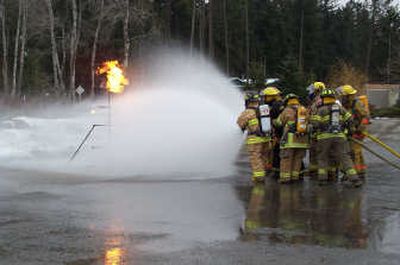
Newman Lake Fire and Rescue is getting a leg up on Spokane County’s plans for a new digital emergency communications network.
The small volunteer force is getting five handheld and two vehicle-mounted radios that will allow it to tap into the new network Kootenai County is building.
Officials believe the radios also will be compatible with the system Spokane County plans to build with a sales tax voters approved in May.
“It’s precisely the same thing,” said Newman Lake Fire Commissioner Bob Neu. “We’re getting a little bit of a head start on it.”
This fall, if construction goes as planned, Newman Lake firefighters will be able to use their new radios when they work and train with Idaho firefighters.
Down the road, officials hope emergency workers throughout both counties will be able to talk as though they were in the same department.
As Kootenai County 911 Director Brad Coughenour put it, “Even though Boise is my capital and Olympia is your capital, who are we going to talk to first about mutual aid?”
Newman Lake Fire and Rescue, also known as Spokane County Fire District 13, already works closely with the Hauser Lake Fire Protection District on the other side of the state line.
Hauser Chief Larry Simms said the districts and Washington Department of Natural Resources fire crews share a “pretty significant urban interface” between the lakes.
“We work well together,” Simms said.
The districts train together and sometimes integrate their crews in incidents on both sides of the state line, Simms said.
So, he said, it made sense to invite Newman Lake to piggyback when his district applied for a federal grant 1 1/2 years ago to buy new digital radios.
The deal allows Newman Lake to acquire some $20,000 worth of radios for 20 cents on the dollar, or about $4,000.
“This gives them enough to be effective when we have a fire along the state line, which happens at least a couple of times a year and sometimes more often,” Simms said.
As the area continues to develop, Simms foresees a closer working relationship with the Spokane Valley Fire Department and perhaps even the Spokane Fire Department.
Coughenour envisions a closer relationship between Kootenai and Spokane counties, too, as they build their new digital radio networks. He hopes to save money by sharing some transmission towers and microwave relays.
Some possibilities include Mica Peak (also known as Signal Point) and Blossom Mountain – both south of Post Falls in Kootenai County – and Mount Spokane in Spokane County.
Kootenai County already has an arrangement with Bonner County, Idaho, to share a tower on Hoodoo Mountain in Bonner County, north of Spirit Lake.
Spokane County officials “absolutely” want a system that meshes with Kootenai County’s and shares equipment to save money or improve service, Spokane County Commissioner Todd Mielke said.
“We are looking at using the same technology,” Mielke said.
A 10-year, 0.1 percent sale tax increase will raise money for Spokane County’s system, which is expected to cost $41 million to $44 million.
That’s a “fantastic” solution that “will serve their public well,” Simms said.
But a voter-approved sales tax is not an option in Kootenai County.
“Most of it is going to come out of dollars we don’t have and needed grant dollars,” Coughenour said. “The good news is we are getting some grants, and the costs are coming down.”
He said a system that was estimated to cost $14 million to $17 million a couple of years ago now is expected to cost $10 million to $12 million because of increased competition among manufacturers.
Even so, Coughenour said Kootenai County emergency organizations have raised only $4.5 million to $5 million.
They’re taking a piecemeal approach in which the Hauser Lake fire district was in charge of securing an 80 percent federal grant for fire department radios throughout the county.
The grant, awarded in December, will provide about 100 vehicle radios, 174 handheld radios and five base radios for fire stations. All but three fire departments in Kootenai will share in the deal, which will provide about $834,000 worth of equipment for $167,000.
Simms said officials hope to order the radios this summer and begin using them on a limited basis this fall. He said organizations probably will need to keep their old analog radios until the “transitional migration” is finished in a half-dozen years or so.
“At least, that’s my estimate, and that’s simply because of the funding issues,” Simms said.
Coughenour said a digital tower on Blossom Mountain is already in operation, and he hopes to add three others this fall – on Mica Peak and Hoodoo Mountain, and on Canfield Mountain, just east of Coeur d’Alene.
A “gateway” device to link the system with other county and tribal networks also will allow Kootenai County to connect old analog radios with new digital towers before the system is complete.
Mielke estimated that Spokane County’s new system will go online for testing in 3 1/2 years.
He said the voter-approved sales tax will provide vehicle and handheld radios for first-line emergency responders, but not secondary users such as utility crews or park workers.
Kootenai County law enforcement agencies are still seeking grants for their new radios, and the county’s 911 communications center is in charge of coming up with money for transmission towers and other backbone equipment.
Coughenour said a 911 telephone tax will cover some of his infrastructure costs, but he can’t afford a “master site switch” to connect transmission towers and individual radios. An entry-level, expandable switch costs about $1 million.
Law enforcement groups were turned down in 2007 for a grant to buy a switch. Coughenour said federal officials thought Kootenai County didn’t need a switch because it was “co-located” with Boise, which already had one.
As it turned out, local officials did find a way to use equipment in Boise by tapping into the state’s radio “backbone.” Local conversations will be routed through Boise, causing momentary delays.
“For the most part, you won’t even be able to tell that there’s a delay unless you’re standing there looking at each other face to face,” Coughenour said.
“As long as the state doesn’t change any type of funding or anything else, with what I’ve got, I think we’ll get there,” Coughenour said. “But it may take a little bit longer.”