
Vertical thrills
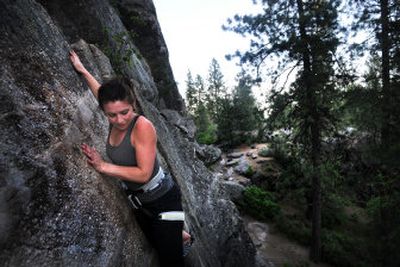
In nature, there are those who look at a tableau and marvel at its beauty, and those who take in the view and say to themselves “I could climb that.”
It’s what leads youngsters to climb trees. Later in life, it’s what leads people to climb mountains.
Climbing areas are one of Spokane’s richest assets. Check in at any of the shops catering to climbers and you will find entire books on area climbs.
Challenging climbs are so abundant that one literally never has to leave the city, as anyone who has ever traveled Upriver Drive on a sunny summer day can attest.
To the average passers-by, it’s called Spokane County’s John H. Shields Park and it sits next to the road opposite Upriver Dam. To rock climbers, it’s Minnehaha – Minne, like the skirt, for short.
If you climb, you know Minne.
“I think just about everyone in here has climbed there numerous times,” Mountain Gear’s Chad Bradley said. “If you have questions, anyone here can answer them.”
The guidebook Inland Northwest Climbs by Marty Bland lists 71 climbing routes at Minnehaha – many with colorful names like Crystal Rock, Barndoor Rock, Finger Ripper Rock, Sentry Box, Morning Cooler, Calcium-Fortified Rock and Cornflake Rock.
In rock-climbing shorthand, Minnehaha climbs are rated between 4.9 and 5.14 for difficulty.
“A steep hiking trail would be rated in the 3.0 range,” Bradley explained. “A tough climb where you need to use your hands would be 4.0. When you’re in the 5.0 range, you’re talking about a vertical ascent.”
Bland puts it this way: “The majority of the routes are vertical to slabby, allowing one to observe exactly how small a feature those sticky boots can glom onto. The harder routes are done as Rites of Passage.”
The Minnehaha area offers all three, making it a popular area for hikers and mountain bikers, as well as climbers.
For hiking and biking, the area requires no special instruction aside from, perhaps, a warning about the way sounds echo during gun range practice at the Spokane Police Academy directly across the Spokane River.
For climbers, it is advised to take at least an introductory climbing class before attacking a craggy chunk of the Selkirk granite that makes up the rocky climbing faces.
“All of the climbs at Minne are top-rope climbs,” Wild Walls climbing instructor Miller Peller said. “It’s not a difficult technique to learn, but it’s one of those things that you really want to have down before you go climbing.”
Bradley agreed.
“It’s a simple technique where you anchor a rope on top of the face and you have someone pull up the slack in the climbing rope as you ascend,” he said. “That way if you fall, you don’t fall all that far. It’s one of those things where you don’t want to make a mistake the first time you try it.”
Mountain Gear, on North Division, offers Tuesday evening climbing classes in-store. Wild Walls, the climbing gym at 202 W. Second Ave., not only offers climbing classes but several summer climbing camps.
“Climbing indoors and outdoors are two different things, obviously,” Peller said. “But the techniques you need are the same for either one.”
Rock climbing is more affordable than most outdoor sports, Peller said.
“It’s not at all like snowboarding or skiing, where you have a lot of up-front expenses,” Peller said. “When it comes to climbing gear, I’d say you could easily get started for about $150. You need a good harness, you need a climbing rope and you need climbing shoes.”
Climbing shoes are designed for a skin-tight fit and feature a textured, sticky sole that allows climbers to find footholds in small areas.
There is an added benefit to tackling the rocky crags at Minnehaha, Dishman Hills, Tum Tum or Post Falls – all of which are included in various climbing guidebooks. As a climbers progress they follow in the handholds of some of the world’s finest climbers.