
Early Plains Indian culture
“The buffalo was part of us, his flesh and blood being absorbed by us until it became our flesh and blood. Our clothing, our tipis, everything we needed for life came from the buffalo’s body. It was hard to say where the animal ended and the man began.” –John Lame Deer (Sioux) 1972
Imagine yourself as a teenager. Don’t dwell on this image too long.
Your tribe has selected you to be a very important person. You will help determine if your people will starve or flourish during the next seasons through cunning, intelligence and athletic speed. You will direct and lead a herd of bison over a cliff to their deaths. This is an essential and critical mission for someone so young. Learn all about it at First People Buffalo Jump State Park near Great Falls.
There are hundreds of buffalo jumps throughout the Western United States, but the jump near Great Falls is said to be unique.
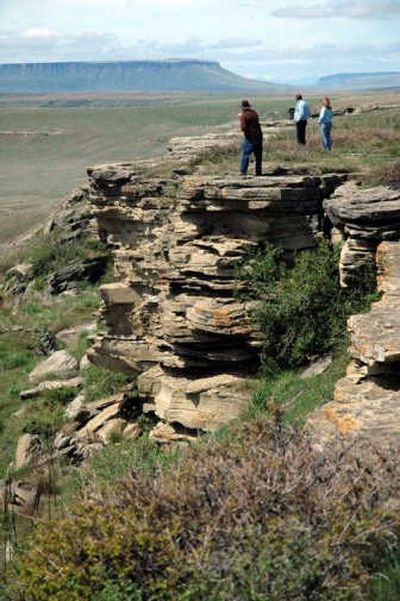
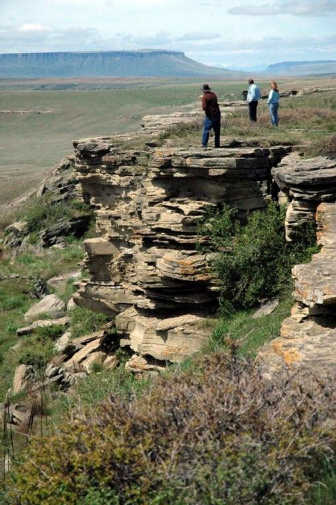
It has been used for possibly thousands of years. The cliff extends for almost two miles, and various portions of the cliff were used. There is evidence of buried buffalo bones piled 13 feet deep, indicating that the jump was used many times over a long period of time.
Usually, an archeologist pulls the artifacts and data together then develops a theory on how a site was used by the Indians. When it comes to buffalo jumps, there is a record of how the jump worked written by a white man. None other than Meriwether Lewis wrote in his journal On May 29, 1805: “… one of the most active and fleet young man is selected and disguised in a robe of buffalo skin … he places himself at a distance between a herd of buffalo and a precipice proper for the purpose; the other Indians now surround the herd on the back and flanks and a signal agreed on all show themselves at the same time moving forward towards the buffalo: The disguised Indian or decoy has taken care to place himself sufficiently near the buffalo to be noticed by them when they take to flight and running before them they follow him in full speed to the precipice; the Indian (decoy) in the meantime has taken care to secure himself in some cranny in the cliff … the part of the decoy I am informed is extremely dangerous …”
If you have an interest in early Indian life and culture, this Montana State Park can provide a slice of how the Plains Indians survived.
Actually, the young Indian was just a part of a well-designed, organized plan to kill buffalo that involved the entire tribe. Starting with the religious ceremonies and dances to assure a successful hunt and ending with butchering and preserving the animals, everyone was involved and needed.
The entire story is elaborate, and is described well near the base of the cliffs at the visitor center. These “savages,” as some of the early settlers called them, were very adept at killing many large two-ton animals that they depended on for food and clothing. They found a way with the use of drive lanes to run the animals over the cliffs to kill these animals with arrows and clubs. Later, of course, horses and rifles arrived, and made the jumps obsolete.
Today there are clues of the past history. On top, behind the 50-foot drop are scattered rock piles all lying in rows that were used to help direct the herd toward the edge. One hundred feet back from the cliff the land slopes so that the buffalo can’t see the cliff edge. Large circles of rocks on the outside of the drive line rocks suggest tipi rings. The rocks were used to hold down the bottom of the tipis.
Below the cliff on a nature trail starting at the visitor center are more tipi rings. Small circular fire rings are sites where the Indian women cooked the bison blood and bone marrow. Fragments of bones are at the base of the cliff where the women cracked bones to extract the rich bone marrow. Obsidian used for numerous arrow heads have been found here where the buffalo were killed.
Inside the visitor center displays will explain the 300 ways that First Peoples used the entire buffalo. For example, a horn (which is hollow) was packed with fire embers when the tribe moved to another camp. It was their way of carrying fire with them. Even the buffalo’s tail was used. It was hung on top of tipi poles to help repel flying insect pests.
The story of the jump which centers on the buffalo is a powerful reminder of how essential this animal was to the Indians. For all practical purposes, the elimination of the buffalo was the end of their traditional way of life. At this place you can find out about the historic American Indian at a location where they lived and survived on the land and the animals they depended on. This is an interesting, poignant experience that may change your view of how these primitive but sophisticated people made ends meet.
Teenagers could provide an important and essential role in the life of the tribe. Maybe there is a lesson here for us that is centuries old. Standing on the cliffs overlooking the prairie and tipis below, your imagination just might allow you to hear the buffalo charging down the hill behind you. Here is a historic view that you can almost feel. Looking for a ledge where someone who was agile could escape while the animals stampeded over them is part of looking over the edge of the cliff in this park. First Peoples Buffalo Jump, a state park with a story about yesterday, today and tomorrow.