
Heat of a different kind
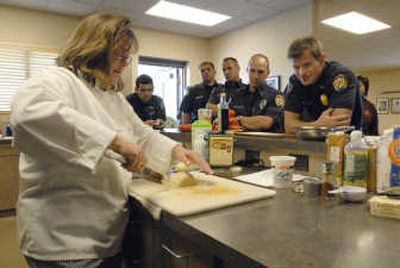

Healthy eating isn’t easy when you’re looking out for everyone else.
Even during firefighters’ annual Safety, Health and Survival Week, it’s easy to view a balanced diet as something for other people.
In a place where the stove shuts off automatically every time a radio squawks, cooking needs to be quick.
So Spokane Valley firefighters observed the nationwide safety event this week with lessons on what might be called the “interruptible meal.”
Their department, which had already provided classroom instruction on nutrition, hired the nonprofit Northwest Health and Wellness Institute in Spokane to arrange a package of hands-on cooking sessions.
Under the guidance of three professionals, firefighters prepared breakfasts, lunches and dinners designed to showcase healthy food.
Thirteen firefighters from four stations gathered Wednesday afternoon at Fire Station 8 on North Wilbur Road to train with kitchen knives instead of pike poles.
First, registered dietician and chef Naomi Kakiuchi of Seattle’s NuCulinary cooking school offered a brief refresher in Fruits and Vegetables 101.
That “apple a day” saying may sound trite, but “it’s amazing” how much fiber an apple has and how much it can lower cholesterol, Kakiuchi said.
On top of that, fruits and vegetables “make your plate look pretty.”
Searing, poaching and grazing are great ways to seal in flavor and avoid calories that frying and other cooking methods can introduce, she said.
Shop the perimeters of grocery stories, Kakiuchi advised. “Down the aisles are the processed things.”
But don’t grab the milk too soon. An hour without refrigeration can cut shelf life by a day or two.
The secret to good fish is to get it fresh and not overcook it, Kakiuchi said. It doesn’t need to have been caught yesterday: Fresh means never frozen.
Choke up on a chef knife for better control and to avoid carpal tunnel injuries. Avoid slicing and dicing injuries by cutting the side off an onion to make it flat.
“It’s really important to have good knives, and it’s important to have them sharp,” Kakiuchi said while skinning a halibut as though lifting a sheet of paper. She suggested a $125 Cutco chef knife or a $40 Kershaw model.
That was bad news for Station 7, where Capt. Sean Barrett said the knives “could use some upkeep.”
A survey on eating habits also revealed some shortcomings.
“I was embarrassed filling out the survey,” Station 2 Capt. Kevin Uphus said. “I’m a meat and potatoes kind of guy.”
He thought he would be inclined to eat more fruits in the future, although not necessarily those prepared by Station 4 engineer Bryan Bucher.
Uphus was working on the grilled strawberries when he and four others were called to help a 51-year-old man who was having chest pains. Bucher took over the strawberries.
When Uphus returned, he found Bucher had sprinkled powdered sugar on only one side of the strawberries and failed to turn them on the barbecue grill.
“Man, what’s the deal here, Bryan?” Uphus demanded in mock astonishment. “Lose focus without me?”
Station 2 engineer Eric Swanson called on NuCulinary chef Susan Kalin to yell at Bucher. “It’s the only way he’ll learn anything.”
Station 1 firefighter Kevin Dunne did his best to chop anchovies into such small pieces they couldn’t be detected in the roasted cauliflower with capers and bread crumbs.
“Oh, God, they stink,” he said.
No one would detect the anchovies once the 400-degree cauliflower hit them, Kalin predicted.
That seemed “dishonest” to Station 4 firefighter Kevin Hoschka, but he later acknowledged the dish “was OK.”
Before eating their creations, the firefighters had to take a quiz.
“Sauce Boy” Barrett got an A+ for his detailed description of the steps he followed, and “Sugar Man” Bucher redeemed himself with an inspired account of strawberries grilled on wooden shish kebob sticks.
“First, you take those sticks and you soak them in water,” he said. “Any of you guys know why?
“Then you put sugar on them. I like to do one side.”
Battalion Chief Ken Capaul pronounced the exercise a success.
“This gives me ideas that I can take home,” he said, confirming – as Northwest Health and Wellness Director Dori Babcock suspected – that many firefighters know more about cooking than they admit.
Many cook at home as well as at the station, Capaul said.
But they tend to “wing it” in the grocery store, he said. “We shop for bulk and get as much as we can for the money.”
The culinary classes were designed to show healthier foods that could be purchased with the same $5 that firefighters are accustomed to contributing to their communal meals, Capaul said.
But there’s not much anyone can do about the interruptions.
Just as firefighters were sitting down to their healthy meal, three of them were called away to help another person with chest pain.
Within five minutes, another medical emergency plucked four more firefighters from the table.
“This happens probably every other shift,” Capaul said. “You get called out during a meal.”
That’s why fire stations have microwaves, Bucher said.
John Craig may be contacted at johnc@spokesman.com.