
A revolutionary experience
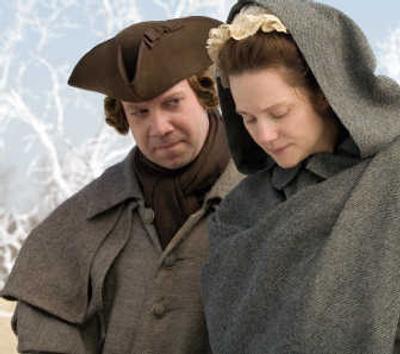
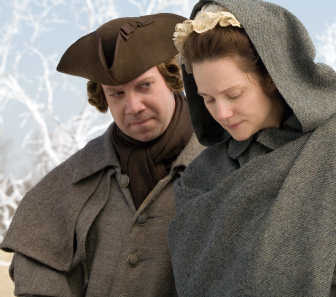
Playing America’s second president in HBO’s “John Adams” was quite the hands-on experience for Paul Giamatti.
On a break from his governmental duties at his Massachusetts farm, Adams shows his son, John Quincy, the finer points of working with manure – manually.
“He was obsessed with coming up with a better kind of manure,” Giamatti explains. “And that was real manure … of some kind.”
As unpleasant as it might have been for him, Giamatti insisted the producers keep the scene intact.
“It was eccentric,” he says, “but Adams took great pride in the fact that he was a real farmer, and it was emblematic of his being a real person.”
The seven-part miniseries premiering tonight is loaded with realistic portrayals of both the people and the period, which its creators feel will depict the American Revolution in a way not previously available to audiences.
“I think it’s as close as anything has ever been to bringing those people and that time alive in a fashion that I don’t think people will ever forget,” says historian David McCullough, on whose book about Adams the series is based.
“Anything else would have been a waste of time,” adds executive producer Tom Hanks, shaking a bag of John Adams golden dollar coins he keeps on his desk.
Everything from the Boston Massacre and the vote for independence to the Adams family’s primitive farm life, smallpox outbreaks and barbarous practices, such as tar and feathering, are portrayed with gritty accuracy.
“It was very important to all of us that it be a sensory experience,” explains Laura Linney, who plays Abigail Adams. “It was not an elegant time.”
Adds director Tom Hooper: “Anyone who thinks it was a ‘golden age’ need only look at the smallpox sequence to be reminded what a tough age it was.”
In that scene, a doctor attempts inoculation of one of Adams’ children by transplanting tissue from a writhing, boil-infested victim, whom he totes from house to house in a cart.
In another scene, a mob pours a large kettle of boiling hot tar on a British sympathizer.
“You can’t watch that scene and ever think of tar and feathering again as some sort of high school prank,” McCullough says. “That was torture. People died from it.”
Perhaps most important is the portrayal of America’s founding fathers as more than one-dimensional, schoolbook images.
“We tend to think of them as godlike characters – marble deities or folk figures,” says McCullough.
“We have stereotypes about what the Declaration of Independence was and who these men were,” Linney adds. “We know they were great men – but why were they great men?”
The most intriguing is Adams himself, who, says HBO Films President Colin Callender, was nothing short of the complicated figure Giamatti portrays.
Adams was a “rational man,” Callender notes, “and yet a man who’s impetuously impulsive and often acts without thinking.
“He’s humble, yet madly ambitious. He was a simple man who was very vain. He was a man who loved his family, yet spent half his life away from them.
“And Paul is fearless in portraying all of this, warts and all.”
As if those weren’t enough personal issues for one founding father, Giamatti adds that Adams was “neurotic and he was depressive. And he was a hypochondriac. He would have complete collapses, and it was never entirely clear what was wrong with him.”
Balancing Adams’ shortfalls were the strengths of his wife, Abigail, who suffered those long gaps away from her husband – as long as five years – forcing her to run the farm and family alone.
Despite such separation, they maintained a durable and relatively close relationship, as evidenced by their letters to each other, all of which Linney read as part of her preparations for the role.
“From the letters, you not only get the deep affection that they had for each other, but also that they were true partners,” she says. “She understood where he was and why he had to be there. But it was tough on her. She wasn’t a saint.”
Though not formally educated, Abigail was extremely intelligent – something which, though potentially threatening to other men, Adams found most appealing.
“He was ahead of his time enjoying intelligent women,” Giamatti says.
Abigail was known to be her husband’s biggest supporter and confidant in all matters, which was not lost on the likes of George Washington and Thomas Jefferson.
In one scene in the film, when asked by Abigail if he would mind delivering her letters to her husband, Washington respectfully replies: “The sooner he receives these, the sooner we’ll be beneficiaries of your wisdom.”