
Great escapes from Seattle’s wet weather
SEATTLE – Consider a cultural getaway to the Great Indoors: the Emerald City’s varied and interesting mix of museums.
Some are internationally known and others are well off the beaten track – the Center for Wooden Boats, for one – but taken together they can provide days of respite from wet winter weather.
There’s even a brand-new one: the Northwest African American Museum, which had its grand opening last weekend (2300 S. Massachusetts St., 206-267-1823, www.naamnw.org).
You can get great off-season hotel rates offered by the Seattle SuperSaver program ( www.seattlesupersaver.com).
During a couple of recent visits, I focused on nearly a dozen spots. I ran out of time to visit Paul Allen’s Experience Music Project, but did take in its 2004 addition, the Science Fiction Museum and Hall of Fame.
Museums are listed here south to north:
Museum of Flight
(9404 E. Marginal Way S., Tukwila, 206-764-5720, www.museumofflight.org)
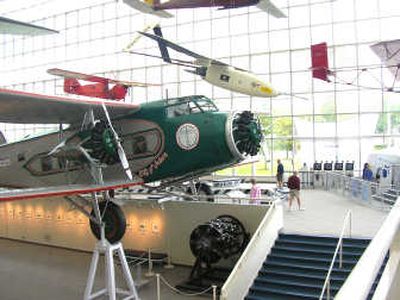
The first Air Force One, the first 747 and the last supersonic Concorde are displayed outside. But it’s the numerous exhibits inside the museum, at the south end of King County International Airport (aka Boeing Field), that will easily consume a full day.
Exhibits feature aviation during the two world wars, including the first fighter plane, which was stored for 85 years in an Italian monastery. But it’s the museum’s displays on civil aviation that are most interesting.
Of course, the museum’s main focus is telling how Seattle’s Bill Boeing started what has become the world’s largest airplane manufacturing company. The Boeing Co.’s original Red Barn, where the first planes were assembled, has been restored to tell the Boeing story.
Also look for the replica of a 1903 Wright Brothers Flyer, a Mach 3 Blackbird spy plane and three flight simulators in the six-story high Great Gallery. A new permanent exhibit on manned and robotic space flight opened last June.
Klondike Museum
(319 Second Ave. S., 206-220-4240, www.nps.gov/klse)
This unit of the National Park System tells the story of the Klondike Gold Rush, the event that catapulted Seattle toward becoming a world-class city. When the steamship Portland arrived in Seattle in 1897 bearing “a ton of gold” from the Yukon, the rush was on.
The Klondike visitor center, which interprets the Seattle side of the gold rush, recently relocated into a historic red-brick building just off Pioneer Square.
Exhibits feature touch-screen computers that let visitors experience the gold rush through the eyes of actual stampeders by using journals and personal accounts.
Frye Art Museum
(704 Terry Ave., 206-622-9250, www.fryeart.org)
This museum may have the best location of any in Seattle, just east of downtown in the prim First Hill neighborhood and a short way from eclectic Capitol Hill.
The Fryes used a fortune they made in meat packing to acquire 232 European paintings during the early part of the 20th century. Following their deaths, the Frye estate built the museum and has operated it since 1952 with free admission and free parking.
The current featured exhibit, which runs through April 6, is “Dreaming the Emerald City: The Collections of Charles and Emma Frye and Horace C. Henry.”
The exhibit features side-by-side displays of 19th century French oil paintings of cattle, one collected by the Fryes and the other by Henry, as well as side-by-side themes they collected on Venice, maidens, seascapes, harvests and more.
Seattle Art Museum
(1300 First Ave., 206-654-3100, www.seattleartmuseum.org)
When I visited Seattle’s major art museum two years ago, I left wondering why I bothered. When I returned in January, I left wondering how soon I could come back.
The downtown museum underwent an expansion last year that nearly doubled its size, giving the museum’s great collection adequate space for display.
Think big when you visit. SAM now has space to display the likes of Palouse area painter Gaylen Hansen’s colorful “Giant Grasshoppers Attacking Cars Stuck in Traffic,” and German artist Katharina Fritsch’s “Mann und Maus” polyester sculpture of a 6-foot black rodent perched on a man sleeping in bed.
SAM welcomes 2008 with two significant exhibitions: Lorenzo Ghiberti’s Gates of Paradise (so named by Michelangelo), the doors from the baptistery of the Florence cathedral, through April 6; and Roman art from the Louvre, featuring some 180 impressive pieces – many never seen before in the U.S. – through May 11.
It also operates the Olympic Sculpture Park, the year-old park at the north end of the downtown waterfront that is already one of Seattle’s favorite outdoor spaces.
Science Fiction Museum and Hall of Fame
(325 Fifth Ave. N., 877-367-7361, www.empsfm.org)
This is the place to see Captain Kirk’s chair from the “Star Trek” TV show, as well as movie costumes and props from “E.T.,” “Planet of the Apes,” “2001: A Space Odyssey” and more.
It claims to be the world’s first museum devoted to the genre. Besides paying homage to luminaries such as H.G. Wells, Gene Roddenberry, George Lucas, Steven Spielberg and Ursula K. Le Guin, the museum encourages visitors to envision what may lie ahead.
Center For Wooden Boats
(1010 Valley St., 206-382-2628, www.cwb.org)
Although not a museum in the truest sense of the word, Seattle’s beloved boathouse calls itself a “living museum.”
The center is beautifully located on the south shore of Lake Union, a few steps from a stop on Seattle’s new streetcar line, which opened in December.
The wooden boat center displays historic small wooden craft, provides a place for craftsmen to restore wooden boats, offers sailing and knot-tying lessons, rents boats and gives steamboat rides. An ongoing project is the carving of a Haida canoe from a cedar log.
Seattle Asian Art Museum
(1400 E. Prospect St., 206-654-3100, www.seattleartmuseum.org/ visit/visitSAAM.asp)
This is the main repository for the city’s love affair with art from the opposite side of the Pacific, housed in Volunteer Park in the original 1933 Seattle Art Museum building.
The museum features an extensive collection of Buddhist art, including an 11-headed and thousand-armed statue of one of the faith’s deities.
Another highlight is the collection of 100 miniature Chinese snuff bottles, made from jade, glass, enamel, porcelain, rock, crystal and ivory. The collection also includes ancient bronzes from the 12th century B.C.
Museum of History and Industry
(McCurdy Park, 2700 24th Ave. E., 206-324-1126, www.seattlehistory.org)
This museum has Seattle nailed. Civil rights, anti-war, grunge, 747, Jimi Hendrix, Microsoft, WTO, native treaty rights, Starbucks, Kingdome, Boeing, Space Needle, Rainier Beer, Bobo the Gorilla, Slo-Mo-Shun IV hydroplane, Alaska-Yukon-Pacific Expo, Pike Place Market … it’s all here.
My favorite display is the room of large black-and-white photographs, mostly taken by the Seattle Post-Intelligencer staff, of famous visitors to the city: Babe Ruth, Rosa Parks, Marlon Brando and more.
The most powerful image: a line of Seattle riot police facing an angry mob of war protesters on I-5, taken May 5, 1970, by the P-I’s Paul Thomas.
Henry Art Gallery
(4100 15th Ave. NE, 206-543-2280, www.henryart.org)
Founded in 1927 on the University of Washington campus, the Henry was the state’s first public art museum. It prides itself on risk-taking: The oldest museum often features the newest art.
Want to stand in a corner and watch a lamp turn off and on? Then by all means visit. Another display that caught my attention was 182 3-foot dolls lined up on what looked like a gym floor.
A can’t-miss feature is a wood-paneled room with an oval skylight in the ceiling. James Turrell’s Skyspace, called Light Reign, gives an unusual perspective on Seattle’s always interesting sky.
Burke Museum of Natural History and Culture
(University of Washington campus, 17th Avenue NE and NE 45th Street, 206-543-5590, www.washington.edu/ burkemuseum/)
A short walk north of the Henry on the UW campus, the Burke is the main repository of natural history in the state. Downstairs is an excellent exhibit on the peoples of the Pacific.
The main level houses changing exhibits, a stunning array of contemporary Northwest native coastal art and significant items of local geology and early human history.
Look for the skeleton of a 12,000-year-old giant ground sloth found in 1961 during construction of Sea-Tac Airport and an almond-shaped volcanic bomb ejected from Lava Butte in Oregon’s Deschutes County.
Nordic Heritage Museum
(3014 NW 67th St., 206-789-5707, www.nordicmuseum.org)
Forget the Norwegian jokes; they take Scandinavian history seriously in the Ballard neighborhood.
A recent Washington census showed that 20 percent of the state population traces bloodlines to Norway, Sweden, Finland, Denmark or Iceland, all of which have full-room artifact displays.
In addition to the historical displays, the museum houses a gallery of stunning work by contemporary Scandinavian heritage artists.