
Then & Now: Theresa Schreck

There was a brief period of time, spanning the 1970s and ‘80s, when photographs of Theresa Schreck, and the accompanying stories detailing her considerable accomplishments on the golf course, graced the front pages of our city’s two daily newspapers on a regular basis.
Both The Spokesman-Review and now-defunct Spokane Chronicle were touting the 5-foot-2 “sweet-swinging” teenage “spark plug” as golf’s next big thing and the region’s top LPGA Tour prospect.
The fact she never lived up to those lofty expectations surprised many of her local followers – but it devastated the still impressionable Schreck, who admitted during a recent telephone interview that it was the things she failed to accomplish on the golf course that prompted her to steer clear of the former hometown she still loves for the better part of the last three decades.
“I honestly can’t remember the last time I was back in Spokane,” said the 45-year-old mother of two, who now lives in the Atlanta suburb of Dawsonville with her husband, Dave, and goes by the name of Theresa Croft. “The main reason I’ve stayed in Atlanta is because I didn’t want to be known as the girl who never made it, because I was sure I was going to – all the way to the top.
“I was afraid if I went back to Spokane, I’d be seen as a failure, which is sad, because I love Spokane. But it was just easier to remain anonymous in Atlanta.”
Croft settled in Atlanta shortly after finishing a splendid collegiate career at the University of New Mexico, where she earned All-American honors as a junior and qualified for three USGA Women’s Amateur events. The idea at the time, she explained, was to pursue a professional career in hopes of eventually qualifying for the LPGA Tour.
But after meeting only limited success during four years of playing in various mini-tour events across the country, and failing in two tries to secure her LPGA Tour card, Croft slipped into a funk that forced her to reassess her career choice.
“My putting went south, and it just wasn’t fun out there anymore,” she recalled. “I wish I’d have had a sports psychologist back then, because I became a basket case. Because I couldn’t putt, it turned into a mind game, and I lost.”
Fortunately, Croft – who, during the winter months of her brief mini-tour career, would return to Spokane to work as an assistant editor at KXLY-TV – landed a job as a disc jockey at an Atlanta-area FM radio station that plays contemporary Christian music.
During her first few years as a DJ, she moonlighted as a teaching golf professional at a nearby country club, but in 1993 she put her clubs away and has not hit a golf ball since.
“You’d think that teaching job would be a dream come true,” she said, “but I was so burned out by that time I really didn’t enjoy golf anymore. After playing at such a high level, I just didn’t think I could enjoy playing at any other level, so I quit the teaching job and just, literally, put the clubs and the memories away.”
Croft spent 15 1/2 years in radio before giving up her job to accompany her husband, who has his own construction business, to New Orleans following the Hurricane Katrina disaster of 2005. The couple had planned to move their family there, but following a short stay, returned to Atlanta to pursue more lucrative opportunities in commercial construction.
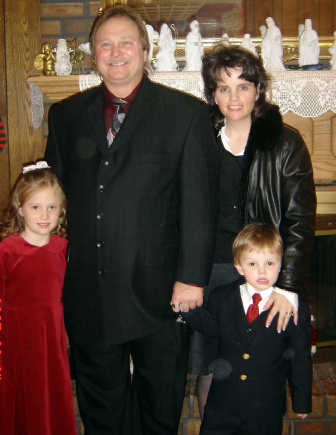
Today, Croft splits her time as a stay-at-home mom, caring for her daughter Anna, 10, and son William James, 5, while also working part time at a nearby Best Buy store. It’s a job she took so she could learn more about computers in an effort to help with her husband’s company and launch her own home-based business geared toward helping others develop similar home-based opportunities.
She admits to still owning a set of golf clubs, but doesn’t know exactly where they might be stored.
“They’re probably considered dinosaurs by now,” Croft said. “I’ll pick up a golf magazine at my dentist’s office, or somewhere, and look at today’s club and can’t believe what technology has done.”
The fact she still picks up a golf magazine now and then might suggest Croft still harbors a spark of interest in the game, but for now, she insists, she can get by on just the memories of her “playing days” back in Spokane, which she still considers “the most incredible golf city in the country.”
Croft’s late father, Jim, who was diagnosed with cancer and died from complications from pneumonia in January of 1986 at the age of 48, moved his family from Yakima to Spokane when his only daughter was a sophomore in high school and purchased a home near Indian Canyon Golf Course.
“My dad was so awesome,” Croft explained. “He knew his little daughter wanted to live near a golf course. I had four brothers, so I wasn’t the only one in the house. But when we went house hunting in Spokane, it included finding a place where Theresa could sneak out the back door and play golf.”
Croft spent much of her spare time in high school hanging out at Indian Canyon and still recalls the late Bill Welch – the Canyon’s head professional at the time – letting her wander out on the first tee late in the afternoon to drive a bag of practice balls down the Canyon’s No. 1 fairway.
“Can you imagine that?” Croft asked. “I had the tee box to myself. It was a kid’s greatest dream, and I still feel so blessed that, at a very young age, I had the incredible support of such people as Bill Welch, Gary Lindeblad and Steve Prugh out at Manito (Country Club).”
It was shortly after her father passed away that Croft’s golf burnout seemed to ignite.
After being named an All-American the year before, she started the fall portion of her senior season at New Mexico on a tear and, at one point, was leading the nation in scoring average.
But after her father’s death, her reliable putting stroke soured and her scores skyrocketed.
“I was like, ‘Where did Theresa Schreck go?’ ” recalled Croft, whose mother, Camille, still works part time in Seattle’s Fred Hutchinson Cancer Research Center. “I just collapsed. That was really hard to deal with, going from being one of the country’s best collegiate golfers to not even making All-American, and I think a lot of it had to do with my father.
“That’s where that sports psychologist thing comes in. I wish I would have had one back then, because golf was so tied to my father.”
These days, the sport is tied – in Croft’s world, at least – to the box of memorabilia she has saved from her days as a high school golf phenom.
Croft afforded herself the luxury of reopening that box a while back after a conversation with a stranger about golf rekindled some pleasant memories.
“I looked in that box again and was amazed,” she said. “I don’t know if it’s because I’m 45 and my memory is gone or what, but I forgot how well I did in so many golf tournaments. I even forgot I was a quarterfinalist at the U.S. Women’s Amateur.
“I still have a ton of USGA medals, which made me realize again that I was a good golfer back then. And I told my mother shortly after that that’s kind of sad that my kids don’t realize that.
“Maybe someday I’ll tell them.”
And maybe someday, Theresa Croft will realize she no longer has to answer to unfulfilled expectations that are now more than a quarter of a century old.
And that “the most incredible golf city in the country” would love to have her back.