
Foot races put kids on fast track to healthy lifestyle
At the Markham household, there’s very little sitting around.
Whenever the family has a free moment, they’re usually outside – walking, running, riding their bikes, or just playing and moving around.
“Exercise is definitely a priority,” says Kristin Markham, mother of three boys – ages 2, 4 and 7. “I want my kids to lead a healthy, happy lifestyle. … They’re happier kids when they play outdoors.”
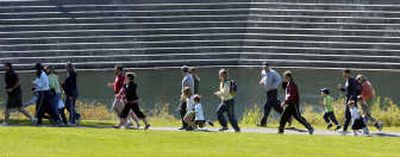
To encourage their sons to remain active, she and her husband also have taken the whole family to the annual Marmot March – the kiddie version of Bloomsday without all the miles and the pressure of a stopwatch.
“They get so excited about it,” said Kristin Markham, who pushed her youngest in a stroller during last year’s 1.2-mile walk through Riverfront Park. “Like everything else, they follow your lead. I’ve always done Bloomsday so they wanted to do their own run, too.”
Like adults, kids need regular physical activity to stay healthy and strong. According to the American Heart Association, exercise helps children to control their weight, reduce the risk of diabetes and other diseases and improve their self-esteem. Other research also suggests that kids who are physically active also score higher on tests, sleep better at night, experience less stress and feel better about themselves. The American Heart Association recommends that children and adolescents participate in at least 60 minutes of moderate to vigorous physical activity every day.
But kids are becoming more sedentary, according to numerous studies. According to the Centers for Disease Control and Prevention, 16 percent of youths ages 6 to 19 are overweight or obese – a figure that has tripled since 1980. The CDC also noted that the childhood obesity rate has more than doubled for preschool children ages 3 to 5 and adolescents ages 12 to 19.
So what can parents do to encourage fitness among youth?
With children’s events such as the Marmot Run and America’s Kids’ Run just around the corner, readers of The Spokesman-Review’s Parents’ Council blog recently discussed the benefits of exercise and the myriad ways to keep children physically active.
In addition to regular play and exercise, Markham also limits the amount of time her kids spend in front of the TV and on the computer. They keep a chart on the wall so the older boys don’t watch more than 30 minutes of television a day or spend more than 15 minutes playing computer games.
Getting kids off the couch and moving eventually creates healthy habits, said Michelle Neill, chairwoman of the annual Marmot March. “When you see kids exercise, you see them start eating better,” she said. “They want water instead of pop. Instead of asking for a cookie, they want an apple.
“Diet and exercise go hand in hand.”
One of the goals of the Marmot March is to encourage all children to be physically active at an early age, Neill said. That’s why there are no stopwatches at the event and everyone receives a blue ribbon at the finish line. It’s also a way to promote walking and jogging as a fun activity for the entire family, Neill said.
While a few older kids zip to the Marmot March finish line, most take their time as they walk with their parents, grandparents, siblings and friends. In addition to all the walkers and joggers, the event welcomes babies and toddlers in strollers, backpacks, carriers and slings.
Older kids in the elementary schools also can get involved with “Fit For Bloomsday … Fit For Life,” a training program developed by Bloomsday volunteers along with teachers, coaches and parents. More than 60 schools and 5,000 children take part in “Fit for Bloomsday,” according to the Lilac Bloomsday Association. The eight- to 10-week program, which teaches the importance of fitness, nutrition and safety, prepares the kids to run or walk Bloomsday on May 3.
Although not affiliated with Bloomsday, the 23rd annual America’s Kids Run also promotes fitness and health by giving kids an opportunity to take part in an untimed, noncompetitive run.
The Kids Run, which is for children ages 5 to 13, was established in 1986 by Mike Erwert of Spokane. The father of a 4-year-old at the time, Erwert wanted to share the excitement he had for Bloomsday with his son and other kids. But since they were too little to complete a 7.46-mile race, he created an event just for them – complete with T-shirts, healthy snacks and cheering crowds at the finish line. For years, it was known as Junior Bloomsday. But in 2002, the event became part of a worldwide running event that included participation on military bases and changed its name to America’s Kids Run.
Over the years, the annual kids run influenced a large number of young people to start running, Erwert said. Many of these youths eventually excelled in track and cross country by the time they were in high school. The run also promoted fitness among youth, he said, even if they chose to do other sports instead of running.
The Kids Run, which used to have as many as 11,000 participants, now has an average attendance of 3,000 to 5,000 kids.
“In the ‘80s, we didn’t have Gameboys and Xboxes,” Erwert said. “Now, kids just want to sit in their rooms and play video games. We have a lot of inactive kids.”
Erwert recommends at least half an hour of exercise a day for kids. He also emphasized that parents need to lead by example.
That’s what Neill and her husband, Jon Neill, try to do with their sons – Seth, who’s almost 3 and Andrew, who will turn 2 in July.
Since they’re both runners, their sons also want to go outside and follow their example.
“They do what they see and what they’re taught,” said Michelle Neill. “If you lead a healthy lifestyle, then your kids will, too.”