
Protesters disrupt torch-lighting ceremony
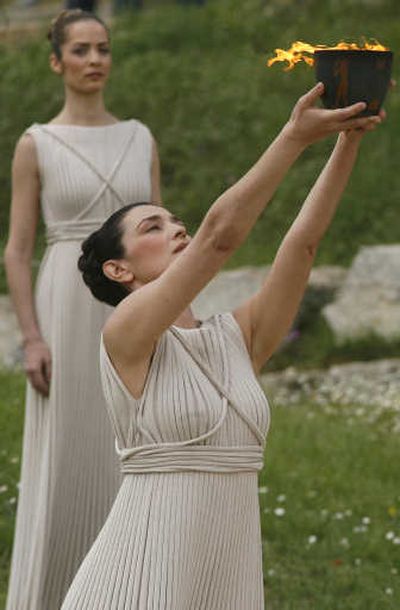
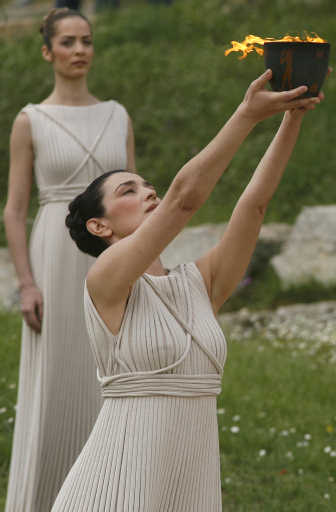
ANCIENT OLYMPIA, Greece – Even before the Olympic flame was lit Monday, a protester of China’s human rights policies disrupted the solemn ceremony, foreshadowing the prospect of demonstrations throughout the 85,000-mile torch-relay route right up to the Beijing Games themselves.
Forecasts of clouds and rain had been considered the main threat to the pomp-filled torch-lighting. But in the end, it was the protesters who turned the joyful bow to the Olympics’ roots into a political statement about China’s crackdown in Tibet and other rights issues.
Three men advocating press freedom evaded massive security and ran onto the field at the ceremony in Ancient Olympia before they were seized by police. Minutes later, a Tibetan woman covered in fake blood briefly blocked the path of the torch relay.
The incidents came after International Olympic Committee President Jacques Rogge said he was engaged in “silent diplomacy” with the Chinese but wouldn’t intervene in politics to try to change their policies.
“We are discussing on a daily basis with Chinese authorities, including discussing these issues, while strictly respecting the sovereignty of China in its affairs,” Rogge said.
Protests are bound to follow the torch throughout its 136-day route across five continents and 20 countries. China pledged strict security measures to ensure its segment of the relay won’t be marred by protests.
Tibetan activists have already said they plan to demonstrate elsewhere on the route.
“Later we will do protests in London and Paris,” said Tenzin Dorjee, a member of Students for a Free Tibet who protested in Ancient Olympia.
Protests of China’s rule turned violent March 14 in the Tibetan capital of Lhasa, sparking waves of unrest in surrounding provinces. China reported a death toll of 22 from the violence, but Tibet’s exiled government says 80 Tibetans were killed. Nineteen died in subsequent violence in Gansu province, it said.
A rising chorus of international criticism and floated calls for a boycott have unnerved the Chinese leadership, which has turned up efforts to put its own version of the unrest before the international public.
China has blamed the riots on followers of the Dalai Lama, Tibet’s exiled spiritual leader. Secretary of State Condoleezza Rice has urged China to start talks with him.
Edward Friedman, a China specialist at the University of Wisconsin, Madison, said he expects Beijing to rally national pride by attacking its critics. Friedman said he expects China to put pressure on other countries to stay neutral and “to not do things to politicize the Olympics.”
Luciano Barra, deputy CEO of the 2006 Winter Games in Turin, recalled how the torch relay in Italy was dogged by protesters opposed to construction of a rail tunnel. Organizers diverted the route at one stage to avoid the demonstrators.
“It makes me laugh compared to the current problem,” Barra said.
Another potential flashpoint is the route through Tibet. The flame is due to be carried to the summit of Mount Everest in May and pass through Lhasa in June.
“The very idea that they will be able to parade the torch through Tibet after the crackdown is obscene given what’s going on in Tibet,” said Anne Holmes, acting director of the London-based Free Tibet campaign.
Tibetan groups have also urged the IOC to keep the relay out of the Himalayan region. Rogge, speaking before the incidents, said there were no plans by Beijing organizers, known as BOCOG, to change the route, but he didn’t rule it out.