
An adventure on ice
STOCKHOLM, Sweden – “It’s a dry cold,” Swedish foreign ministry officer Gabriella Augustsson tried to reassure me as we made our way through the Stockholm airport.
A dry cold. The phrase was eerily reminiscent of that hairy chestnut “a dry heat,” which people use to try to convince you it doesn’t matter when the mercury regularly climbs well above 100 degrees Fahrenheit in some godforsaken corner of the world.
We were heading to the Ice Hotel to learn how an exceptionally pure river can produce one of the most visually arresting construction projects on Earth.
Made entirely from blocks of ice and packed snow, the Ice Hotel combines the best elements of highly stylized interior design with one of nature’s most basic elements: water.
Swedish officials view it as a sort of national treasure, because it fits neatly into the government’s project of educating people around the world about how clean water is essential for a healthy environment.
Since 1992, the Ice Hotel has attracted 100,000 guests from around the globe to an unforgiving landscape during the chilliest time of the year. A replica of it has been featured in a James Bond film as well as in high-end fashion ad campaigns, and its rooms are booked for months in advance.
There was only one problem: I don’t like the cold.
I can trot out an array of reasonable explanations: I have poor circulation, I’m pretty skinny, and my skin becomes reddened and chafed once the temperature begins to dip. Just a few days before my departure, my physical therapist looked at me with concern and said, “You know, you probably have 5 percent body fat, at most.”
But over the past couple of years, as it becomes increasingly clear that the northernmost regions of the globe are becoming less frigid, I began pondering the intrinsic value of cold.
What would it be like to visit a place of bitter iciness that faces the risk of losing that cold altogether? Only one place would satisfy my curiosity: the village whose townspeople have turned freezing into an asset.
•
Seated on a Scandinavian Airlines plane headed for the northern town of Kiruna, I peered out the window and saw a sticker for a university located not far from our ultimate destination, the tiny village of Jukkasjarvi: “First Choice Scandinavia – Great ideas grow better below zero.”
We made our way out of the plane onto the snow-covered tarmac. While it was only 1:30 in the afternoon, the sun was beginning to set. As I scurried inside the airport, I felt … a dry cold. It was crisp, and chilly, but it wasn’t the kind of wet, oppressive cold that seeps into your bones.
Joined by Ice Hotel spokeswoman Camilla Bondareva, we made our way to Kenth Fjellborg’s sled dog kennel. Fjellborg comes from one of Jukkasjarvi’s founding families (the fourth one to move to town, once the church was established in the 1600s). Since that tentative start, nine generations of Fjellborgs have eked out a living in the region, through farming, hunting and fishing.
“For them, 40 below was a problem. For me, that has been an asset,” Fjellborg said. “That has been something people want.
“If you told my grandfather you’re going to take ice from the river and people would come to stay in it, he probably would have thought you should go to the hospital.”
Fjellborg grew up playing outdoors, and when he was 12, he became entranced by the dog sled tours that had just started going by his home. After finishing school, he moved to raise dogs in Alaska and Minnesota before returning to Jukkasjarvi, where he started his own business in the mid-1990s.
His team provided our transport across the Torne River to the Ice Hotel, in the form of a 15-minute dog sled ride. As the sled skidded to a halt, the hotel’s founder, Yngve Bergqvist, came out to meet us, swaddled in many layers, his face encircled with a sort of animal fur that gave him a haloed appearance.
“Welcome to Jukkasjarvi!” he declared, giving us a brief sketch of the town. It took about one minute, which was good, because we were standing outside and freezing after our sled ride.
“This is one of the coldest places in Sweden,” he said. “It’s a way of living.”
Bergqvist, who had spent years in Jukkasjarvi (pronounced YUK-kas-yair-vey) working as a river rafting guide and advising a local mining company on environmental practices, started plotting how to lure tourists to his adopted home two decades ago. He called up the tourist chief in Kiruna, a larger town 12 miles away, to see what advice he might have for such a project.
“Nothing,” he recalls the tourist chief replying.
“Give me advice!” Bergqvist pressed him.
“Close up,” the official retorted. “Everybody knows that place is koldhala” – a Swedish word that means, roughly, “a cold spot where nobody wants to go.”
While another man might have given up at that moment, Bergqvist was undaunted. He did what any savvy entrepreneur would do: He looked overseas to see how other chilly towns attracted visitors.
In 1989, he attended the Hokkaido winter festival and watched as 35 jumbo jets ferried in tourists from Tokyo to gaze at ice sculptures. The next year, he invited Japanese artists to Jukkasjarvi for a workshop, where they transformed ice taken from the sparkling Torne River into art.
Over time, Bergqvist and his colleagues perfected the art of making an Antonio Gaudi-inspired igloo, cutting more than a thousand blocks of crystal-clear ice from the river with industrial saws while spraying a mixture of wet snow he has dubbed “snice” onto massive metal forms.
By the winter of 1992-93, people started paying to sleep in his well-appointed igloo. Fifteen years later, the Ice Hotel has become a destination of a lifetime.
•
The modern-day teepee stretched high above my head was glowing from the light emanating from the small bonfire roaring in its center. I tried to lean back a bit as Yana Mangi crooned in the language of Lapland’s native people, the Sami.
She sang of “the little brook between the lakes” and of herding reindeer, a simple life conveyed with the kind of pleasant, ethereal sound I usually associate with the American Southwest.
As each song came to an end, the audience of several dozen tourists expressed their appreciation the way one does when the temperature outside is beginning to dip to 35 degrees below zero Fahrenheit: with a muffled clapping, because everyone in the room was wearing mittens.
Mangi’s concert – which she has put on three nights a week each season for more than a dozen years – is one of the few warm attractions at the Ice Hotel, which is 125 miles north of the Arctic Circle. When you build a hotel entirely out of ice and snow, there is no indoor heating. The teepee was packed.
After nearly an hour the show, which included Mangi’s husband on keyboards and an audience singalong, was over. I exited with several dozen tourists out into the dark and the snow, to the icy edifice that would be my home for the next two nights.
A rush of wind passed over me, and I looked up at the black sky scattered with a few stars. It was only a matter of yards to the white, glowing building that offered some shelter from the Arctic air, but as I made my way there I contemplated a simple fact: I wouldn’t be that warm again anytime soon.
The Ice Hotel – which gives off an eerie blue glow when spotted from across the frozen Torne River – is a massive, beautiful igloo. Sure, it has cathedral-like ceilings, intricate sculptures and electricity running throughout the building, but make no mistake: It’s an igloo.
To step inside is to feel as if you have crossed into another civilization, which is at once more sophisticated than ours and more severe.
Each of the two dozen or so intricately carved suites represents a world of its own. (Sixty other ice rooms without artistic carvings are cheaper to stay in and are reminiscent of actual igloos. Single ice suites range from $400 to $800 per night; simple ice rooms, $325 to $500.)
During my stay, one suite, crafted by a Swedish painter, was called Virgin Angel, but the angel in question looked more like a sexy It Girl from the 1960s, with pert, snowy breasts and elaborately patterned ice wings.
Another, called Projection Room, appeared to have trapped an enormous, twisted tree in ice. In fact, the artists who created it had to methodically chip away, one after the other, to hollow out spaces in the ice to give the impression of a frozen trunk.
A glowing ice chandelier filled with electric lights dipped from the lobby’s ceiling, illuminating the room, while a hotel worker quietly cleaned the lobby by sweeping the floor’s snow cover.
Everything slows down a bit as you tromp through the Ice Hotel’s halls with your boots and swaddled clothing, peering at the designs on the walls and the flower-inspired carvings paying homage to Swedish scientist Carl Linnaeus, who came up with the idea of taxonomic classification of plants and animals (2007 marked the 300th anniversary of his birth).
Part of the hotel’s allure stems from its simplicity. Bergqvist and his art director, Arne Bergh, like to talk about the purity of “genuine Torne River ice,” and they’re not lying.
The ice, stacked up in thousands of blocks in a nearby storage facility, is shockingly clear. While occasional cracks make patterns in the blocks, the ice itself is completely transparent – unlike ordinary tap water – which makes it look otherworldly.
Bergh has a dreamy, philosophical air about him. “Sometimes when I look into the ice I see the sky, I see the emptiness,” he said.
He explained that it’s the specific flow of the river that makes the ice distinctive: “The conditions are perfect. It’s slowly moving, so air bubbles don’t get stuck in the ice. If it’s too fast moving it wouldn’t be as thick. … It’s like frozen time.”
So Bergh has a strict rule for the few dozen artists who come each year to create the hotel and craft the suites: They have to work with what nature has supplied and nothing else.
“There are two colors: white and transparent, and then there’s the light,” he said.
The 22 individualized suites at the time of my stay were stunning in their originality. One, designed by two graffiti artists from Ireland and England, resembled a traditional English country lord’s estate, complete with sitting chairs and a faux fireplace.
Another evoked a Turkish bath, complete with pillars. And a third gave guests the sensation of being tucked inside a hot-air balloon, where the bed took on the form of a woven basket and sleepers looked straight into the pillowy, concave form of the balloon’s ceiling.
The artists – many of whom have never worked with ice before – take anywhere from a few days to a couple of weeks to complete their creations. Coming from countries that include Bulgaria, Russia, Sweden and the United States, their backgrounds are as varied as the spaces they produce.
Doug Meerdink is an art director in Los Angeles, and David E. Scott is a graphic designer there. They designed the first room I stayed in, the Helices. It consisted of an oval ice bed lying in front of a sort of clam-shaped sculpture carved into the snowy wall above it. Two corners of the room featured curved, patterned walls, which gave it a sort of glacial feng-shui flow.
Michael Jermann, a freelance product and graphic designer from Germany, had never worked with ice or snow before designing the room Flowing Edge, which I stayed in my second night.
At first glance, I thought it was pedestrian because it lacked the intricate carving of other suites. It was only after I had spent some time in it that I realized its simplicity helped put guests in a sort of zone, lulled by the undulating shapes Jermann had sculpted.
•
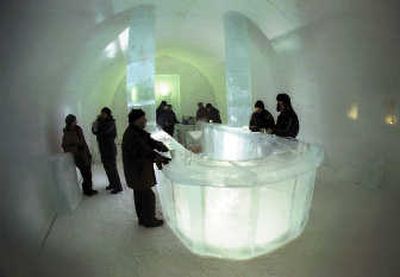
The Ice Bar, however, is where visitors actually spend most of their time.
Bergqvist, who is more a visionary than a traditional entrepreneur, realized soon after starting the hotel that he needed some corporate sponsorship if he was going to survive financially. As he tells the story, it was exposure to intense heat, rather than the cold, that gave him the inspiration to enlist Swedish vodka maker Absolut in his business venture.
In the early 1990s, he recalled, “We got a brilliant idea one day when we were sitting in the sauna. How could we let people know what we were doing? We wanted to send a press release around the world. Suddenly, we were dropping that and drinking beer.”
This is the problem with dreaming up your business model in a sauna: It becomes too hot, you have to leave to grab a beer, and you forget your big idea. Luckily, Bergqvist and his friends remembered the next day what they had been discussing, most likely because they had re-entered the sauna at some point.
“We thought, maybe if we did a press release, Absolut would see what we were doing,” he continued, adding that he simply bought some bottles of Absolut, put them in the Ice Bar, snapped some photos and sent them out, with the help of the Swedish Tourist Board, to journalists in New York, London and Hamburg.
Sure enough, a few newspapers wrote stories about the Ice Bar, and shortly afterward an Absolut executive called Bergqvist to discuss the matter.
They quickly made a deal, and now Bergqvist’s bartenders only sell Absolut vodka (in multiflavored incarnations) in square-shaped glasses made entirely of genuine Torne River ice. The Ice Bar is Jukkasjarvi’s most successful export: There are now Ice Bars in Stockholm, Copenhagen, London, Milan and Tokyo, with other locations in the works.
In the original Ice Bar, guests from around the world spill forth with explanations of why they have trekked this far north to experience frigidity at its finest.
Claire Gross, a 20-something fisherwoman from Juneau, Alaska, had been plotting to visit the Ice Hotel since a friend told her in fifth grade that it existed. Even though she had imbibed a few vodka drinks by the time I interviewed her, Gross recognized the irony in the idea that she’d journeyed from Alaska to the Swedish Arctic.
“I’ve come to the Ice Hotel, which is (messed) up because I come from an ice hotel of a state,” she said, adding that visiting Jukkasjarvi has satisfied her curiosity.
Even Jacinthe Moreau, who works for an international Internet-based pharmaceutical company and was snookered into coming to the Ice Hotel by co-workers as part of a morale-building exercise, said she could appreciate the place’s charms.
“It’s just, like, ‘wow’ from the very beginning,” she said.
Guests at the Ice Bar chat, dance and drink until the early hours of the morning, swapping stories and checking one another out. Perhaps this is because they’re afraid to go to sleep in their rooms.
I prepared myself as best I could for my first night in the Helices suite, shedding my snowsuit but keeping on my thick, high-tech long johns, hat, gloves and wool socks. I laid out the blue thermal sleeping bag the hotel supplies each of its guests, as well as a set of sheets that go inside the bag, and a small pillow.
It wasn’t as if I were sleeping directly on the ice: On top of the oval ice bed lay a thin foam mattress covered by reindeer skins. I crawled into the sleeping bag, turned out the light with a switch right by the bed and gazed for a minute at the conical shapes protruding from the ceiling – which made me realize I hadn’t seen a patterned ceiling since I tilted my head up in my best friend’s freshman-year dorm room and wondered how a single decade such as the ‘70s could produce so much atrocious architecture.
I did a quick check to make sure that only the minimal amount of my body was directly exposed to the frigid air. Just relax, I told myself, you’re not going to freeze overnight. Then, I promptly fell asleep.
In the morning, a hotel employee came in and delivered my wake-up call with a critical source of sustenance: hot lingonberry juice.
Now, you might think that after sleeping in a room that’s several degrees below freezing you would prefer a cup of coffee or hot chocolate, but lingonberry proves to be an almost magical aid just after you’ve awakened, shivering, and need something to propel you out of your bed and a few dozen yards down the hallway to the adjoining, heated building where you’ve stored your luggage. (That, incidentally, is where the bathrooms are, because the hotel’s engineers have yet to perfect frozen plumbing.)
Fortified, I sprinted down the hall to the heated changing room and then ventured up the road to the building that houses both showers and a sauna, as well as the main dining room.
I opted to sleep in the Ice Hotel for the second night, something that guests rarely do, because there are plenty of heated chalets people can rent once they’ve proved their mettle. I didn’t stay the second night to prove a point: I did it because I had come to find the extreme cold relaxing, a way to dial back the stress and hyperactivity that characterize my everyday existence.
Some people tout sweaty yoga as a way to center themselves, but that trendy exercise pales in comparison with the soothing balm of a constant – but bearable – freeze.
•
Each spring the Ice Hotel disappears.
“We take 100 million liters of water from the river a year,” Bergqvist said. “That’s a loan. We give it back in May, June.”
Art director Bergh actually likes walking among the ruins of the hotel, when the walls separate and open toward the sky. He is philosophical about the ritual collapse of his work.
“You know it’s ephemeral. You know it will melt,” he said.
At the same time, the warming temperatures globally are a cause of concern for the hotel’s operators. Their annual opening on the first weekend in December has not changed, even if it is not getting cold as quickly as it used to in the winter.
“We’ve been more and more hurried opening it, because it always opens at the same time,” Bergh said, explaining that they have had to start building it later in recent years.
Fjellborg, the sled dog breeder, is more worried about how global warming is jeopardizing the reason people now come to Jukkasjarvi.
“Right now, this environment that used to be a problem for my grandfather is the reason we have a good life, because we can make this place interesting for people,” he said.
“If that goes away, that true winter climate, it’s going to affect us all. Not dramatically, but super-dramatically, because we’ll be done.”